On eBird ↗
Small-billed Elaenia
Live sightings near you, the range map, bar charts of when it is seen, and Macaulay Library photos and recordings.
Small-billed Elaenia
Elaenia parvirostris
The small-billed elaenia (Elaenia parvirostris) is a species of bird in subfamily Elaeniinae of family Tyrannidae, the tyrant flycatchers. It is found in every mainland South American country except Chile, plus Aruba and Trinidad.
From the article Small-billed elaenia on Wikipedia (CC BY-SA), quoted section by section
Description
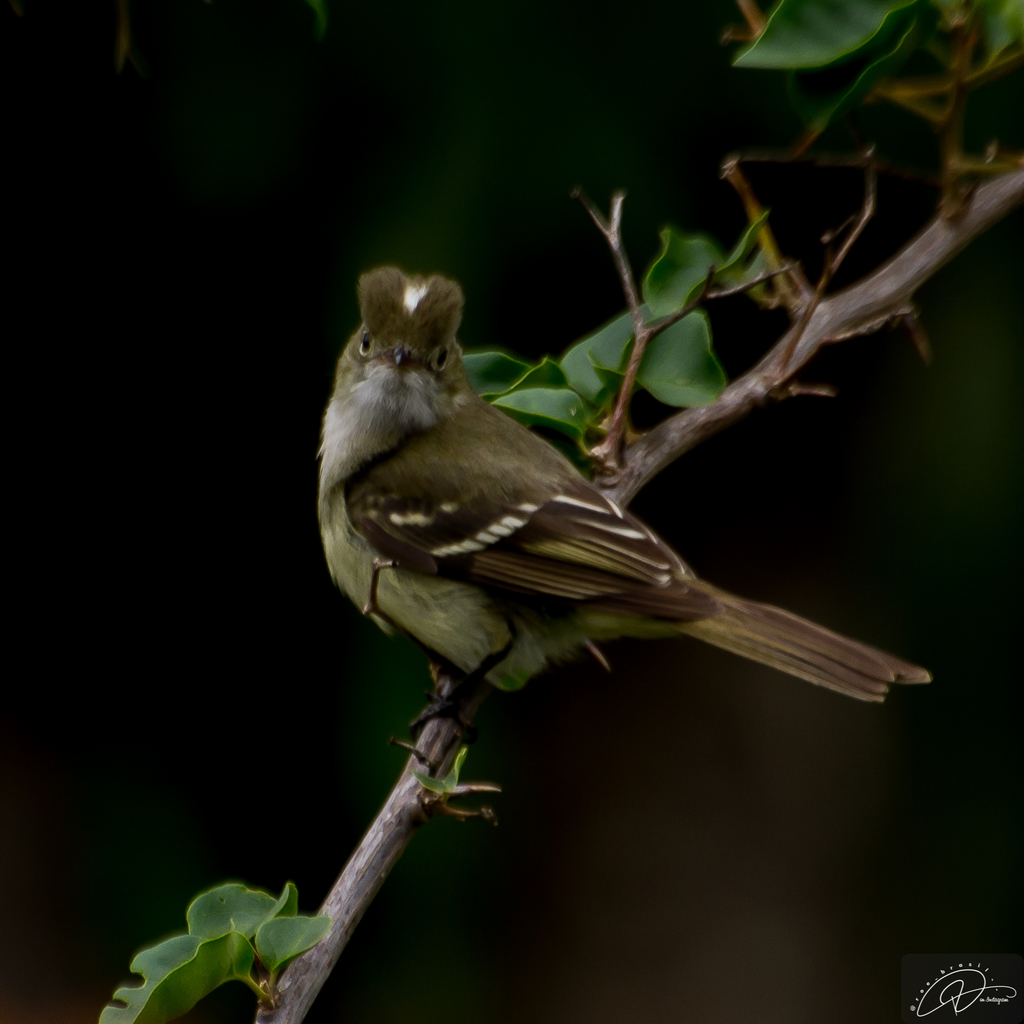
The small-billed elaenia is 13 to 15 cm (5.1 to 5.9 in) long. It is a small elaenia without a crest. The sexes have the same plumage. Adults have a bright olive-green crown with a partially visible white stripe in the middle. They have whitish lores and a thin but distinct white eyering. Their upperparts are bright olive-green. Their wings are dusky with whitish tips on the coverts that show as three wing bars. Their flight feathers have narrow whitish edges.The Small-billed elaenia features a short, stubby beak with a slightly curved upper mandible that is perfectly adapted for snatching insects and plucking small berries. Its bill is notably smaller and more delicate than those of other similar flycatchers, serving as a key identifying feature for birdwatchers in South America. Their tail is dusky. Their throat is gray, their breast a slightly darker gray with sometimes an olive wash, and their belly and undertail coverts whitish. Both sexes have a dark brown iris, a black bill with a dull pinkish base to the mandible, and black legs and feet.
Range & habitat
The small-billed elaenia breeds in eastern and southeastern Bolivia, most of Paraguay, Brazil from São Paulo state south through Rio Grande do Sul, all of Uruguay, and northeastern Argentina as far south as central Buenos Aires Province and coastally somewhat further. For the austral winter it moves north into the western half of Brazil; northern Bolivia; east of the Andes in Peru, Ecuador, Colombia, and Venezuela; the Guianas; Aruba; and Trinidad. It has been documented as a vagrant twice in Illinois and once in each of Texas and Quebec, but not in Mexico, Central America, or the Caribbean away from the South American coastal islands. An individual was seen in Florida in 2025. In its breeding range the small-billed elaenia inhabits somewhat open landscapes including the edges and openings of forest and woodland, riparian forest, secondary forest, taller shrublands, parks, and gardens. In the austral winter it also inhabits most of the same landscapes and adds savanna, the canopy of humid forest, and river islands.
Wikipedia: “Distribution and habitat”
What it does
The small-billed elaenia feeds on insects and small fruits. It typically forages singly but sometimes in a small group of congeners; it also sometimes joins mixed-species feeding flocks. It captures prey and plucks fruit by gleaning while perched and while briefly hovering and also captures flying insects on the wing.
Wikipedia: “Feeding”
Listen
Looking for field recordings…
Where it lives
Recorded sightings
—
geo-referenced records in GBIF, from museums, herbaria and field observers.
Drag the globe to turn it. Dots are where records exist, not a range map; darker means more records.
In the stacks
Searching the stacks…
Every page naming Elaenia parvirostris in the Biodiversity Heritage Library →
This page is assembled live from iNaturalist, GBIF, Wikipedia, the Source Library and the Internet Archive. It is not yet part of the hand-edited codex. iNaturalist taxon 16733.