- Plants
- ›Vascular Plants
- ›flowering plants
- ›Dicots
- ›Sunflowers, Bellflowers, Fanflowers, and Allies
- ›Sunflowers, Daisies, Asters, and Allies
- ›Asteroideae
- ›stinkworts and allies
- ›Plucheinae
- ›Pluchea
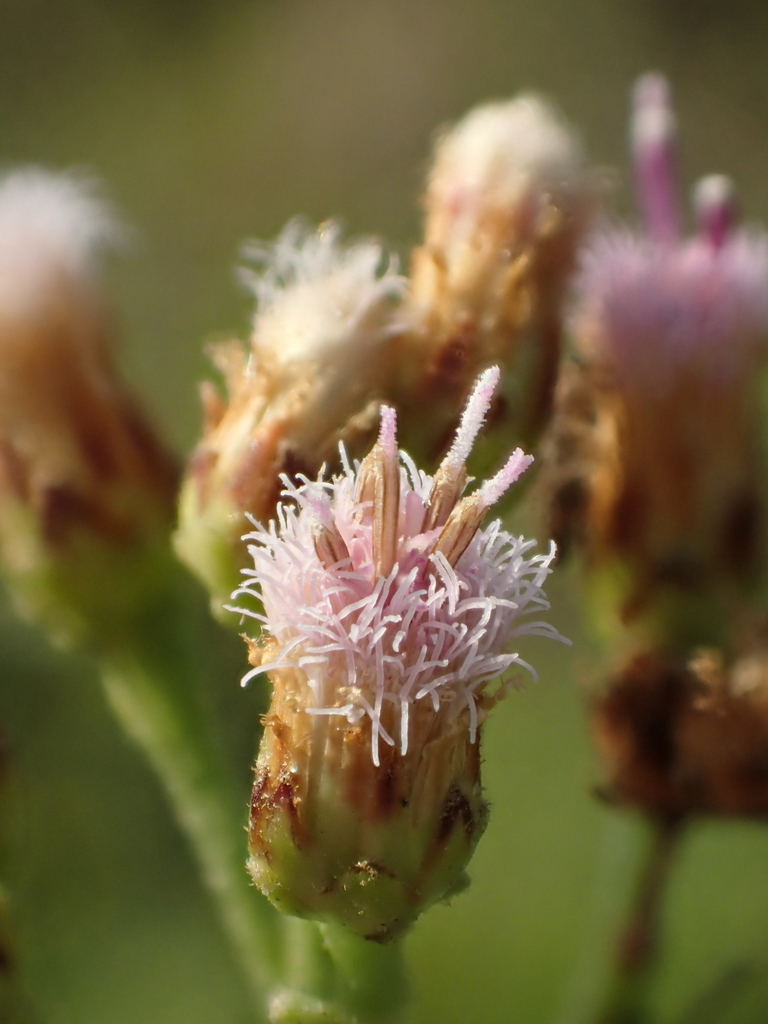
Indian marsh fleabane
Pluchea indica
Pluchea indica is a species of flowering plant in the aster family, Asteraceae. Its common names include Indian camphorweed, Indian fleabane, and Indian pluchea. It is native to parts of Asia and Australia, and it is widespread in the Pacific Islands as an introduced and often invasive species.
The species hybridizes with Pluchea carolinensis when the two plants grow together, yielding a hybrid that has been named Pluchea × fosbergii.
From the article Pluchea indica on Wikipedia (CC BY-SA), quoted section by section
Description
This species is a branching shrub up to 2 meters tall. The toothed oval leaf blades are papery but not thin, and often have a fine coating of hairs. The flower heads grow in dense clusters in the leaf axils and at the branch tips. The pinkish purple florets have long, protruding styles. Florets along the edges of the head produce fruits. The fruit body is a millimeter in length with a white pappus about 5 millimeters long. The seeds are dispersed on the wind.
Range & habitat
The plant often grows in wet saline coastal habitat, such as brackish marshes and mangroves. Though it is not very competitive with other flora, it can easily colonize coastal habitat and impact native and cultivated plants. It alters waterbird habitat. It is considered invasive in New Caledonia, where it was introduced in 1967.
Wikipedia: “Habitat”
At the table
The plant contains the compounds β-sitosterol and stigmasterol, which have antidiabetic properties. The β-sitosterol isolated from the root extract can also neutralize the venom of Russell's viper (Daboia russelii) and the monocled cobra (Naja kaouthia).
Wikipedia: “Uses”
Where it lives
Recorded sightings
—
geo-referenced records in GBIF, from museums, herbaria and field observers.
Drag the globe to turn it. Dots are where records exist, not a range map; darker means more records.
In the stacks
Searching the stacks…
Every page naming Pluchea indica in the Biodiversity Heritage Library →
This page is assembled live from iNaturalist, GBIF, Wikipedia, the Source Library and the Internet Archive. It is not yet part of the hand-edited codex. iNaturalist taxon 167069.