On eBird ↗
White-crested Elaenia
Live sightings near you, the range map, bar charts of when it is seen, and Macaulay Library photos and recordings.
White-crested Elaenia
Elaenia albiceps
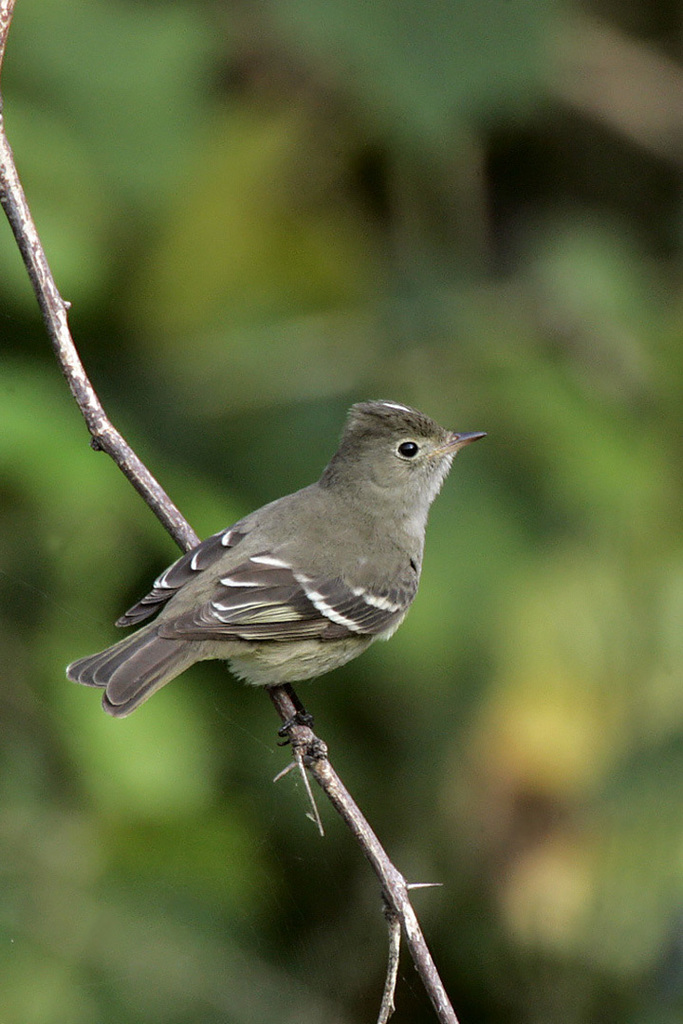
The white-crested elaenia (Elaenia albiceps) is a species of bird in the family Tyrannidae, the tyrant flycatchers. It has several subspecies breeding across southern and western parts of South America. Southern birds migrate north in winter.
From the article White-crested elaenia on Wikipedia (CC BY-SA), quoted section by section
Description
The white-crested elaenia is 13.5 to 15 cm (5.3 to 5.9 in) long and weighs 12.5 to 24.2 g (0.44 to 0.85 oz). It is a small to medium size elaenia with a small bushy crest. The sexes have the same plumage. Adults of the nominate subspecies E. a. albiceps have a mostly dull olive to olive-gray head with a partially hidden white or creamy white stripe in the middle of the crest. They have whitish lores and eyering. Their upperparts are dull olive to olive-gray. Their wings are dusky with white or whitish tips on the coverts that show as two wing bars. Their flight feathers have narrow whitish or yellowish edges with dusky bases on the inner pairs. Their tail is dusky with narrow olive edges to the feathers. Their throat is light gray or whitish gray, their breast light gray or grayish brown, and their belly and undertail coverts whitish. The other subspecies of the white-crested elaenia differ from the nominate and each other thus:
E. a. griseigularis: paler upperparts than nominate, with less white on a shorter crest and a less distinct eyering E. a. diversa: like griseigularis with a whiter throat, less distinct wing bars, and more contrast between the flanks and belly E. a. urubambae: paler upperparts than nominate with paler lores, less prominent eyering, duller wing bars, and a pale yellow wash on the belly E. a. …
Range & habitat
Elaenias listed as white-crested by the SACC have been recorded as vagrants on the Falkland Islands but without subspecies identification, so they could have been what the IOC but not the SACC recognizes as the Chilean elaenia. The Chilean elaenia is highly migratory. The white-crested elaenia's habitat has been studied for all subspecies except E. a. modesta, and it is assumed to have similar requirements to the others. They inhabit the edges of subtropical and temperate forest, the interior of more open woodlands and secondary forest, and scrublands. In many areas the species favors intermontane valleys that are drier than the slopes above. In elevation it ranges up to 3,200 m (10,500 ft) in Colombia, between 1,500 and 2,800 m (4,900 and 9,200 ft) in Ecuador, and between 800 and 3,500 m (2,600 and 11,500 ft) on the west slope and 1,000 and 3,300 m (3,300 and 10,800 ft) on the east slope in Peru.
Wikipedia: “Distribution and habitat”
What it does
The white-crested elaenia's diet has not been detailed but is known to include insects and fruit. It typically forages singly. It sometimes joins mixed-species feeding flocks, and often feeds at fruiting trees with individuals of its own and other species. It captures prey and plucks fruit by gleaning while perched and while briefly hovering.
Wikipedia: “Feeding”
Listen
Looking for field recordings…
Where it lives
Recorded sightings
—
geo-referenced records in GBIF, from museums, herbaria and field observers.
Drag the globe to turn it. Dots are where records exist, not a range map; darker means more records.
In the stacks
Searching the stacks…
Every page naming Elaenia albiceps in the Biodiversity Heritage Library →
This page is assembled live from iNaturalist, GBIF, Wikipedia, the Source Library and the Internet Archive. It is not yet part of the hand-edited codex. iNaturalist taxon 16686.