On eBird ↗
Pine Flycatcher
Live sightings near you, the range map, bar charts of when it is seen, and Macaulay Library photos and recordings.
Pine Flycatcher
Empidonax affinis
The pine flycatcher (Empidonax affinis) is a species of bird in the family Tyrannidae, the tyrant flycatchers. It is found in the montane tropical and subtropical coniferous forests of Mexico and southwestern Guatemala. A vagrant bird found in the Santa Rita Mountains, Arizona, in late May 2016 is the first record north of Mexico. (An erroneous 2009 record from Choke Canyon State Park in southern Texas was later shown to be a misidentified Least Flycatcher.)
From the article Pine flycatcher on Wikipedia (CC BY-SA), quoted section by section
Description
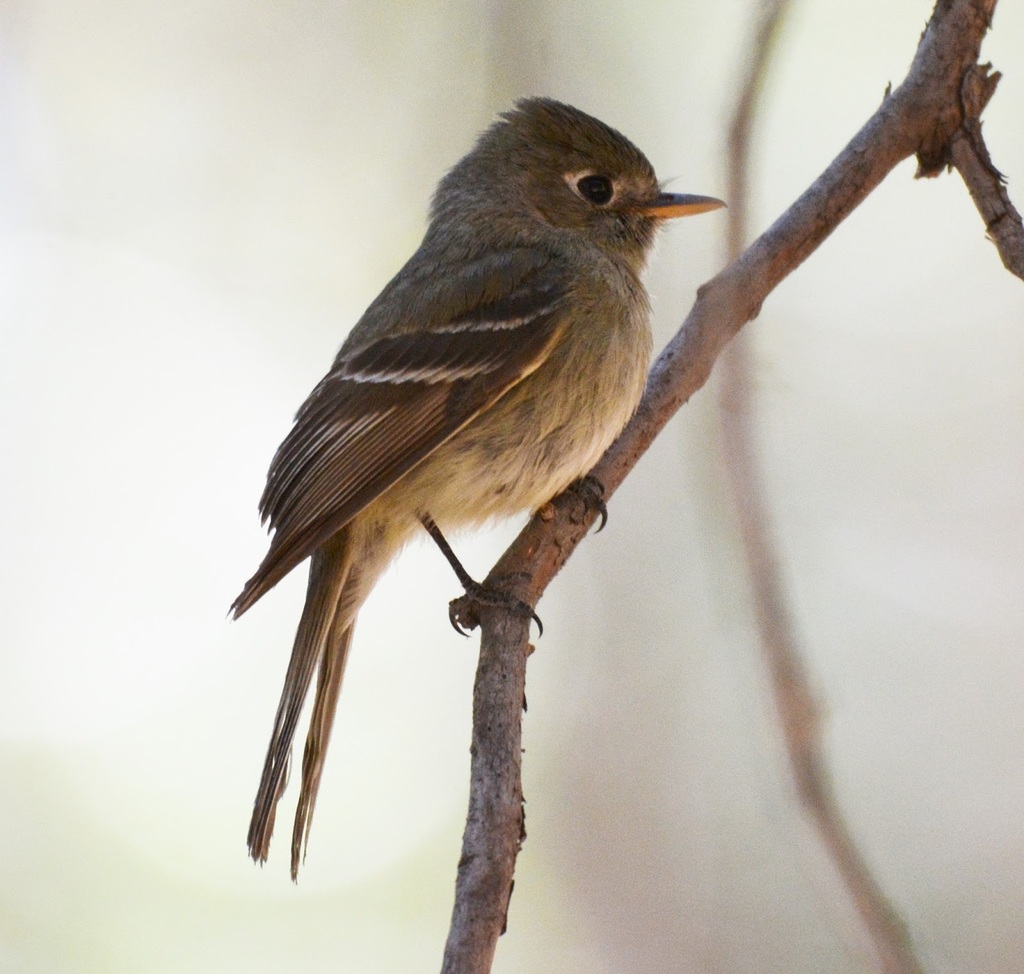
The pine flycatcher is 13 to 14.5 cm (5.1 to 5.7 in) long and weighs about 11.5 g (0.41 oz). The sexes are alike. Adults of the nominate subspecies E. a. affinis have pale grayish lores and a whitish tear-shaped eye-ring that becomes a point behind the eye on an otherwise olive to grayish olive head. Their upperparts are also olive to grayish olive. Their tail is dusky. Their wings are mostly dusky, with whitish to buff tips on the coverts that show as two wing bars. The wing's secondaries and tertials have pale yellow edges. Their throat is pale grayish yellow and their underparts pale yellow with a gray or grayish olive wash across the breast. They have a dark iris, a black maxilla, an orange-yellow mandible, and blackish legs and feet. Juveniles have buffy wing bars. The other subspecies of the pine flycatcher differ from the nominate and each other thus:
E. a. pulverius: grayest back and breast of all subspecies E. a. trepidus: dark olive crown contrasting with lighter olive of back E. a. bairdi: slightly greener upperparts and slightly yellower underparts than others E. a. vigensis: duller than nominate but otherwise the same
Range & habitat
The pine flycatcher has a disjunct distribution. The subspecies are found thus:
E. a. pulverius: northwestern Mexico from southeastern Sonora and southwestern Chihuahua south to Jalisco E. a. trepidus: southeastern Coahuila to southwestern Tamaulipas in northeastern Mexico E. a. affinis: central Mexico from Michoacán south to Puebla E. a. bairdi: from Guerrero, Oaxaca, and Chiapas in southern Mexico into western Guatemala E. a. vigensis: west-central Veracruz in southeastern Mexico A vagrant bird found in the Santa Rita Mountains, Arizona, in late May 2016 was the first record north of Mexico. An apparent record in 2009 from Choke Canyon State Park in southern Texas was later shown to be a least flycatcher (E. minimus). The pine flycatcher inhabits pine savanna and the interior, edges, and openings of semi-arid to humid pine-oak forest. In elevation it overall ranges between 1,500 and 3,500 m (4,900 and 11,500 ft) but between 1,750 and 3,350 m (5,700 and 11,000 ft) in Guatemala.
Wikipedia: “Distribution and habitat”
What it does
The pine flycatcher's diet and foraging behavior are almost unknown. It feeds on insects. In Mexico it apparently forages at all levels of the forest but in Guatemala only in its lower to mid-levels.
Wikipedia: “Feeding”
Listen
Looking for field recordings…
Where it lives
Recorded sightings
—
geo-referenced records in GBIF, from museums, herbaria and field observers.
Drag the globe to turn it. Dots are where records exist, not a range map; darker means more records.
In the stacks
Searching the stacks…
Every page naming Empidonax affinis in the Biodiversity Heritage Library →
This page is assembled live from iNaturalist, GBIF, Wikipedia, the Source Library and the Internet Archive. It is not yet part of the hand-edited codex. iNaturalist taxon 16632.