On eBird ↗
Black-capped Flycatcher
Live sightings near you, the range map, bar charts of when it is seen, and Macaulay Library photos and recordings.
Black-capped Flycatcher
Empidonax atriceps
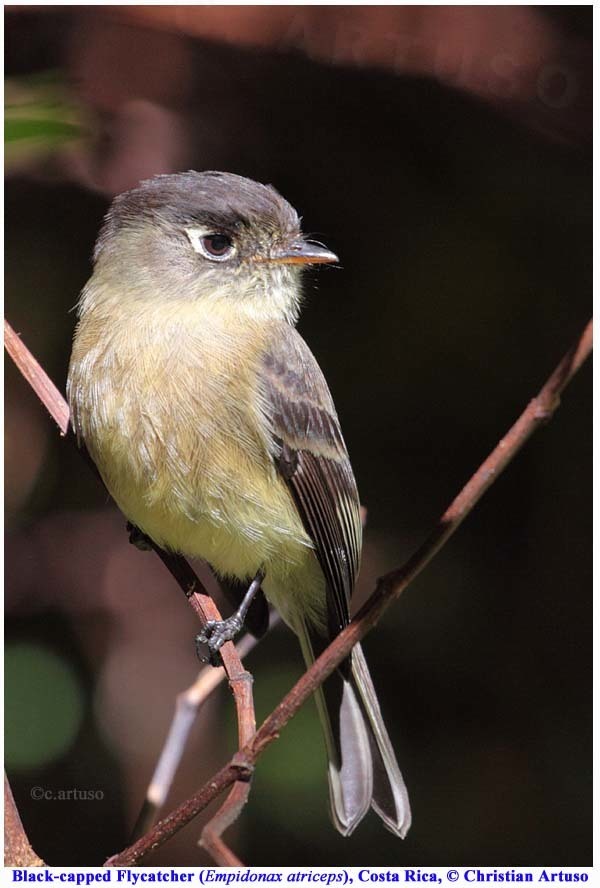
The black-capped flycatcher (Empidonax atriceps) is a very small passerine bird in the tyrant flycatcher family. It is endemic to the highlands of Costa Rica and western Panama.
From the article Black-capped flycatcher on Wikipedia (CC BY-SA), quoted section by section
Description
The black-capped flycatcher is 10 to 12 cm (3.9 to 4.7 in) long and weighs about 9 g (0.32 oz). The sexes are alike. Adults have a black crown with a short crest and a bold white eye-ring that is wider behind the eye on an otherwise brownish olive face. These features by themselves set it apart from all other Empidonax. Their nape and upperparts are also brownish olive. Their tail is dusky with white outer webs on the outer feathers. Their wings are dusky with pale brown edges on the secondaries and tertials. The wing coverts are dusky with pale brown tips that show as two wing bars. Their throat is white and their breast and belly pale buffish cinnamon. They have a dark iris, a black maxilla, an orange-yellow mandible with a dark tip, and blackish legs and feet. Juveniles have a slightly duller black cap than adults with browner upperparts, buffy edges and tips on the wing feathers, and a paler belly.
Range & habitat
The black-capped flycatcher has a disjunct distribution. It is found in Costa Rica on the Cordillera Central, the Dota Mountains, and the Cordillera de Talamanca. Its range continues on the last of these into western Panama's Chiriquí and Bocas del Toro provinces. It mostly inhabits primary and secondary montane evergreen forest in the upper subtropical and temperate zones, and also shrubby pastures. In elevation it mostly ranges from 2,100 to 3,300 m (6,900 to 10,800 ft), the upper reaches of which are at the lower edge of the páramo zone. It sometimes goes as low as 1,850 m (6,100 ft) in the rainy season.
Wikipedia: “Distribution and habitat”
What it does
The black-capped flycatcher feeds on insects. It perches high in the forest canopy or, in more open areas, on a bush or fence. It captures prey in mid-air with sallies from it ("hawking") and often returns to the same perch. It quivers the tail when it lands.
Wikipedia: “Feeding”
Listen
Looking for field recordings…
Where it lives
Recorded sightings
—
geo-referenced records in GBIF, from museums, herbaria and field observers.
Drag the globe to turn it. Dots are where records exist, not a range map; darker means more records.
In the stacks
Searching the stacks…
Every page naming Empidonax atriceps in the Biodiversity Heritage Library →
This page is assembled live from iNaturalist, GBIF, Wikipedia, the Source Library and the Internet Archive. It is not yet part of the hand-edited codex. iNaturalist taxon 16623.