- Plants
- ›Vascular Plants
- ›flowering plants
- ›Dicots
- ›Sunflowers, Bellflowers, Fanflowers, and Allies
- ›Sunflowers, Daisies, Asters, and Allies
- ›Asteroideae
- ›Sunflowers and Allies
- ›Cockleburs, Ragweeds, and Wild Quinines
- ›Parthenium
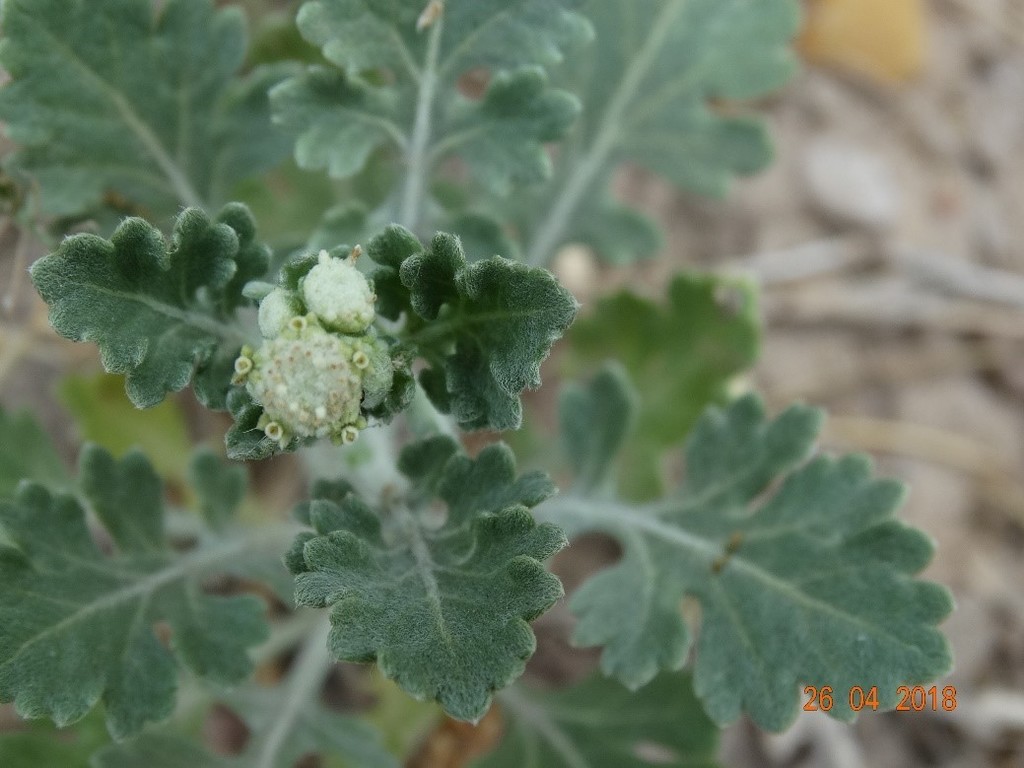
Gray's feverfew
Parthenium confertum
Parthenium confertum, or Gray's feverfew, is a biennial plant belonging to the family Asteraceae.
From the article Parthenium confertum on Wikipedia (CC BY-SA), quoted section by section
Description
As can be confirmed on a page displaying images of different Parthenium species—the "feverfews"—documented by citizen scientists throughout the world, Gray's feverfew is typical of the 16 or so feverfew species by producing a certain kind of flowering arrangement with these traits:
Flowering heads are quite small and white. They are composed of five or so unusually short, widely spaced, petal-like "ray florets" surrounding numerous small, closely packed "disk florets". The ray florets produce tiny, one-seeded, cypsela-type fruits, while the disk florets usually provide only pollen The heads are arrayed in more or less panicle-type inflorescences.
Among features distinguishing Gray's feverfew from similar species of Parthenium are these:
It is a biennial. It stands up to 60+ cm tall (~2 feet). Its leaves are oval to rounded-triangular or elliptic. Leaf blades usually have irregularly pinnately lobed margins. Leaves can develop to 120+ mm in length and 40+ mm in width (~4+3⁄4 x 1+1⁄2 inches). Both leaf surfaces are gland-dotted. Leaves bear stiff, slender, pressed-flat hairs, or trichomes interspersed with erect trichomes up to 2mm tall (+1⁄16 inch). Disk florets usually number 20-30. Unlike some other Parthenium species whose injured parts produce white latex historically used as a natural source for rubber, Parthenium confertum produces no white latex.
Range & habitat
In the Southwestern United States Parthenium confertum occurs in the states of Arizona, New Mexico and Texas. In eastern Mexico it reaches as far south as the state of Querétaro in the country's central highlands. In western Mexico it occurs in the states of Baja California, Sonora and Sinaloa.
Wikipedia: “Distribution”
In human culture
The genus name Parthenium probably either derives from the Greek parthenos, which means "virgin", or parthenion, the ancient name of some kind of plant. The allusion is unclear. The species name confertum apparently is derived from the New Latin confertus, meaning "crowded/pressed together/thronging," which is a good description of how the numerous disk florets are crowded into such a small space in the flowering heads.
== References ==
Wikipedia: “Etymology”
Where it lives
Recorded sightings
—
geo-referenced records in GBIF, from museums, herbaria and field observers.
Drag the globe to turn it. Dots are where records exist, not a range map; darker means more records.
In the stacks
Searching the stacks…
Every page naming Parthenium confertum in the Biodiversity Heritage Library →
This page is assembled live from iNaturalist, GBIF, Wikipedia, the Source Library and the Internet Archive. It is not yet part of the hand-edited codex. iNaturalist taxon 166157.