- Plants
- ›Vascular Plants
- ›flowering plants
- ›Dicots
- ›Legumes, Milkworts, and Allies
- ›Legumes
- ›Faboideae
- ›Hedysareae
- ›Hedysarum
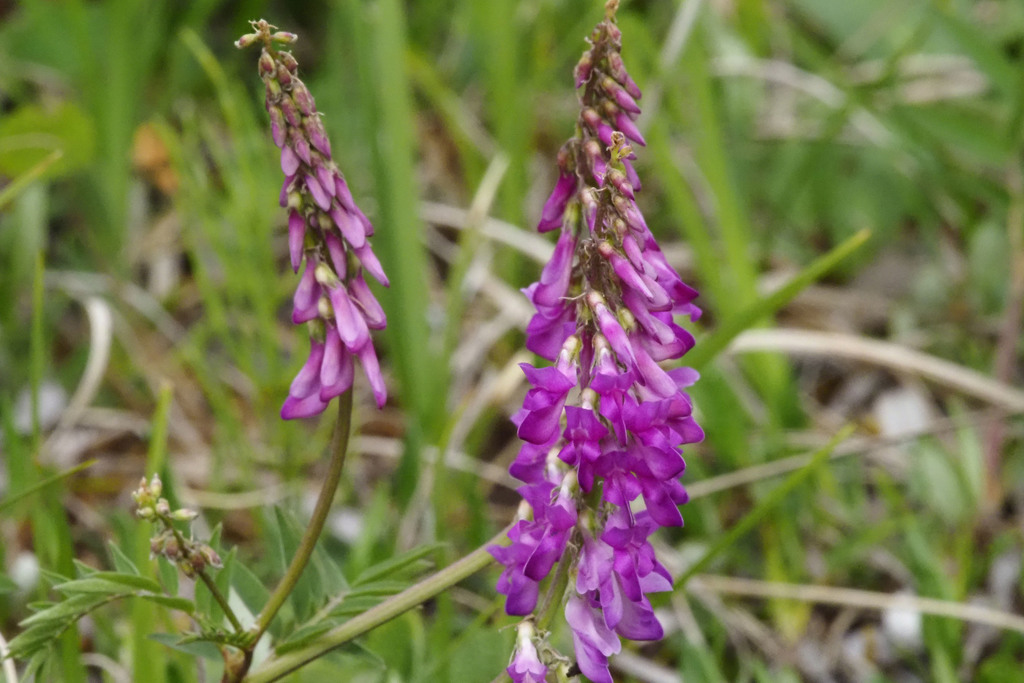
Alpine Sweet-vetch
Hedysarum alpinum
Hedysarum alpinum is a species of flowering plant in the legume family known by the common name alpine sweetvetch, bear root, or eskimo potato. It is called masu, mashu, masru or mazu in the Iñupiaq language, and as food aigak, meaning edible root. It has a circumpolar distribution, occurring throughout the northern latitudes of the Northern Hemisphere. In North America it is widespread in Canada and the northernmost United States, including Alaska.
From the article Hedysarum alpinum on Wikipedia (CC BY-SA), quoted section by section
Description
This plant is a perennial herb producing several erect stems from its caudex. It grows to 70 centimetres (28 inches) in height. The taproot is thick and woody, and it has rhizomes which can produce new stems. The leaves are each divided into a number of leaflets up to 3.5 centimetres (1.4 inches) long. The inflorescence is a dense raceme of flowers. The flowers are pink or pale purple and up to 1.5 centimetres (0.59 inches) long. The flowers are pollinated by insects such as the bumblebee and honeybee. The fruit is a flat legume pod which is narrowed between the seeds, with as many as 9 segments.
Range & habitat
This plant generally grows in the boreal and northern temperate climates. It occurs in tundra and taiga habitat types, in floodplains, grasslands, and dry forests. It is well adapted to calcareous soils. It is usually not a dominant species but it is considered dominant in several river deltas and plains in Alaska. It is a pioneer species on floodplains that have been recently scoured by water and ice. It grows with willows and birches along waterways and in forests dominated by spruces. It grows on grasslands with grass species such as little bluestem (Schizachyrium scoparium), Canada bluegrass (Poa compressa), and American dunegrass (Leymus mollis).
Wikipedia: “Distribution and habitat”
What it does
Alpine sweetvetch is an important source of food for many types of animals, including black bears, grizzly bears, American bison, moose, Dall's sheep, and caribou. Bears are adept at digging up the nutritious roots, and patches of exposed dirt may be found around where the plants grow. The roots are a primary food for grizzly bears in some areas, such as Banff National Park. In parts of Alaska this plant is a primary food for Dall's sheep, caribou, and muskoxen. Many small mammals, such as voles and short-tailed weasels eat it, and a variety of birds nest in alpine sweetvetch habitat.
Wikipedia: “Ecology”
Where it lives
Recorded sightings
—
geo-referenced records in GBIF, from museums, herbaria and field observers.
Drag the globe to turn it. Dots are where records exist, not a range map; darker means more records.
In the stacks
Searching the stacks…
Every page naming Hedysarum alpinum in the Biodiversity Heritage Library →
This page is assembled live from iNaturalist, GBIF, Wikipedia, the Source Library and the Internet Archive. It is not yet part of the hand-edited codex. iNaturalist taxon 163580.