- Plants
- ›Vascular Plants
- ›flowering plants
- ›Dicots
- ›Legumes, Milkworts, and Allies
- ›Legumes
- ›Peacock Flower Subfamily
- ›Caesalpinieae
- ›Haematoxylum
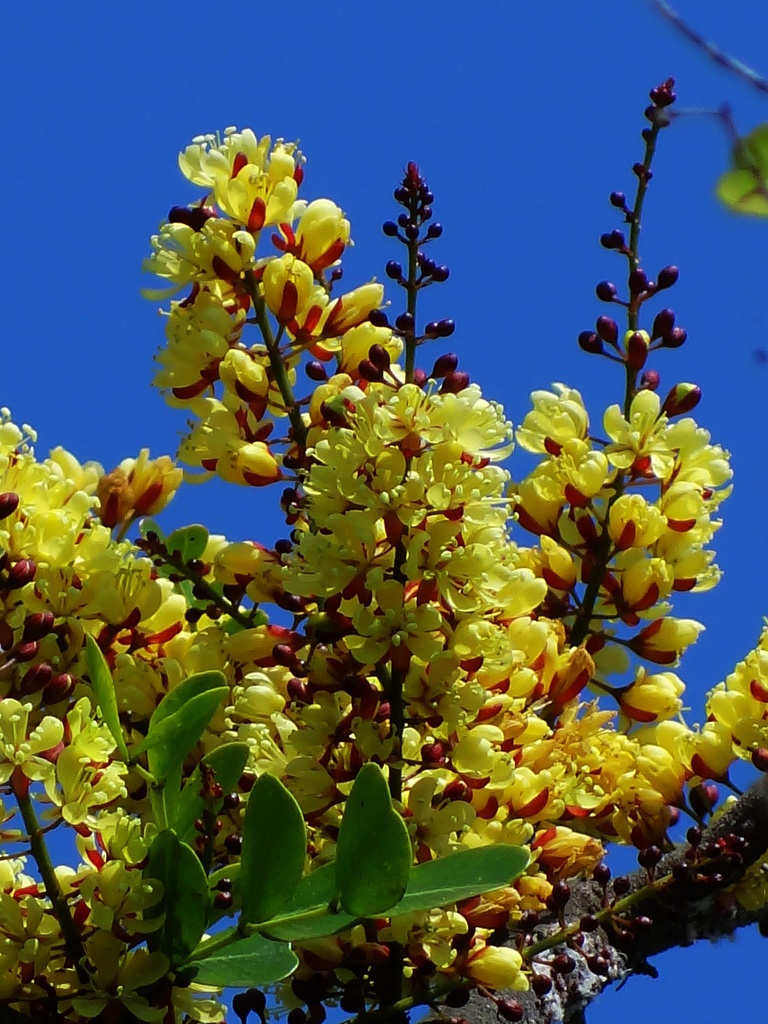
Bloodwood Tree
Haematoxylum campechianum
Haematoxylum campechianum (blackwood, bloodwood tree, bluewood, campeachy tree, campeachy wood, campeche logwood, campeche wood, Jamaica wood, logwood or logwood tree) is a species of flowering tree in the legume family, Fabaceae, that is native to southern Mexico, and introduced to the Caribbean, northern Central America, and other localities around the world.
The tree was of great economic importance from the 17th century to the 19th century, when it was commonly logged and exported to Europe for use in dyeing fabrics. The modern nation of Belize developed from 17th- and 18th-century logging camps established by the English. The tree's scientific name means "bloodwood" (haima being Greek for blood and xylon for wood).
From the article Haematoxylum campechianum on Wikipedia (CC BY-SA), quoted section by section
At the table
Haematoxylum campechianum was used for a long time as a natural source of dye. The woodchips are still used as an important source of haematoxylin, which is used in histology for staining. The bark and leaves are also used in various medical applications. In its time, it was considered a versatile dye, and was widely used on textiles and also for paper. The extract was once used as a pH indicator. Brownish when neutral, it becomes yellow reddish under acidic conditions and purple when alkaline. In a small demonstrative experiment, if two drops, one of concentrated ammonia and one of logwood extract, are placed close enough, the NH3 vapours will change the color of the extract to a purple shade.
Wikipedia: “Uses”
Where it lives
Recorded sightings
—
geo-referenced records in GBIF, from museums, herbaria and field observers.
Drag the globe to turn it. Dots are where records exist, not a range map; darker means more records.
In the stacks
Searching the stacks…
Every page naming Haematoxylum campechianum in the Biodiversity Heritage Library →
This page is assembled live from iNaturalist, GBIF, Wikipedia, the Source Library and the Internet Archive. It is not yet part of the hand-edited codex. iNaturalist taxon 163502.