- Plants
- ›Vascular Plants
- ›flowering plants
- ›Dicots
- ›Sunflowers, Bellflowers, Fanflowers, and Allies
- ›Sunflowers, Daisies, Asters, and Allies
- ›Asteroideae
- ›groundsels and allies
- ›Senecioninae
- ›Gynura
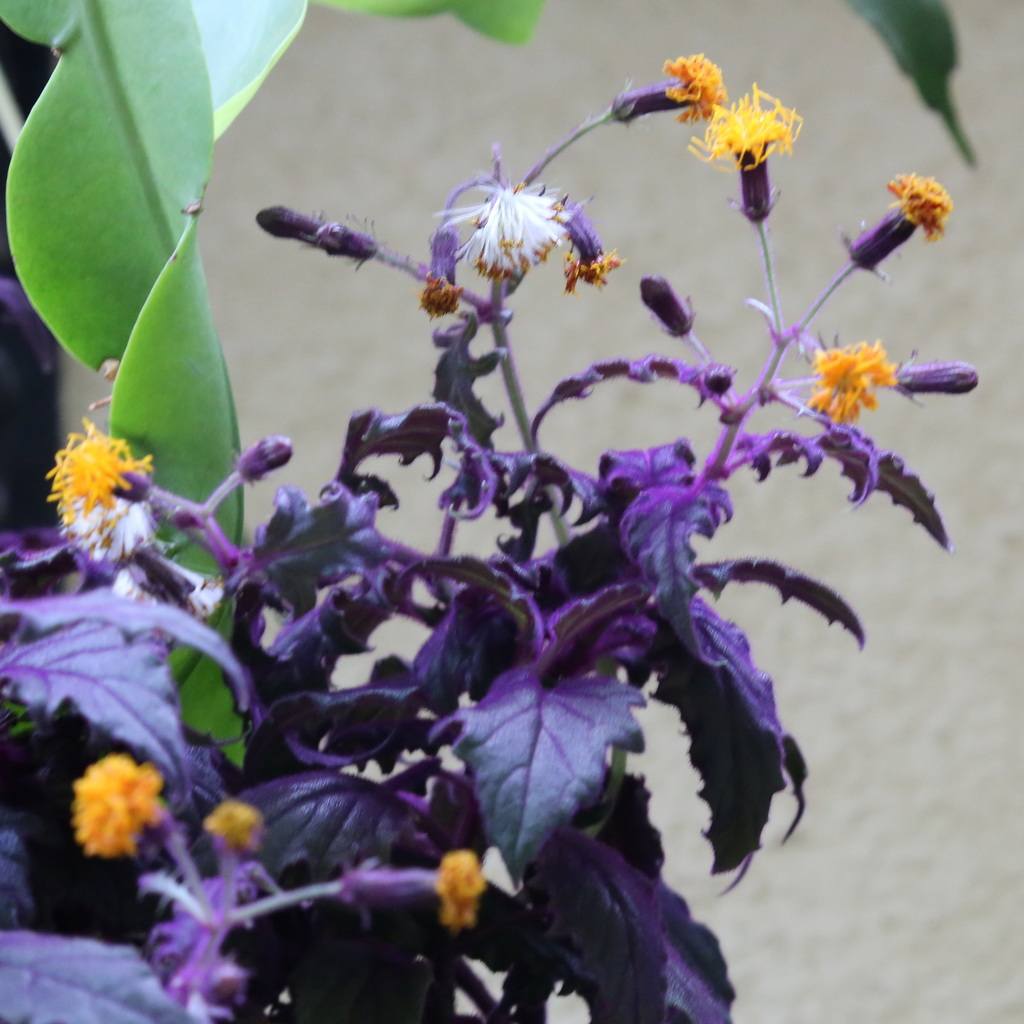
purple passion plant
Gynura aurantiaca
Gynura aurantiaca, called purple passion or velvet plant, is a species of flowering plant in the daisy family Asteraceae. It is native to Southeast Asia but grown in many other places as a house plant. In warm regions, it is frequently grown outdoors on patios and in gardens rather than inside buildings, and hence it has escaped into the wild in Africa, Australia, South America, Mesoamerica, Florida, and a few other places.
From the article Gynura aurantiaca on Wikipedia (CC BY-SA), quoted section by section
Description
Gynura aurantiaca is an evergreen perennial growing to 30 cm (12 in) tall, the stems sometimes growing straight up but other times reclining against other objects, when stems can reach 2 m (6.6 ft). As a house plant, the long trailing vines are appropriate for a hanging pot or similar arrangement. Leaves, stems, and bracts are dark green, covered with soft purple hairs that impart a velvety feeling to the plant. One plant can produce 1-5 flower heads, each on its own flower stalk. The flowers have a rather strong odour. Each head contains several yellow, orange, or red disc flowers but no ray flowers.
How it is grown
In cultivation in the UK this plant has gained the Royal Horticultural Society's Award of Garden Merit.
== References ==
Wikipedia: “Horticulture”
In human culture
The Latin specific epithet aurantiaca means "orange", referring to the usual colour of the blooms.
Wikipedia: “Etymology”
Where it lives
Recorded sightings
—
geo-referenced records in GBIF, from museums, herbaria and field observers.
Drag the globe to turn it. Dots are where records exist, not a range map; darker means more records.
In the stacks
Searching the stacks…
Every page naming Gynura aurantiaca in the Biodiversity Heritage Library →
This page is assembled live from iNaturalist, GBIF, Wikipedia, the Source Library and the Internet Archive. It is not yet part of the hand-edited codex. iNaturalist taxon 163472.