- Plants
- ›Vascular Plants
- ›flowering plants
- ›Dicots
- ›Legumes, Milkworts, and Allies
- ›Legumes
- ›Peacock Flower Subfamily
- ›Gymnocladus
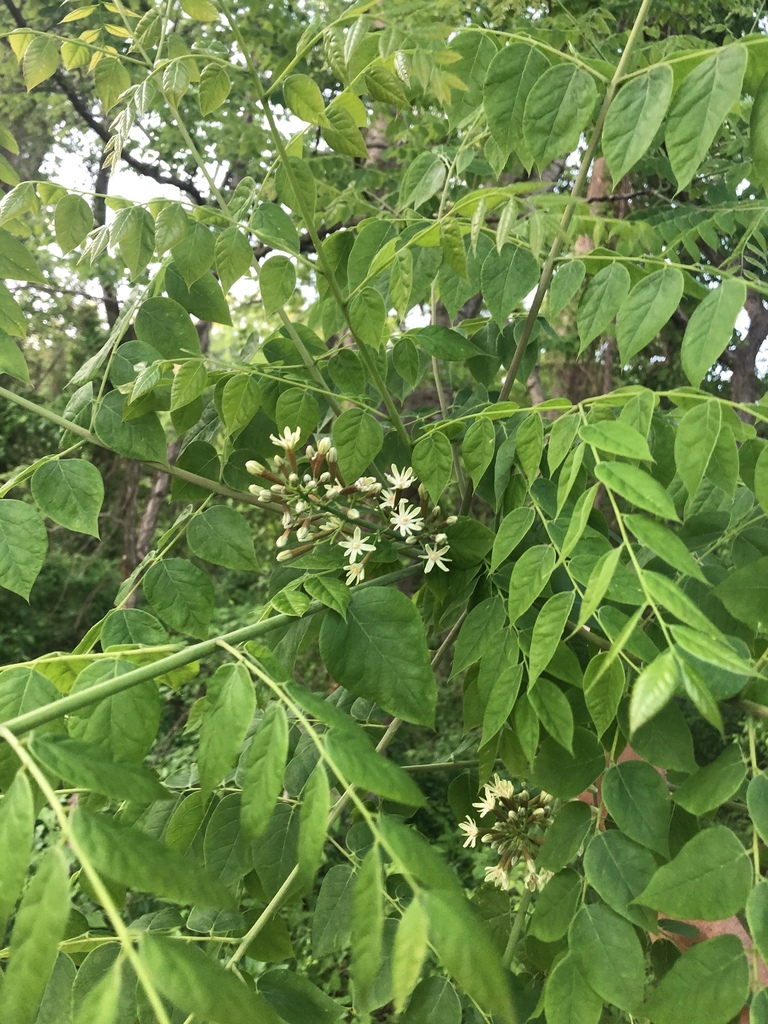
Kentucky coffeetree
Gymnocladus dioicus
The Kentucky coffeetree (Gymnocladus dioicus), also known as American coffee berry, Kentucky mahogany, nicker tree, and stump tree, is a tree in the subfamily Caesalpinioideae of the legume family Fabaceae, native to the Midwest, Upper South, Appalachia, and small pockets of New York in the United States and Ontario in Canada. The seed may be roasted and used as a substitute for coffee beans; however, unroasted pods and seeds are toxic. The wood from the tree is used by cabinetmakers and carpenters. It is also planted as a street tree.
From 1976 to 1994, the Kentucky coffeetree was the state tree of Kentucky, after which the tulip poplar was returned to that designation.
From the article Kentucky coffeetree on Wikipedia (CC BY-SA), quoted section by section
Description
The tree varies from 18 to 21 meters (59 to 69 ft) high with a spread of 12–15 meters (39–49 ft) and a trunk up to one meter (3.3 feet) in diameter. The tree grows at a medium rate with height increases of anywhere from 12 to 24 in (30 to 61 cm) per year. A 10-year-old sapling will stand about 4 meters (13 feet) tall. It usually separates 3 to 4+1⁄2 meters (9.8 to 14.8 feet) from the ground into three or four divisions which spread slightly and form a narrow pyramidal head; or when crowded by other trees, sending up one tall central branchless shaft to the height of 15–21 m (49–69 ft). Branches are stout, pithy, and blunt; roots are fibrous. The Kentucky coffeetree is a moderately fast-growing tree, and male trees are often grown in parks and along city streets for ornamental purposes. The tree is typically fairly short-lived, healthy trees living from 100 to 150 years. The Kentucky coffeetree sheds its leaves early during the fall and appears bare for up to 6 months. The naked appearance of the tree is reflected through the Kentucky coffeetree's Greek genus name, which means "naked branch". Like the Sumac, branches are absent of fine spray; smaller branches are thick and lumpish. Because of the absence of smaller branches and its later leafing, the French in Canada named it Chicot, "stubby". …
Range & habitat
The Kentucky coffeetree is widely distributed, but considered a rare tree species. "Rare species are those that are so uncommon that they should be monitored to determine whether their populations are becoming threatened." The tree's native range is limited, occurring from Southern Ontario, Canada and in the United States from Kentucky (where it was first encountered by Europeans) and Connecticut in the east, to Kansas, eastern Nebraska, and southeastern South Dakota in the west, to southern Wisconsin and Michigan in the north, and to northern Louisiana in the south. It is planted as an urban shade tree across the United States and eastern Canada, including California. It has a disjunct population in Central New York. The trees occur either in the form of widely dispersed individuals, or as small colonial groups with interconnected root systems. This tree is typically found in floodplains and river valleys, but is also sometimes seen on rocky hillsides and limestone woods. In the northeastern part of its range, seemingly natural groves of this tree are actually associated with known prehistoric village sites. In some parts of its range, this tree may be used as an indicator of the presence of limestone or of calcareous soils. The Kentucky coffeetree is considered an example of an evolutionary anachronism. …
Wikipedia: “Distribution”
At the table
The beans of the tree were eaten, after roasting, in the Meskwaki (Fox), Ho-Chunk (Winnebago) and Pawnee Native American cultures. The Meskwaki also drank the roasted ground seeds in a hot beverage similar to coffee. The common name "coffeetree" derives from this latter use of the roasted seeds, which was imitated by settlers because it seemed a substitute for coffee, especially in times of poverty, similar to chicory. The European colonialists, however, considered it inferior to real coffee:
When Kentucky was first settled by the adventurous pioneers from the Atlantic states who commenced their career in the primeval wilderness, almost without the necessaries of life, except as they produced them from the fertile soil, they fancied that they had discovered a substitute for coffee in the seeds of this tree; and accordingly the name of coffee-tree was bestowed upon it. But when communication was established with the sea-ports, they gladly relinquished their Kentucky beverage for the more grateful flavor of the Indian berry; and no use is at present made of it in that manner. The roasted seeds can be eaten like sweet chestnuts. Usefully, the fruits can be collected and picked up from the tree or ground at any time during fall, winter, and spring.
Toxicity. …
Wikipedia: “Food”
How it is grown
Gymnocladus dioicus is considered well-suited to urban environments, as it is tolerant of poor soils, has extreme drought tolerance, and is not vulnerable to serious insect infestations or disease problems. It is cultivated by specialty tree plant nurseries as an ornamental tree for planting in gardens and parks. The peculiarly late-emerging and early-dropping leaves, coupled with the fact that the large leaves mean few twigs in the winter profile, make it a tree that is ideal for urban shading where winter sunlight is to be maximized (such as in proximity to solar hot-air systems). It is often planted because of its unique appearance and interesting character. There are several Kentucky coffeetrees at Mount Vernon, in the gardens along the path leading up to the house of George Washington. Trees prefer a rich moist soil, such as bottom lands. Their growth is largely unaffected by heat, cold, drought, insects, disease, road salt, ice, and alkaline soil. Kentucky coffeetree is easy to grow from seed. Filing the seedcoat by hand with a small file, and then soaking the seeds in water for 24 hours will ensure rapid germination. Propagation is also easy from dormant root cuttings from December through March. The Kentucky coffeetree is typically found on "alluvial soils of river and flood plains and nearby terraces". …
Wikipedia: “Cultivation”
In human culture
In addition to use as a food, the seeds of Kentucky coffeetree were used by Native Americans for ceremonial and recreational purposes. Seeds were used as dice in games of chance that were common in eastern tribes. It is likely that indigenous community members carved patterns on coffeetree seeds used in ceremonial dice games, which also served to scarify the seeds and prepare them for germination. The seeds were also used in jewelry. The importance of the Kentucky coffeetree to Native Americans undoubtedly contributed to its dispersal. Gymnocladus dioicus is used as a street tree as far north as Québec City, Québec. It resists harsh winters and de-icing salts.
Wikipedia: “Culture”
Where it lives
Recorded sightings
—
geo-referenced records in GBIF, from museums, herbaria and field observers.
Drag the globe to turn it. Dots are where records exist, not a range map; darker means more records.
In the stacks
Searching the stacks…
Every page naming Gymnocladus dioicus in the Biodiversity Heritage Library →
This page is assembled live from iNaturalist, GBIF, Wikipedia, the Source Library and the Internet Archive. It is not yet part of the hand-edited codex. iNaturalist taxon 163451.