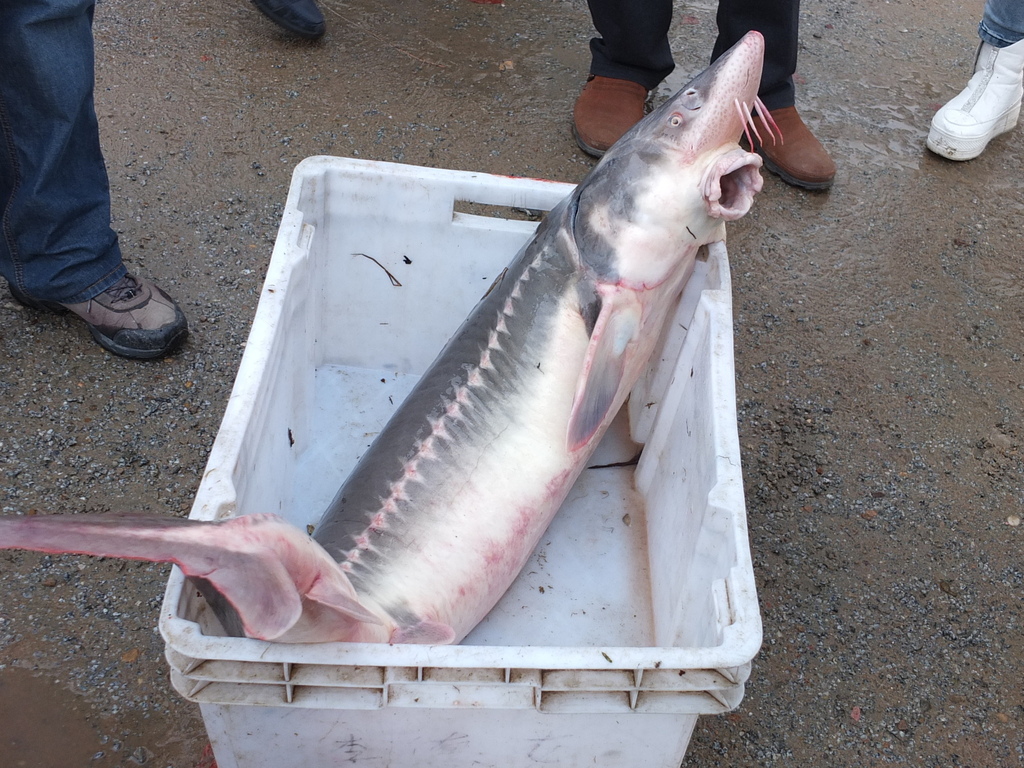
Amur Sturgeon
Sinosturio schrenckii
Sinosturio schrenckii, the Amur sturgeon, sometimes known as the Japanese sturgeon, is a freshwater species of fish in the sturgeon family. Being able to grow up to a length of 3 meters and weight of 190 kg, this species can be primarily found in its two distinct morphs of grey and brown in the Amur River and Amur Estuary. This sturgeon is a potamodromous migrator, performing their migrations through the Amur river. Due to over-fishing and caviar production, this species is currently listed as critically endangered on the IUCN red list.
From the article Amur sturgeon on Wikipedia (CC BY-SA), quoted section by section
Description
Amur sturgeon are massive fish that can grow to a length of 3 meters, and achieve a weight of up to 190 kilograms, though known hybrids between the Amur sturgeon and the kaluga, a much larger species also of genus Sinosturio present in the Amur, can be found with a maximum length of 1.9 meters and a weight of 70 kilograms. Being this size, these fish have 32-47 lateral scutes, 7-9 ventral scutes, and 11-17 dorsal scutes that can be found in two distinct color morphs of grey and brown, with brown morphs being the more rare of the two. Each of their scutes can be found with spines in the center, and of the 11-17 dorsal scutes present the first dorsal scute is the largest. Sinosturio schrenckii shares many traits with other Western Pacific species within its genus, most notably being a large compressed snout, small barbels, multiple dermal skin ossifications covering the body, and a laterodorsal row of scutes. However, the Amur sturgeon lacks a lateroventral band and a fontanel in between the frontal bones that can be found in many species within Sinusturio. This species has very large pectoral fins and a long caudal peduncle that lacks oblique scale rows. …
Range & habitat
The Amur sturgeon is a freshwater fish that has a distribution almost entirely limited to the range of the Amur river, otherwise known as Heilongjang River, and Amur estuary, although a documented catch in Hokkaido, Japan has suggested that this species may make rare anadromous migrations. Within the Amur, Sinosturio schrenckii prefers areas with sandy or rocky bottoms to allow for their bottom feeder lifestyle. In the Amur river Sinosturio schrenckii are most concentrated near the mouth of the river, with the most concentrated region being 100 - 200 kilometers from the mouth. In the Amur estuary, Amur sturgeon can be primarily found in the Western and Northwestern sections, decreasing in abundance as estuary salinity increases. The Amur estuary shows a high frequency of occurrence of Amur sturgeon, with frequencies of 59.5% in 2016 and 65.8% in 2011, although their presence has begun to see declines with 2021 showing a frequency of occurrence of 37.1%.
Wikipedia: “Distribution”
What it does
Unlike its neighbor the kaluga, an active fish eating predator, the Amur sturgeon is a benthic feeder that can be found primarily consuming mollusks and small fish. The Amur sturgeon's diet consists of over 90% mollusks, small fish, and crustaceans and the remaining 10% content being insect larvae, oligochaetes, and polychaetes. However, the contents and primary prey changes as Amur sturgeon grow in age and size. Amur sturgeons that are less than 100 centimeters in length will typically eat small fish, most commonly the pond smelt Hypomesus olidus, as their primary source of food. Fish of this species that grow to over 100 centimeters shift over to mollusks as their primary food source, more specifically the mollusk species Japanese corbicule, C. japonica. As Amur sturgeon grow so does the importance of mollusks in their diet, as mollusks have shown an average of 87.6% of food mass in Amur sturgeons.
Wikipedia: “Diet”
Where it lives
Recorded sightings
—
geo-referenced records in GBIF, from museums, herbaria and field observers.
Drag the globe to turn it. Dots are where records exist, not a range map; darker means more records.
In the stacks
Searching the stacks…
Every page naming Sinosturio schrenckii in the Biodiversity Heritage Library →
This page is assembled live from iNaturalist, GBIF, Wikipedia, the Source Library and the Internet Archive. It is not yet part of the hand-edited codex. iNaturalist taxon 1633200.