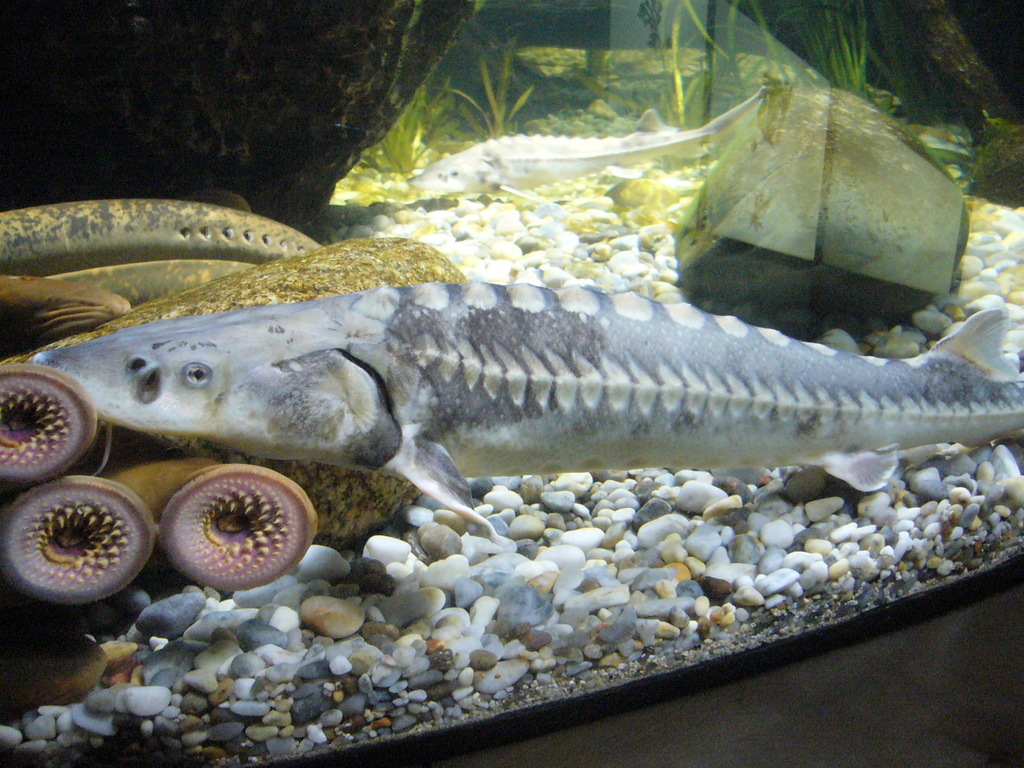
Adriatic Sturgeon
Huso naccarii
The Adriatic sturgeon (Huso naccarii) is a species of fish in the family Acipenseridae. It is native to the Adriatic Sea and large rivers which flow in it of Albania, Greece, Italy, Montenegro, Croatia, Bosnia and Herzegovina and Slovenia.
Prior to 2025, it was placed in the genus Acipenser, but this placement was found to be paraphyletic, and it is more accurately placed in the genus Huso.
From the article Adriatic sturgeon on Wikipedia (CC BY-SA), quoted section by section
Description
The Adriatic sturgeon reaches a maximum length exceeding 2 m (6.6 ft); the published maximum weight was 25 kg (55 lb), but large wild fish recently caught were evidently exceeding 40 kg (88 lb). Like other sturgeons it has an elongated body, heterocercal tail, partially cartilaginous skeleton, naked skin and longitudinal series of bony scutes on the body. The rostrum is tendentially conical and rather short (1/3 of the head), the head is broad and rounded at the apex, with a protractile mouth which lower lip is thin with a central cleft, and four barbels (circular section) which are closer to the tip of the snout than they are to the mouth. The series of longitudinal scutes are five: dorsal (1 series, 10–14 scutes), lateral (2 series, one per side, 30–42 scutes each) and ventral series (2 series, one per side, 8–11 scutes each). The dorsal fin has no spines and 36 to 48 soft rays, and the anal fin has 24 to 31 soft rays. The dorsal colouring is olive-brown, the flanks are paler and the underside white. Juveniles have a flattened and triangular rostrum, with a distinctive colouring on the back, dark brown with wide paler areas casually distributed. Adriatic sturgeon was reported as very similar to the critically endangered European sea sturgeon (Acipenser sturio), once sympatric in the Adriatic sea, but distinctive characters for H. …
Range & habitat
The Adriatic sturgeon can be found in freshwater and marine environments, including estuaries and brackish water. Historically it was to be found in the Adriatic Sea and the rivers flowing into it on either side. In 1932 its range in the sea was reported to be from Venice and Trieste to Greece and Corfu. It used to be present in the rivers Adige, Brenta, Bacchiglione, Piave, Livenza and Tagliamento. In the Po and its tributaries, it used to be present as far upstream as Turin, and it was reported numerous in the Ticino and Adda rivers. It traditionally occurred along the Albanian coasts, and in the rivers of Slovenia, Croatia, Bosnia-Herzegovina and Montenegro, including Lake Skadar.
Wikipedia: “Distribution”
What it does
Adriatic sturgeons are slow-growing, long-lived fish; wild males are sexually mature at 7–11 years old (about 80 cm (2.6 ft), long), and females at 12–14 years old (at least 1 m (3.3 ft), long). Females ovulate every 2–4 years. During spring months mature fish migrate to the upper part of the rivers, then they lay eggs from April to June in deep and oxygenated waters, on gravelly substrates at a depth of 2–10 m (10–30 ft), with a current velocity of 0.8 m/s (2.6 ft/s) at least. Water turbulence is very important for the reproductive success of sturgeons, since it avoids egg stress, aggregation of the eggs, anoxia, parasites, and predators. The eggs adhere at the substrate and hatch after about a week, fry are about 8–10 mm (0.31–0.39 in) long with pelagic attitude like other sturgeons, then after ten days they begin to be demersal.
Wikipedia: “Reproduction”
Where it lives
Recorded sightings
—
geo-referenced records in GBIF, from museums, herbaria and field observers.
Drag the globe to turn it. Dots are where records exist, not a range map; darker means more records.
In the stacks
Searching the stacks…
Every page naming Huso naccarii in the Biodiversity Heritage Library →
This page is assembled live from iNaturalist, GBIF, Wikipedia, the Source Library and the Internet Archive. It is not yet part of the hand-edited codex. iNaturalist taxon 1633142.