- Plants
- ›Vascular Plants
- ›flowering plants
- ›Dicots
- ›Legumes, Milkworts, and Allies
- ›Legumes
- ›Acacias, Mimosas, Mesquites, and Allies
- ›Mimoseae
- ›Entada
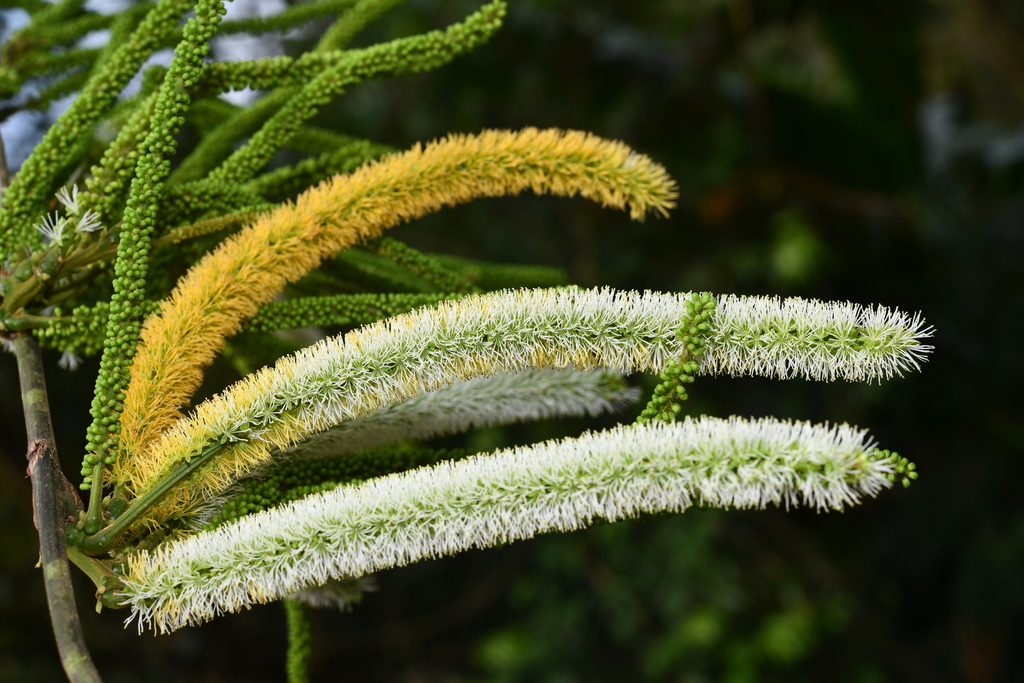
Matchbox Bean
Entada phaseoloides
Entada phaseoloides, commonly known in English as the matchbox bean or St. Thomas' bean, is a large twining vine or liana in the pea and bean family Fabaceae, native to a broad area of Asia-Pacific, from China to northern Australia and the southwestern Pacific.
It is also known as gugo in the Philippines, where the bark sap is used as a traditional shampoo.
From the article Entada phaseoloides on Wikipedia (CC BY-SA), quoted section by section
Description
Entada phaseoloides is a large woody liana whose stems may reach up to 18 cm (7.1 in) diameter. They are dark brown with a course bark, and are flattened laterally and spirally twisted. The bipinnate leaves are up to 25 cm (9.8 in) long, with 1 to 2 pairs of leaflets, each of which is again divided into 1 to 2 pairs of "pinnules" (leaflets). The pinnules are somewhat leathery, asymmetrical or oblique, and measure up to 10 cm (3.9 in) long by 5 cm (2.0 in) wide. The inflorescences take the form of a spike measuring around 25–30 cm (9.8–11.8 in) long, carrying numerous sessile flowers. The individual flowers are very small, measuring only about 1.2 mm (0.05 in) diameter. There are five petals, green with a reddish base, measuring about 3–4 mm (0.12–0.16 in) long, stamens about 7 mm (0.28 in) long. In contrast to the tiny flowers, the fruit of this species is a very large, flattened, woody pod or capsule, measuring about 1–1.2 m (3 ft 3 in – 3 ft 11 in) long and 12 cm (4.7 in) wide. They are usually slightly curved longitudinally, and have about 12 segments, each containing one seed. The seeds are lens-like, glossy brown and smooth, measuring about 5–6 cm (2.0–2.4 in) wide and long, and 1–1.5 cm (0.39–0.59 in) thick.
Range & habitat
The matchbox bean is native to a broad area from mainland Asia, through Melanesia to northern Australia and the western Pacific. Regions and/or countries include Tibet, south and southeast China, Japan, Mainland Southeast Asia, Malesia, Papuasia, northern Australia, New Caledonia, Vanuatu, Fiji, and Hawaii.
Wikipedia: “Distribution”
At the table
Filipinos have been traditionally using gugo before commercial shampoos were sold in stores. The shampoo is obtained by soaking and rubbing the bark of the vine gugo (Entada phaseoloides), producing a lather that cleanses the scalp effectively. Gugo is also used as an ingredient in hair tonics. Gugo contains saponin, triterpenes, and phenolic compounds. A study by the Philippines Department of Science and Technology found that gugo prevents hair fall because it stimulates micro circulation in the blood vessels. Tongans use the seeds of this plant (known as paʻanga) as ankle decorations for their traditional kailao dance as well as for use in an ancient game called lafo. The paʻanga is also the name given to their currency.
Wikipedia: “Uses”
Where it lives
Recorded sightings
—
geo-referenced records in GBIF, from museums, herbaria and field observers.
Drag the globe to turn it. Dots are where records exist, not a range map; darker means more records.
In the old herbals & bestiaries


In the stacks
Searching the stacks…
Every page naming Entada phaseoloides in the Biodiversity Heritage Library →
This page is assembled live from iNaturalist, GBIF, Wikipedia, the Source Library and the Internet Archive. It is not yet part of the hand-edited codex. iNaturalist taxon 162325.