On eBird ↗
Eastern Striolated-Puffbird
Live sightings near you, the range map, bar charts of when it is seen, and Macaulay Library photos and recordings.
Eastern Striolated-Puffbird
Nystalus striolatus
The eastern striolated puffbird (Nystalus striolatus) is a species of bird in the family Bucconidae, the puffbirds, nunlets, and nunbirds. It is found in Bolivia and Brazil.
From the article Eastern striolated puffbird on Wikipedia (CC BY-SA), quoted section by section
Description
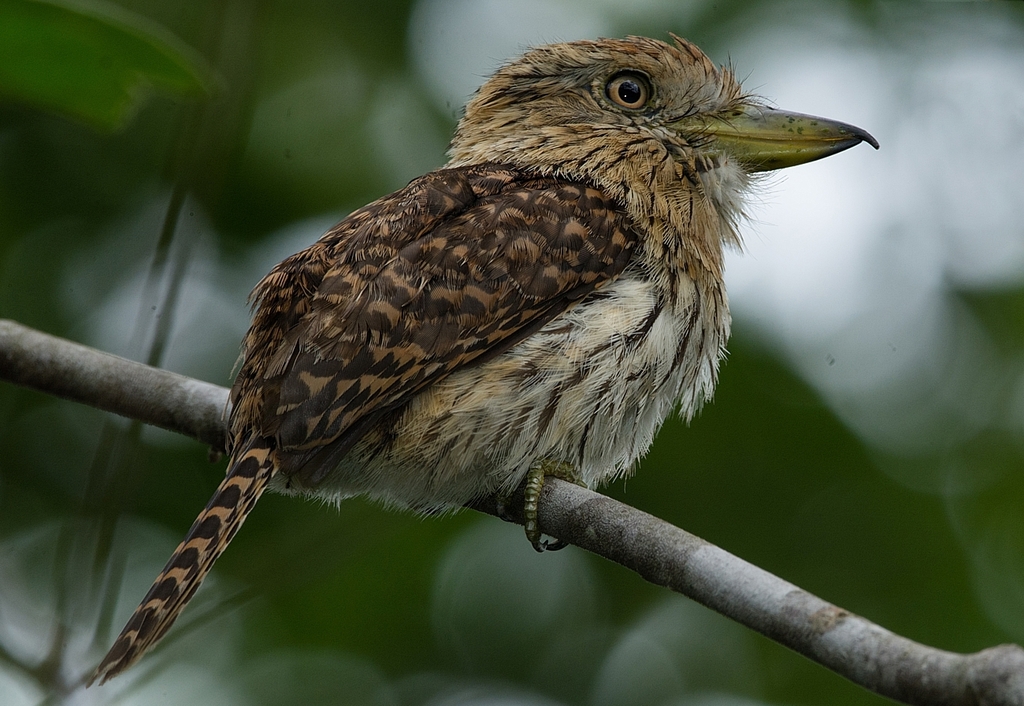
The eastern striolated puffbird is about 20 cm (7.9 in) long and weighs 43 to 47 g (1.5 to 1.7 oz). Its crown is dark brown with wide rufous bars, blackish toward the rear. Its hindneck has a broad buffy collar. Below that is a blackish band and the rest of the upperparts are dark brown with reddish buff spots and (at the rear) bars. The tail is narrow and blackish brown with thin rufous bars. The face has a white spot in front of the eye; the rest of the face is buffy with fine dusky streaks. The chin is white and the throat ochraceous with fine blackish streaks that gets lighter to the rear with heavier stripes. The center of the belly is whiter and unstreaked. The bill is mostly olive green, the eye pale ochre, the legs brown, and the feet dirty green.
Range & habitat
The nominate subspecies of eastern striolated puffbird is found in the south central Amazon Basin, in Brazil between the Madeira and Tapajós rivers, and into extreme northeastern Bolivia (Santa Cruz Department). N. s. torridus is found in northeastern Amazonian Brazil south of the Amazon River and east of the Tapajós River. The species inhabits a variety of landscapes including the edges of humid tropical, terra firme, and swamp forests, and also transitional forest. It typically occurs near water or clearings, and tends to stay in the subcanopy or canopy. The species is not known to migrate.
Wikipedia: “Distribution and habitat”
What it does
The foraging behavior and diet of the eastern striolated puffbird have not been documented. Most puffbirds hunt by sallying from a perch to pluck large insects and small vertebrates from foliage or bark.
Wikipedia: “Feeding”
Listen
Looking for field recordings…
Where it lives
Recorded sightings
—
geo-referenced records in GBIF, from museums, herbaria and field observers.
Drag the globe to turn it. Dots are where records exist, not a range map; darker means more records.
In the stacks
Searching the stacks…
Every page naming Nystalus striolatus in the Biodiversity Heritage Library →
This page is assembled live from iNaturalist, GBIF, Wikipedia, the Source Library and the Internet Archive. It is not yet part of the hand-edited codex. iNaturalist taxon 1613.