On eBird ↗
White-throated Pewee
Live sightings near you, the range map, bar charts of when it is seen, and Macaulay Library photos and recordings.
White-throated Pewee
Contopus albogularis
The white-throated pewee (Contopus albogularis) is a species of bird in the family Tyrannidae. It is found in Brazil, French Guiana, and Suriname. Its natural habitat is subtropical or tropical moist lowland forests.
From the article White-throated pewee on Wikipedia (CC BY-SA), quoted section by section
Description
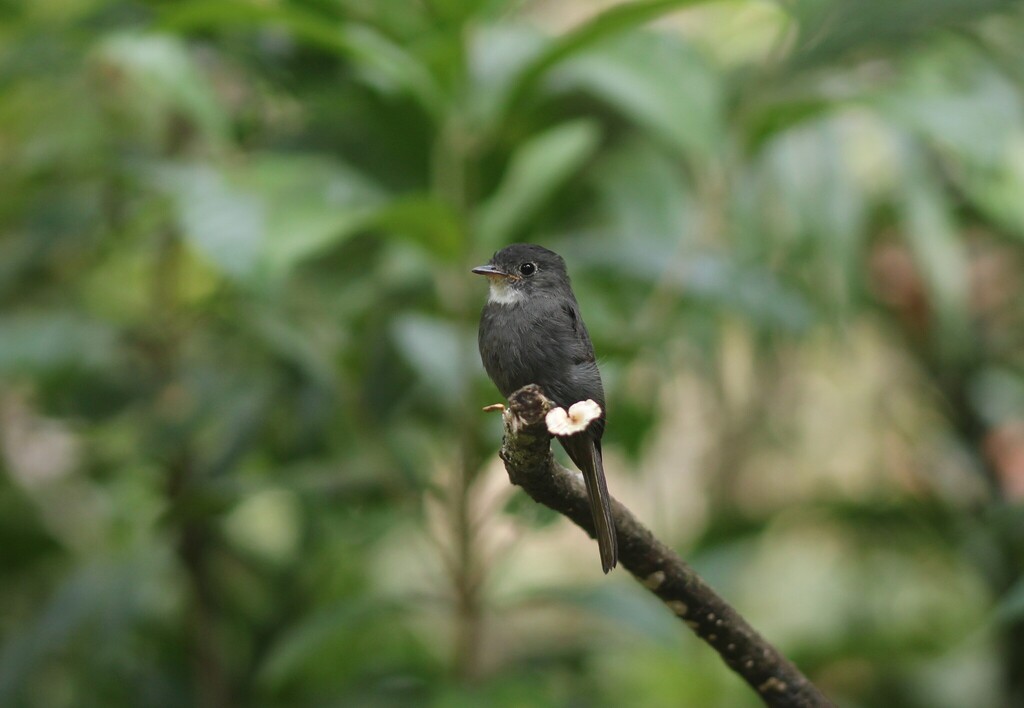
The white-throated pewee is about 13 cm (5.1 in) long. The sexes have the same plumage. Adults have a dark blackish gray crown with a slight crest, slightly paler gray lores, and a thin white eye-ring on an otherwise dark sooty gray face. Their back is also dark sooty gray. Their wings are blackish brown and their tail blackish. Their throat is white and the rest of their underparts sooty gray. They have a dark iris, a wide flat bill with a black maxilla and yellow mandible, and black legs and feet.
Range & habitat
The white-throated pewee is found at scattered locations from eastern Suriname east through central French Guiana into far northeastern Brazil's Amapá state. It inhabits the edges and clearings of humid primary and secondary forest. In elevation it ranges between 400 and 700 m (1,300 and 2,300 ft).
Wikipedia: “Distribution and habitat”
What it does
The white-throated pewee feeds on insects, though details are lacking. It sits erect on an exposed perch high in a tree and captures prey in mid-air with sallies from it ("hawking"). It usually returns to the same perch after a sally and "shivers" its tail upon landing.
Wikipedia: “Feeding”
Listen
Looking for field recordings…
Where it lives
Recorded sightings
—
geo-referenced records in GBIF, from museums, herbaria and field observers.
Drag the globe to turn it. Dots are where records exist, not a range map; darker means more records.
In the stacks
Searching the stacks…
Every page naming Contopus albogularis in the Biodiversity Heritage Library →
This page is assembled live from iNaturalist, GBIF, Wikipedia, the Source Library and the Internet Archive. It is not yet part of the hand-edited codex. iNaturalist taxon 16111.