On eBird ↗
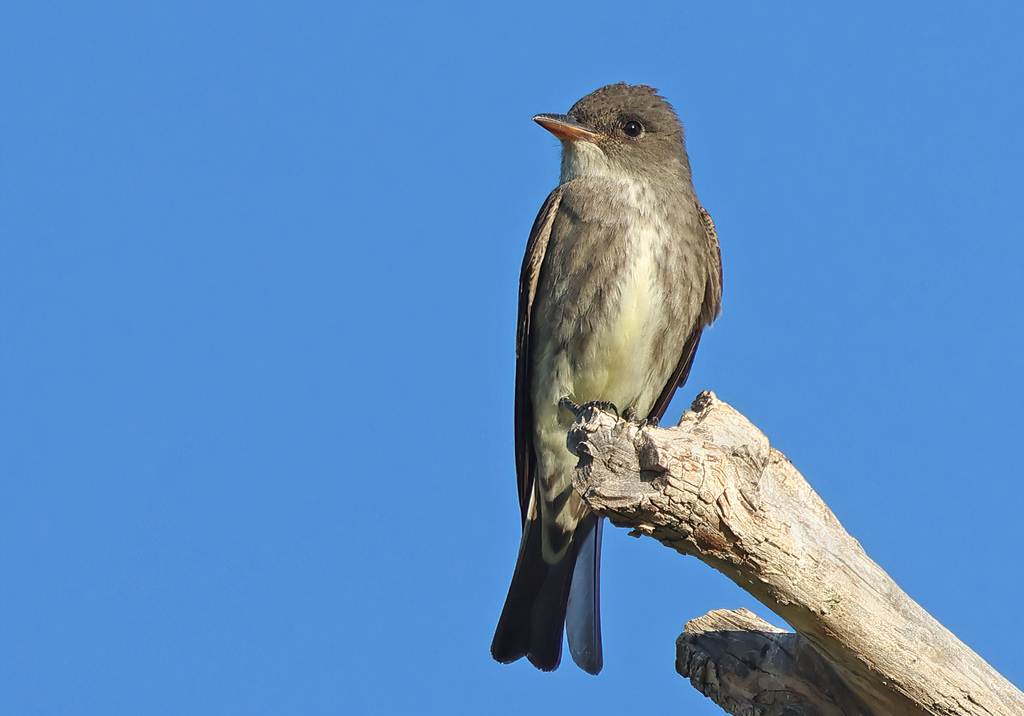
Olive-sided Flycatcher
Live sightings near you, the range map, bar charts of when it is seen, and Macaulay Library photos and recordings.
Olive-sided Flycatcher
Contopus cooperi
The olive-sided flycatcher (Contopus cooperi) is a small to medium sized passerine bird in the family Tyrannidae, the tyrant flycatcher family. It is a migratory species that travels from South America to North America to breed during the summer. It is an agile flyer and mainly consumes flying insects caught in flight. Since 2016, this species has been assessed as being near-threatened globally (IUCN) and threatened in Canada (SRA) due to its declining populations.
From the article Olive-sided flycatcher on Wikipedia (CC BY-SA), quoted section by section
Range & habitat
The olive-sided flycatcher is distributed throughout North and South America. Its breeding habitat ranges from California and New Mexico all the way up to central Alaska, then across Canada (except for most of the Northwest Territories and Nunavut) and through a portion of northeastern US. Its non-breeding habitat is mainly in the northern part of South America and a small area in Central America. Their breeding habitat is mainly in open areas or edges of boreal, coniferous forests or temperate western forests, in areas up to 10,000 feet in elevation (e.g., in the Rockies), and always near water. They can also nest in cities or on farms. In their non-breeding habitat, olive-sided flycatchers use similar habitats as their breeding habitats, such as open areas and forest edges, but do not need water proximity as much as in their breeding habitat. They are also associated with habitats with very tall trees. Two forest habitats used by olive-sided flycatchers in the winter are tropical montane and tropical lowland evergreen forests.
Wikipedia: “Distribution and habitat”
What it does
Olive-sided flycatchers breed once per year and usually lay clutches of 3 to 4 eggs. The incubation period lasts for 15 to 19 days and so does the nestling stage. The egg is approximately 0.8–0.9 inches long by 0.6–0.7 inches wide and is a creamy white colour with brownish spots that form a ring on the larger end of the egg. The nest location is chosen by the female and is usually on a horizontal branch of coniferous trees, but they have also been seen on other types of trees. The lowest nest was 5 feet high and the highest was 197 feet. In Western regions, olive-sided flycatchers tend to have higher nests than in their Eastern distributions. The nest is about 4.6 inches wide on the outside and 2.8 inches wide on the inside and is cup-shaped. The outer part is made with twigs and small branches, while the inside is usually lined with finer material such as grass, lichen, and needles. The hatching are born naked and helpless. The male defends a large area around the nesting territory. Both parents feed the young birds.
Wikipedia: “Reproduction”
Listen
Looking for field recordings…
Where it lives
Recorded sightings
—
geo-referenced records in GBIF, from museums, herbaria and field observers.
Drag the globe to turn it. Dots are where records exist, not a range map; darker means more records.
In the stacks
Searching the stacks…
Every page naming Contopus cooperi in the Biodiversity Heritage Library →
This page is assembled live from iNaturalist, GBIF, Wikipedia, the Source Library and the Internet Archive. It is not yet part of the hand-edited codex. iNaturalist taxon 16110.