On eBird ↗
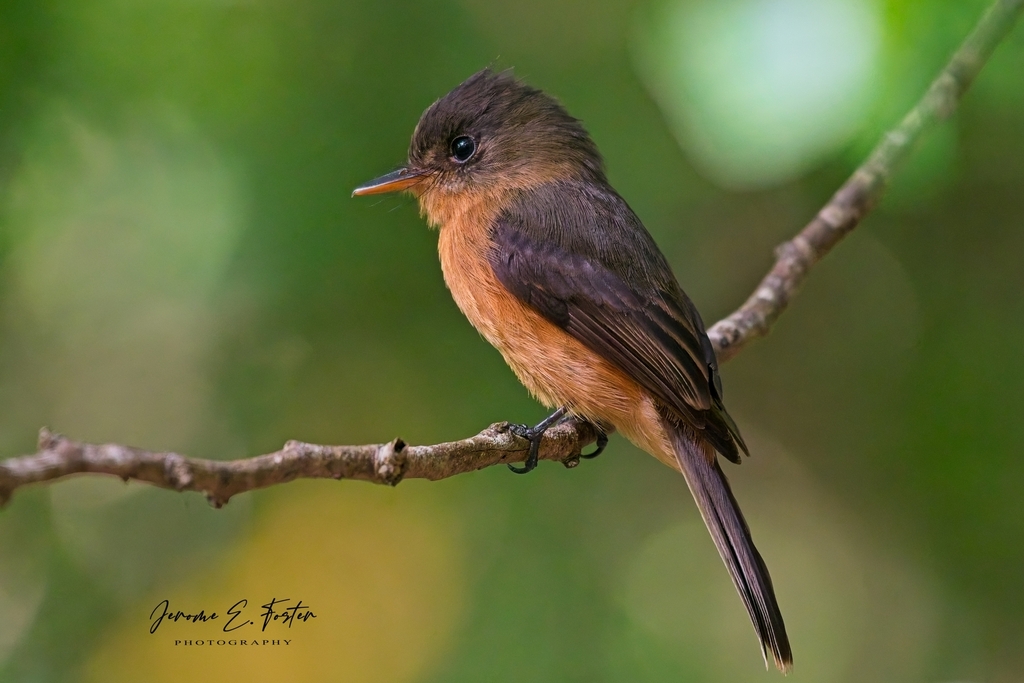
Lesser Antillean Pewee
Live sightings near you, the range map, bar charts of when it is seen, and Macaulay Library photos and recordings.
Lesser Antillean Pewee
Contopus latirostris
The Lesser Antillean pewee (Contopus latirostris) is a species of bird in the family Tyrannidae, the tyrant flycatchers. It is found in Dominica, Guadeloupe, Martinique, Puerto Rico, and Saint Lucia. There are also scattered records on Saint Kitts.
From the article Lesser Antillean pewee on Wikipedia (CC BY-SA), quoted section by section
Description
All three subspecies of the Lesser Antillean pewee are about 15 cm (5.9 in) long. Within each subspecies the sexes are alike. Adults of the nominate subspecies have a dark sooty brown crown, an olive-brown face with a fulvous tinge, and olive-brown upperparts with a cinnamon tinge on the rump and uppertail coverts. Their tail is dark grayish brown with pale grayish brown or buffy tips on the feathers and light grayish brown on the feather edges. Their wings are mostly dusky with pale cinnamon buff or grayish buff edges on the secondaries. Their underparts are cinnamon tawny or dull tawny ochraceous. They have a brown iris, a horn brown maxilla, a whitish mandible, and dusky brown legs and feet. Adults of subspecies C. l. blancoi have a dark sooty olive to sooty blackish crown, deep olive head and upperparts, and a dusky grayish brown tail with some olive on the feather edges. Their wings are mostly dusky with thin paler edges near the tips of the coverts and pale brownish buff edges on the secondaries. Their underparts are mostly deep brownish buff with paler undertail coverts and a dark olive shade on the breast and sides. They have a brown iris, a brownish black or blackish brown maxilla, a pale mandible usually with a dusky tip, and dusky brown or blackish legs and feet. Adults of subspecies C. l. …
Range & habitat
The nominate subspecies of the Lesser Antillean pewee is found on St. Lucia, where it primarily inhabits montane forest. Subspecies C. l. blancoi is found on Puerto Rico, though it is rare in the eastern third of the island. It also primarily inhabits montane forest. Both are also found in lower elevation forest, wooded hills, and coffee plantations and locally in semi-arid scrublands and coastal mangroves. C. l. brunneicapillus is found on Guadeloupe, Dominica, and Martinique. There it inhabits the same variety of habitat but does not appear to favor any particular one. The species is found in the tropical zone from sea level to about 900 m (3,000 ft) of elevation. The species also is recorded occasionally in the mountains of St. Kitts but it is not known if they are vagrants or remnants of a formerly more robust population.
Wikipedia: “Distribution and habitat”
What it does
The Lesser Antillean pewee feeds mostly on insects and includes a small amount of fruit in its diet. It sits erect on a perch low to the ground, usually at the edge of an open area within forest, and captures prey in mid-air with sallies from it ("hawking"). It has been observed following mixed-species feeding flocks in montane forest.
Wikipedia: “Feeding”
Listen
Looking for field recordings…
Where it lives
Recorded sightings
—
geo-referenced records in GBIF, from museums, herbaria and field observers.
Drag the globe to turn it. Dots are where records exist, not a range map; darker means more records.
In the stacks
Searching the stacks…
Every page naming Contopus latirostris in the Biodiversity Heritage Library →
This page is assembled live from iNaturalist, GBIF, Wikipedia, the Source Library and the Internet Archive. It is not yet part of the hand-edited codex. iNaturalist taxon 16102.