- Plants
- ›Vascular Plants
- ›flowering plants
- ›Dicots
- ›Legumes, Milkworts, and Allies
- ›Legumes
- ›Faboideae
- ›Phaseoleae
- ›Clitoriinae
- ›Clitoria
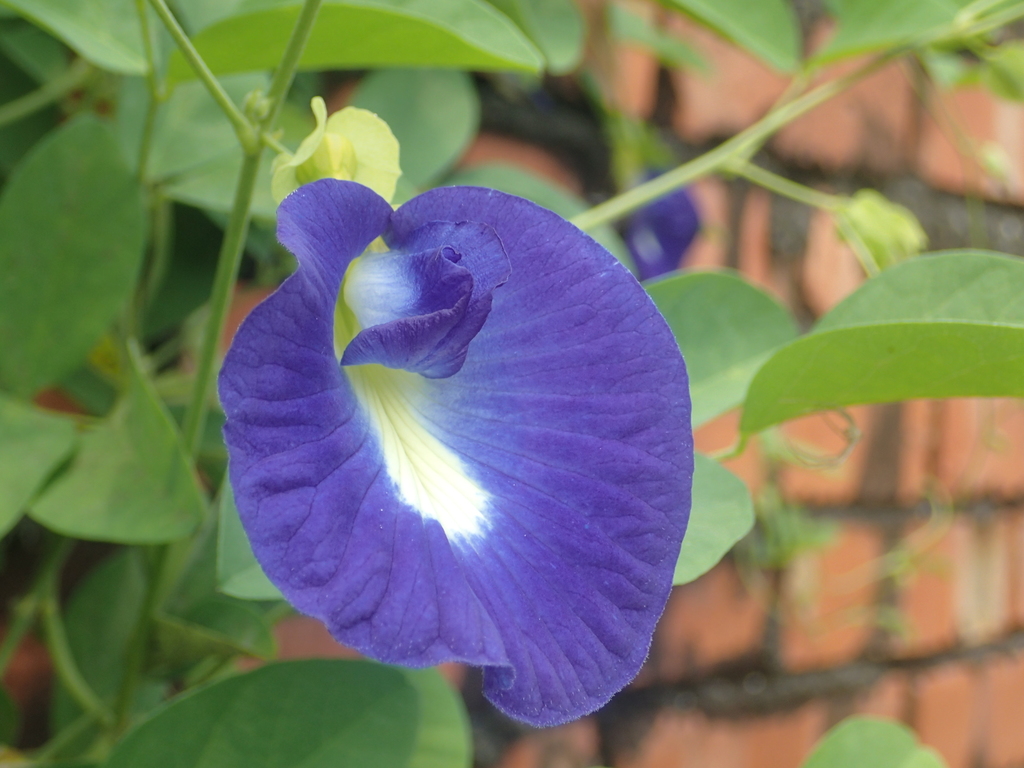
Blue Pea
Clitoria ternatea
Clitoria ternatea, commonly known as Asian pigeonwings, bluebellvine, blue pea, butterfly pea, cordofan pea and Darwin pea, is a plant species belonging to the Fabaceae family. The flowers of this vine were imagined to have the shape of human female genitals, hence the Latin name of the genus "Clitoria", from "clitoris". (Synonyms: Clitoris principissae.).
From the article Clitoria ternatea on Wikipedia (CC BY-SA), quoted section by section
Description
It is a perennial herbaceous plant, with elliptic, obtuse leaves. It grows as a vine or creeper, doing well in moist, neutral soil. Its most striking feature is the color of its flowers, a vivid deep blue; solitary, with light yellow markings. They are about 4 cm (1+1⁄2 in) long by 3 cm (1+1⁄4 in) wide. Some varieties yield white flowers and pink. The fruits are 5–7 cm (2–2+3⁄4 in) long, flat pods with six to ten seeds in each pod. It is grown as an ornamental plant and as a revegetation species (e.g., in coal mines in Australia), requiring little care when cultivated. As a legume, its roots form a symbiotic association with soil bacteria known as rhizobia, which transform atmospheric N2 into a plant-usable form (a process called nitrogen fixation), therefore, this plant is also used to improve soil quality through the decomposition of nitrogen rich plant material.
Chemistry. Chemical compounds isolated from C. ternatea include various triterpenoids, flavonol glycosides, anthocyanins and steroids. Cyclic peptides known as cliotides have been isolated from the heat-stable fraction of C. ternatea extract. The blue colour of C. ternatea is a result of various anthocyanins, most importantly ternatins – polyacylated derivatives of delphinidin 3,3', 5'-triglucoside (Da-T). Clitorin is a flavonol glycoside found in C. ternatea and several other plants.
Range & habitat
This plant is native to equatorial Asia, including locations in South Asia and Southeast Asia but has also been introduced to Africa, Australia and the Americas.
Wikipedia: “Distribution”
At the table
The flower can be used to dye natural fibers and is used by traditional societies in Asia to do so.
Culinary. In Southeast Asia, the flower is used as a natural food colouring to colour glutinous rice and desserts like the Eurasian putugal as well as an ayurvedic medicine. In Kelantan, in the north-east of peninsular Malaysia, it is an important ingredient in nasi kerabu, giving it its characteristic bluish colour. It is also used to colour the Nyonya dish pulut tai tai. The seeds are not edible. The pods are edible when young. Butterfly pea flower tea is made from the ternatea flowers and dried lemongrass and changes color depending on what is added to the liquid, with lemon juice turning it purple. In Thailand and Vietnam, this butterfly blue pea flower tea is commonly mixed with honey and lemon to increase acidity and turn the beverage a pink-purple color, to produce for a drink usually served after dinner, or as a refreshment at hotels and spas. The drink is a typical local drink like chamomile tea is in other parts of the world. The tea is found in both hot and cold varieties. The flowers have more recently been used in a color-changing gin and absinthe. Blue in the bottle, it turns pink when mixed with a carbonated mixer such as tonic water due to the change in pH. …
Wikipedia: “Uses”
In human culture
The genus name Clitoria is derived from "clitoris", due to their blossoms' shape that resembles the shape of a human vulva. The first reference to the genus, which includes an illustration of the plant, was made in 1678 by Jakób Breyne, a Polish naturalist, who described it as Flos clitoridis ternatensibus, meaning 'Ternatean flower of the clitoris'. The species name is derived from the name of the island where botanist Carl Linnaeus's specimens originated: the Ternate Island, located in the northern part of the Maluku Islands.
Wikipedia: “Etymology”
Where it lives
Recorded sightings
—
geo-referenced records in GBIF, from museums, herbaria and field observers.
Drag the globe to turn it. Dots are where records exist, not a range map; darker means more records.
In the old herbals & bestiaries


In the stacks
Searching the stacks…
Every page naming Clitoria ternatea in the Biodiversity Heritage Library →
This page is assembled live from iNaturalist, GBIF, Wikipedia, the Source Library and the Internet Archive. It is not yet part of the hand-edited codex. iNaturalist taxon 160759.