- Plants
- ›Vascular Plants
- ›flowering plants
- ›Dicots
- ›Mints, Plantains, Olives, and Allies
- ›Mint Family
- ›Ajugoideae
- ›Clerodendrum
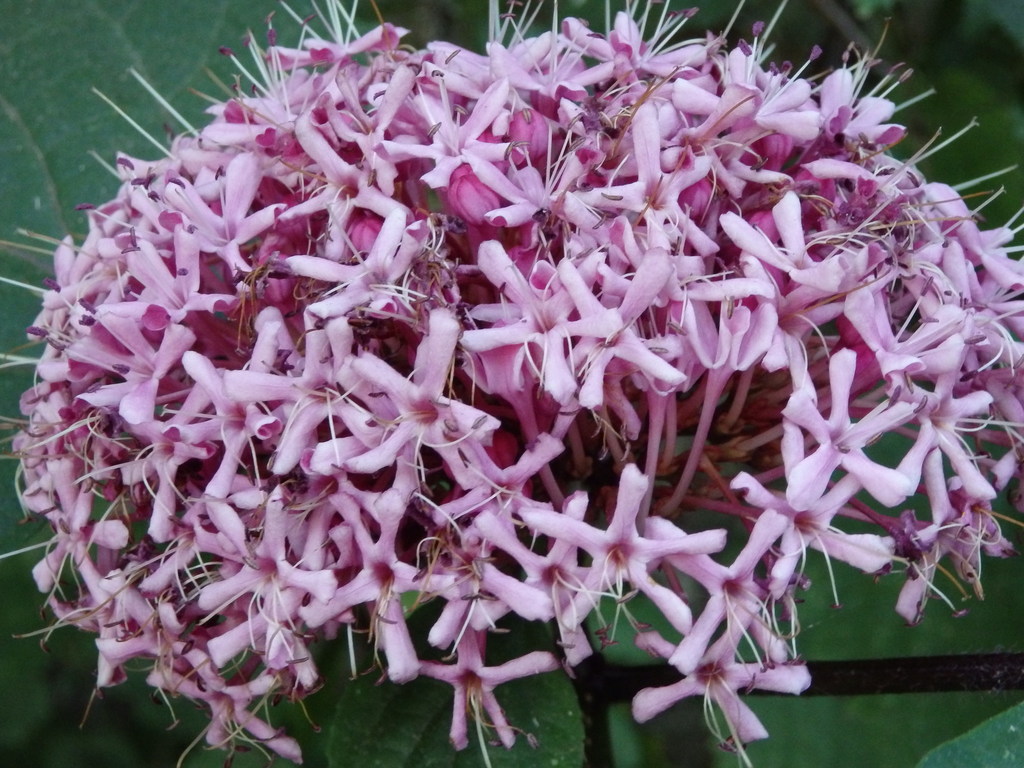
rose glorybower
Clerodendrum bungei
Clerodendrum bungei, commonly known as rose glory bower, glory flower or Mexican hydrangea (though neither a Hydrangea nor from Mexico), is a species of flowering plant in the deadnettle family, Lamiaceae. Native to China, it is commonly grown in gardens as an ornamental shrub. It has escaped from cultivation and is naturalized in the Americas.
From the article Clerodendrum bungei on Wikipedia (CC BY-SA), quoted section by section
Description
Clerodendrum bungei is a deciduous shrub that grows up to 2 m in height. Its leaves are cordate (heart-shaped), 10–20 cm long and not quite as wide, and have coarsely toothed edges. The flowers, which appear in late summer, are coloured rose, crimson, or pink, and arranged in a conspicuous rounded terminal inflorescence known as corymb, which is up to 10 cm in diameter. As in other Clerodendrum species, the calyx is five-lobed. At the centre of each flower there is a slender tube c. 3–4 cm long which terminates in five spreading white lobes. While the flowers are fragrant, crushed leaves have an unpleasant odour. Clerodendrum bungei possess extrafloral nectaries that produce a sweet secretion attracting ants (and other arthropods), which in return often protect plant from herbivory.
Range & habitat
Clerodendrum bungei is native to Taiwan, Vietnam, and all the mainland provinces and autonomous regions of China except Jilin and Liaoning. It grows along roadsides and in mixed forests on mountain slopes below 2500 m.
Wikipedia: “Distribution and habitat”
How it is grown
Clerodendrum bungei was first introduced into Europe c. 1850 by Scottish plant collector Robert Fortune. At Kew Gardens in England it was treated as a greenhouse plant until another nursery proved its winter hardiness. As in nature, cultivated plants grow to the height of 2 m. In the British Isles it is frequently killed to the ground by frost, only to send up "vigorous, erect, woody shoots" the next summer. In colder areas, such as the U.S. state of Missouri, it is grown in containers and overwintered in sunny rooms or conservatories. Its flowers attract butterflies. Clerodendrum bungei is noted for its suckering habit and rapid growth which allow it to form spreading colonies. It is valued for its flowers but its aggressive spread makes it suited best for somewhat isolated areas. C. bungei has escaped from gardens in North America and naturalized from Texas to Georgia and Florida.
Wikipedia: “Cultivation”
Where it lives
Recorded sightings
—
geo-referenced records in GBIF, from museums, herbaria and field observers.
Drag the globe to turn it. Dots are where records exist, not a range map; darker means more records.
In the old herbals & bestiaries

In the stacks
Searching the stacks…
Every page naming Clerodendrum bungei in the Biodiversity Heritage Library →
This page is assembled live from iNaturalist, GBIF, Wikipedia, the Source Library and the Internet Archive. It is not yet part of the hand-edited codex. iNaturalist taxon 160739.