On eBird ↗
Sulphur-bellied Flycatcher
Live sightings near you, the range map, bar charts of when it is seen, and Macaulay Library photos and recordings.
Sulphur-bellied Flycatcher
Myiodynastes luteiventris
The sulphur-bellied flycatcher (Myiodynastes luteiventris) is a large tyrant flycatcher. This bird breeds from southeasternmost Arizona of the United States (the Madrean sky islands region of Arizona, southwestern New Mexico, and northern Sonora, Mexico) to Costa Rica. They are short distance migrants, spending winters in the eastern Andean foothills of Colombia, Ecuador, Peru, Bolivia, and Brazil, and are passage migrants over the southern portions of Central America.
From the article Sulphur-bellied flycatcher on Wikipedia (CC BY-SA), quoted section by section
Description
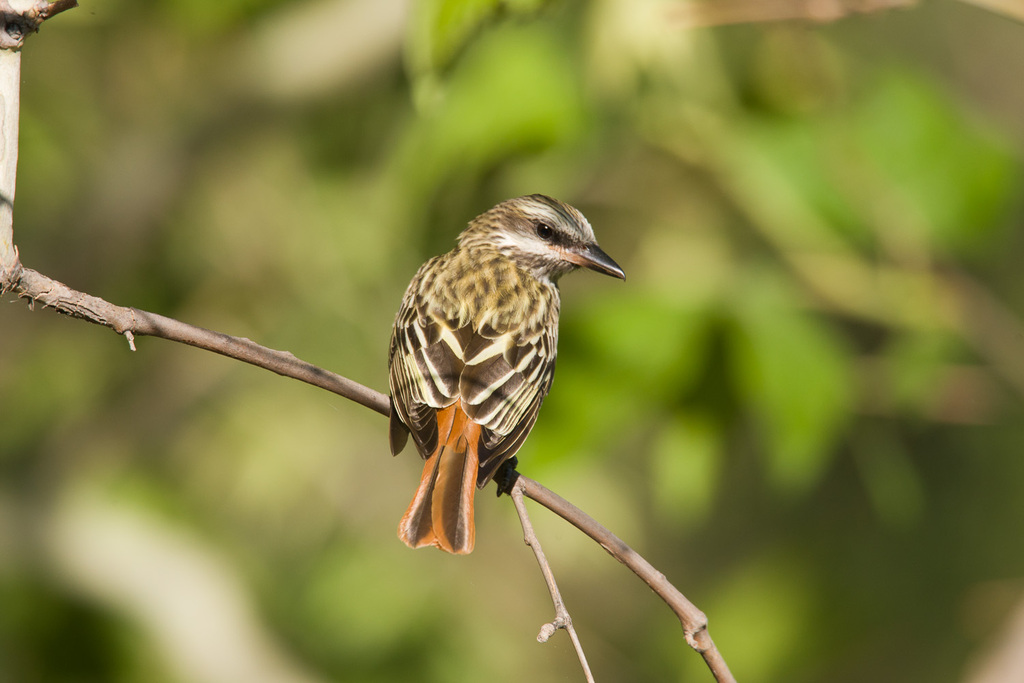
The sulphur-bellied flycatcher is about 20 cm (7.9 in) long and weighs about 40 to 57 g (1.4 to 2.0 oz). The sexes have the same plumage. Adults have a pale hoary gray or grayish white forecrown and supercilium. They have a brownish gray to olive crown with blackish streaks and a large, usually hidden, canary-yellow patch in the center. They have dusky lores; the color extends to the ear coverts and forms a dark "mask". Below the mask is a wide white stripe with thin dusky streaks and below that a thin dusky stripe. Their nape and upperparts to the upper rump are light olive with a buffy tinge and dusky centers to the feathers that give a streaked appearance. Their lower rump and uppertail coverts are cinnamon-rufous with dusky streaks. Their wings are dusky with wide yellowish white to primrose yellow edges on the outer webs of the median and greater coverts and inner secondaries. The inner webs of the median coverts have wide grayish olive to buffy grayish edges, the outer greater coverts have a pale cinnamon wash, and the outer webs of the primary coverts and primaries have thin pale olive to buffy grayish edges. Their tail is mostly cinnamon-rufous with dusky shafts that show as streaks. Their chin and the sides of their throat are grayish olive with dusky streaks and the rest of their throat is white with dusky streaks. …
Range & habitat
The sulphur-bellied flycatcher breeds in the Madrean sky islands of southeastern Arizona and south from there through western Mexico to central Costa Rica. It also breeds from southern Nuevo León and southern Tamaulipas in northeastern Mexico south through eastern Mexico, including the Yucatán Peninsula, to join the western range in Guatemala. It is absent in central Mexico, the northern tip of the Yucatán Peninsula, and from central Chiapas into south-central Guatemala. It passes in migration from Costa Rica south through Panama and western Colombia and winters on the eastern slope of the Andes from northern Ecuador south through eastern Peru and across most of north-central Bolivia. There are multiple records in California, central Arizona, New Mexico, and Texas and a few in Louisiana, Alabama, and Florida. It has occurred as a vagrant in Nevada and Massachusetts, and in Ontario, New Brunswick, and Newfoundland in Canada. In South America it has occurred as a vagrant in Brazil, Chile, and Venezuela. In its breeding range the sulphur-bellied flycatcher inhabits deciduous forest, gallery forest, and the edges of evergreen forest in the tropical and subtropical zones. In Arizona it typically is found in riparian canyons. In migration the species favors somewhat open woodlands and the edges of denser forest. …
Wikipedia: “Distribution and habitat”
What it does
The sulphur-bellied flycatcher feeds on insects year-round and in the non-breeding season adds much fruit to its diet. There are few data about its foraging technique, which is assumed to be similar to that of others of its genus. Those species usually perch in trees from about their mid-height to the canopy. They take insect prey with sallies to glean it from another perch, to snatch it during a brief hover, and in mid-air by hawking. They take most fruits by gleaning while perched.
Breeding. The sulphur-bellied flycatcher breeds between April and early August. The female alone builds the nest in a tree cavity, either natural or excavated by a woodpecker. The nest is a cup made from small sticks, pine needles, and rootlets and is usually lined with softer plant material. The usual clutch is three or four eggs that are white to creamy buff with red, lilac, or purple blotches. The incubation period is about 16 days; the female alone incubates. The time to fledging is not known. Both parents provision nestlings.
Vocalization. Only male sulphur-bellied flycatchers sing. The song is variously described as a "soft, liquid, almost warbled tre-le-re-re, tre-le-re-re", a "persistently repeated, a soft chu-eer", and a "clipped, slightly liquid phrase: chee-a-leet s-lik or chew-ee ti-lit or doo-ee ti-chu". …
Wikipedia: “Feeding”
Listen
Looking for field recordings…
Where it lives
Recorded sightings
—
geo-referenced records in GBIF, from museums, herbaria and field observers.
Drag the globe to turn it. Dots are where records exist, not a range map; darker means more records.
In the stacks
Searching the stacks…
Every page naming Myiodynastes luteiventris in the Biodiversity Heritage Library →
This page is assembled live from iNaturalist, GBIF, Wikipedia, the Source Library and the Internet Archive. It is not yet part of the hand-edited codex. iNaturalist taxon 16071.