On eBird ↗
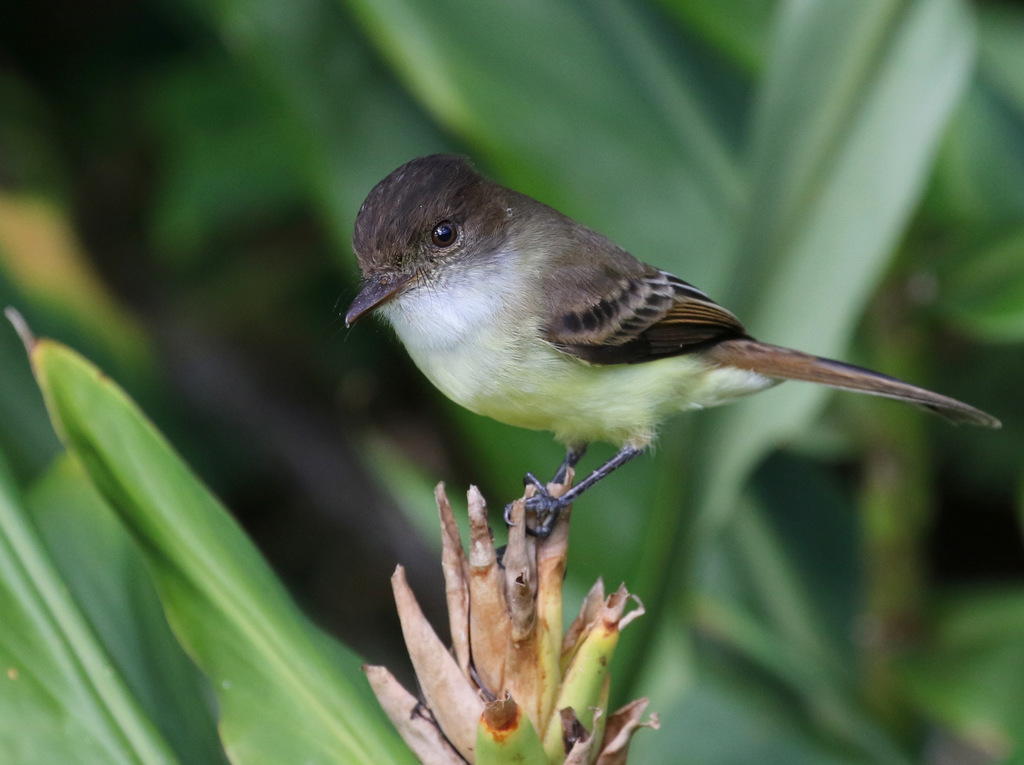
Sad Flycatcher
Live sightings near you, the range map, bar charts of when it is seen, and Macaulay Library photos and recordings.
Sad Flycatcher
Myiarchus barbirostris
The sad flycatcher (Myiarchus barbirostris) is a species of bird in the family Tyrannidae. It is endemic to Jamaica. Its natural habitats are subtropical or tropical moist lowland forests, subtropical or tropical moist montane forests, and heavily degraded former forest.
From the article Sad flycatcher on Wikipedia (CC BY-SA), quoted section by section
Description
The sad flycatcher is 16.5 to 17 cm (6.5 to 6.7 in) long and weighs 11.5 to 16 g (0.41 to 0.56 oz). The sexes have the same plumage. Adults have a smoky olive-brown crown and face; the crown feathers form a crest. Their upperparts are more olive with rufous-tinged olive-brown uppertail coverts. Their wings are mostly brown with pale grayish edges on the tertials. Their greater and median wing coverts have a rufous tinge that forms faint wing bars. Their tail is mostly brown with rufous on the outer webs of some feathers. Their throat and upper breast are gray to pale whitish and their lower breast, belly, and undertail coverts lemon-yellow. They have a dark iris, bill, and legs and feet. Juveniles have entirely gray underparts.
Range & habitat
The sad flycatcher is found throughout most of Jamaica. It primarily inhabits lowland and montane evergreen forest and woodlands, to a lesser extent drier lowland areas and open high-elevation forest, and seldom mangroves. In elevation it ranges from sea level to 2,000 m (6,600 ft).
Wikipedia: “Distribution and habitat”
What it does
The sad flycatcher feeds on small insects. It typically perches about 3 to 9 m (10 to 30 ft) above the ground and makes sallies to grab prey from foliage. It often returns to the same perch.
Wikipedia: “Feeding”
Listen
Looking for field recordings…
Where it lives
Recorded sightings
—
geo-referenced records in GBIF, from museums, herbaria and field observers.
Drag the globe to turn it. Dots are where records exist, not a range map; darker means more records.
In the stacks
Searching the stacks…
Every page naming Myiarchus barbirostris in the Biodiversity Heritage Library →
This page is assembled live from iNaturalist, GBIF, Wikipedia, the Source Library and the Internet Archive. It is not yet part of the hand-edited codex. iNaturalist taxon 16057.