On eBird ↗
Stolid Flycatcher
Live sightings near you, the range map, bar charts of when it is seen, and Macaulay Library photos and recordings.
Stolid Flycatcher
Myiarchus stolidus
The stolid flycatcher (Myiarchus stolidus) is a species of bird in the family Tyrannidae. It is found in Cayman Islands, the Dominican Republic, Haiti, and Jamaica. Its natural habitats are subtropical or tropical dry forest, subtropical or tropical moist lowland forest, subtropical or tropical mangrove forest, and heavily degraded former forest.
From the article Stolid flycatcher on Wikipedia (CC BY-SA), quoted section by section
Description
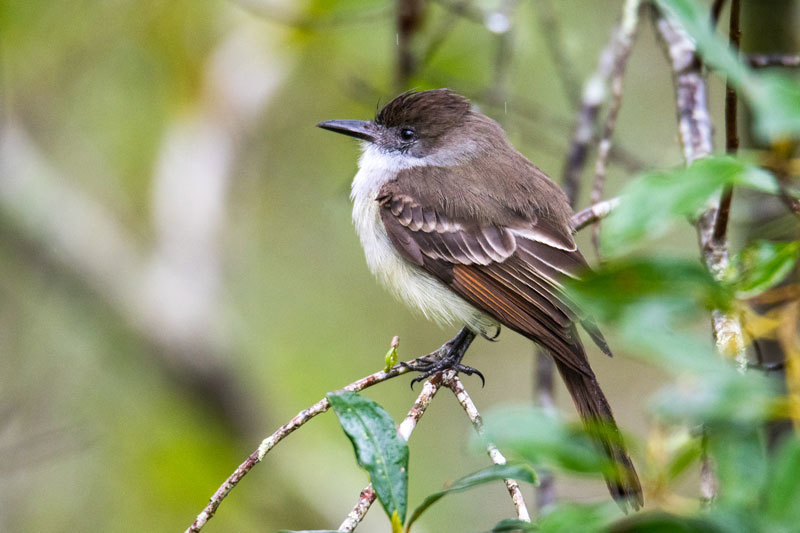
The stolid flycatcher is 20 cm (7.9 in) long and weighs about 19 to 26 g (0.67 to 0.92 oz). The sexes have the same plumage. Adults of the nominate subspecies have an olive-green crown that has a small crest. Their face is dark gray. Their upperparts are mostly olive-green with slightly lighter uppertail coverts. Their wings are mostly brown with thin rufous edges on the primaries and pale grayish white edges on the outer webs of the secondaries and tertials. The wing's greater and median coverts have wide pale grayish white tips that show as two clear wing bars. Their tail is mostly brown with rufous inner webs of all but the outermost feathers. Their throat and breast are pale ashen gray and their belly and undertail coverts yellow. Subspecies M. s. dominicensis has rufous on all the tail feathers. Both subspecies have a dark iris, a dark bill, and dark legs and feet.
Range & habitat
The nominate subspecies of the stolid flycatcher is endemic to Jamaica. The subspecies M. s. dominicensis is found in the Dominican Republic and Haiti, including their offshore islands; the countries share the island of Hispaniola. On both islands it is found in the tropical zone. It inhabits the interior and edges of lowland forest, drier woodlands, scrublands, and mangroves. On Hispaniola it also occurs in pine forest. Though it ranges from sea level to 1,800 m (5,900 ft) it is found less frequently in the higher elevations.
Wikipedia: “Distribution and habitat”
What it does
The stolid flycatcher feeds on insects and fruits. It typically forages by snatching prey and fruit from vegetation while briefly hovering after a sally from a perch.
Wikipedia: “Feeding”
Listen
Looking for field recordings…
Where it lives
Recorded sightings
—
geo-referenced records in GBIF, from museums, herbaria and field observers.
Drag the globe to turn it. Dots are where records exist, not a range map; darker means more records.
In the stacks
Searching the stacks…
Every page naming Myiarchus stolidus in the Biodiversity Heritage Library →
This page is assembled live from iNaturalist, GBIF, Wikipedia, the Source Library and the Internet Archive. It is not yet part of the hand-edited codex. iNaturalist taxon 16013.