On eBird ↗
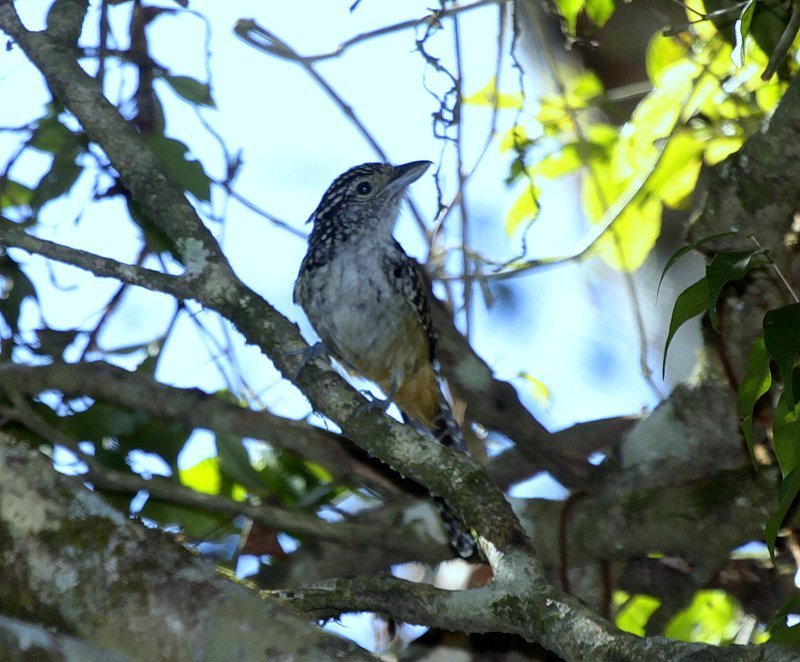
Spot-backed Antshrike
Live sightings near you, the range map, bar charts of when it is seen, and Macaulay Library photos and recordings.
Spot-backed Antshrike
Hypoedaleus guttatus
The spot-backed antshrike (Hypoedaleus guttatus) is a species of bird in the family Thamnophilidae. It is the only member of the genus Hypoedaleus. It is found in southeastern Brazil, eastern Paraguay and far northeastern Argentina. Its natural habitat is subtropical or tropical moist lowland forest.
From the article Spot-backed antshrike on Wikipedia (CC BY-SA), quoted section by section
Description
The spot-backed antshrike is a large antbird, 20 to 21 cm (7.9 to 8.3 in) long. The species exhibits slight sexual dimorphism. Both sexes have a short, heavy, gray bill with a hook at the end like true shrikes. Adult males have a black crown, nape, and upperparts spotted with white and a brownish black tail with white bars. Their throat and breast are white and their sides pale gray. Their belly and crissum are nearly white in the northern part of their range and gradually darken to brownish yellow to the south. Adult females have a similar pattern as males, but with buff spots on their upperparts and more extensive brownish yellow on their underparts.
Range & habitat
The spot-backed antshrike is found from eastern Alagoas in eastern Brazil south to northern Rio Grande do Sul and southwest through eastern Paraguay and into northeastern Argentina's Misiones Province. It is a bird of the Atlantic Forest, where it inhabits the subcanopy and canopy of lowland evergreen forest. It almost exclusively stays in wetter areas with dense vines and other vegetation. In elevation it ranges from sea level to about 900 m (3,000 ft).
Wikipedia: “Distribution and habitat”
What it does
The spot-backed antshrike feeds on a variety of insects and other arthropods; its diet also includes snails and possibly small vertebrates like tree-frogs and lizards. It usually forages in pairs, mostly about between 8 and 15 m (25 and 50 ft) above the ground, and sometimes joins mixed-species feeding flocks. It hops sluggishly through dense vines and other vegetation, reaching from a perch to glean prey from leaves, especially those of bromeliads and epiphytic ferns, and also from stems and branches. It was once observed following an army ant swarm, staying low to the ground to capture prey disturbed by the ants.
Wikipedia: “Feeding”
Listen
Looking for field recordings…
Where it lives
Recorded sightings
—
geo-referenced records in GBIF, from museums, herbaria and field observers.
Drag the globe to turn it. Dots are where records exist, not a range map; darker means more records.
In the stacks
Searching the stacks…
Every page naming Hypoedaleus guttatus in the Biodiversity Heritage Library →
This page is assembled live from iNaturalist, GBIF, Wikipedia, the Source Library and the Internet Archive. It is not yet part of the hand-edited codex. iNaturalist taxon 15959.