On eBird ↗
White-shouldered Fire-eye
Live sightings near you, the range map, bar charts of when it is seen, and Macaulay Library photos and recordings.
White-shouldered Fire-eye
Pyriglena leucoptera
The white-shouldered fire-eye (Pyriglena leucoptera) is a species of bird in subfamily Thamnophilinae of family Thamnophilidae, the "typical antbirds". It is found in Argentina, Brazil, and Paraguay.
From the article White-shouldered fire-eye on Wikipedia (CC BY-SA), quoted section by section
Description
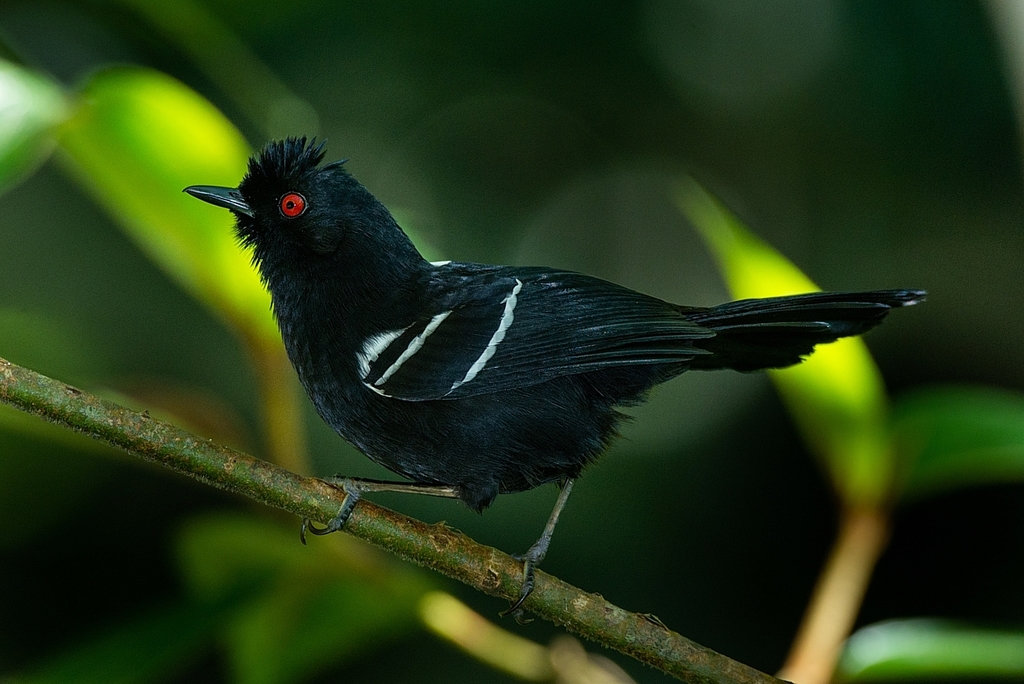
The white-shouldered fire-eye is 16 to 18 cm (6.3 to 7.1 in) long and weighs 25 to 34 g (0.88 to 1.2 oz). Adults of both sexes have bright red irises. Males are mostly glossy black. They have a white patch between their scapulars, white lesser wing coverts, white-tipped median and greater wing coverts, and blackish gray underwing coverts. Females have yellowish brown to chestnut crown, upperparts, and wings with no interscapular patch. Their tail is brownish black. Their face is olive-tinged gray with black lores. Their chin and throat are white, their breast light yellowish olive-brown, their belly a whiter olive-brown, and their flanks, crissum, and underwing coverts dark gray-tinged olive-brown.
Range & habitat
The white-shouldered fire-eye is found in eastern Brazil from eastern Bahia and southwestern Minas Gerais south to Mato Grosso do Sul and extreme northern Rio Grande do Sul, in eastern Paraguay from Canindeyú to Itapúa, and in extreme northeastern Argentina's Misiones Province. It inhabits dense understorey vegetation in lowland evergreen forest. It mostly occurs at the edges of primary forest, in mature secondary forest, and in clearings such as those caused by fallen trees. It also occurs in selectively logged forest and in plantations. It favors areas with dense thickets, vine tangles, and large stands of bamboo. It shuns sunlit areas such as open woodland with little undergrowth. In elevation it ranges from near sea level to about 1,300 m (4,300 ft).
Wikipedia: “Distribution and habitat”
What it does
The white-shouldered fire-eye feeds on insects (e.g. cockroaches, beetles, and ants), other arthropods such as spiders, and small vertebrates such as geckos. It typically forages singly, in pairs, or in family groups in dense vegetation, mostly on the ground and within about 3 m (10 ft) above it but as high as 10 m (33 ft). It hops between short feeding stops, pumping its tail. It captures prey by gleaning, reaching, jumping (upward and to the ground), lunging from a perch, and by searching leaf litter on the ground. Much less frequently it makes short sallies to glean or capture prey on the wing. It frequently follows army ant swarms to capture prey disturbed by the ants. It sometimes briefly joins mixed-species feeding flocks.
Wikipedia: “Feeding”
Listen
Looking for field recordings…
Where it lives
Recorded sightings
—
geo-referenced records in GBIF, from museums, herbaria and field observers.
Drag the globe to turn it. Dots are where records exist, not a range map; darker means more records.
In the stacks
Searching the stacks…
Every page naming Pyriglena leucoptera in the Biodiversity Heritage Library →
This page is assembled live from iNaturalist, GBIF, Wikipedia, the Source Library and the Internet Archive. It is not yet part of the hand-edited codex. iNaturalist taxon 15952.