On eBird ↗
Black-and-white Antbird
Live sightings near you, the range map, bar charts of when it is seen, and Macaulay Library photos and recordings.
Black-and-white Antbird
Myrmochanes hemileucus
The black-and-white antbird (Myrmochanes hemileucus) is a species of bird in the family Thamnophilidae. It is monotypic within the genus Myrmochanes. It is found in Bolivia, Brazil, Colombia, Ecuador, and Peru. Its natural habitats are subtropical or tropical moist lowland forests and subtropical or tropical moist shrubland.
From the article Black-and-white antbird on Wikipedia (CC BY-SA), quoted section by section
Description
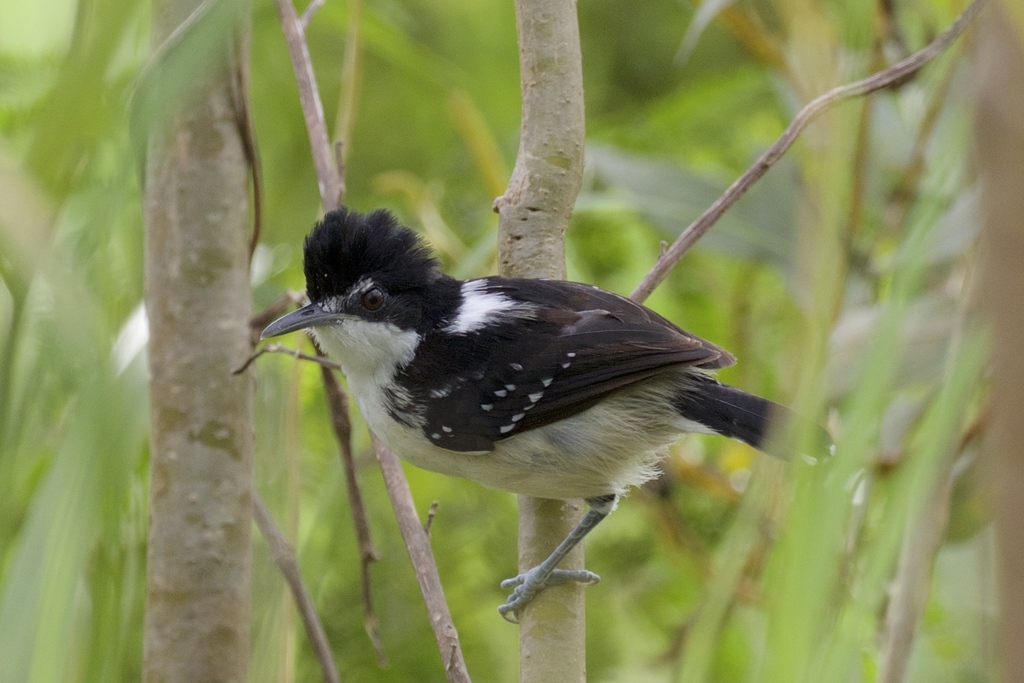
The black-and-white antbird is 10 to 12.2 cm (3.9 to 4.8 in) long and weighs 12 to 13 g (0.42 to 0.46 oz). Adult males' face, crown, nape, and upperparts are black except for a mostly hidden white patch between the shoulders. Their wings are black with sparse white tips on the coverts. Their tail is short, somewhat graduated, and black with white tips on the feathers. Their throat and underparts are white with variable amounts of buff on the flanks and belly. Adult females resemble males with the addition of white spots on the lores and a buffier belly and undertail coverts. The species' bill is long, slender, and black, its iris brown, and its legs and feet gray.
Range & habitat
The black-and-white antbird is found in the western Amazon Basin along the Amazon from its origin in Peru to the mouth of the Rio Madeira in Brazil, and also along its major tributaries. It occurs along the Rio Napo from northwestern Ecuador through northern Peru to its confluence with the Amazon. In Peru it also occurs along the rios Ucayali and Marañón to where their confluence creates the Amazon, and on the Amazon itself. From the south it occurs along the Rio Madeira through central Bolivia and Brazil to the Amazon. In far southern Colombia it occurs only along the Amazon where the river forms the border with Peru. The black-and-white antbird is found almost exclusively on river islands, though it has been observed in agricultural plots on the mainland. It favors young to middle-aged islands with Tessaria scrub and vine tangles in the understory of tall Cecropia forest.
Wikipedia: “Distribution and habitat”
What it does
The diet of the black-and-white antbirds is not known in detail but includes insects and probably spiders. It typically forages in pairs or family groups, less often singly, and never as part of a mixed-species feeding flock. It mostly forages in vine tangles and other vegetation in the understory of Cecropia woods, and usually between about 1 and 4 m (3 and 13 ft) of the ground but occasionally as high as 8 m (26 ft). It takes most of its prey by gleaning from leaves, bark, and grass blades. It forages very actively, often by lunging after prey, and sometimes makes short sallies from a perch.
Wikipedia: “Feeding”
Listen
Looking for field recordings…
Where it lives
Recorded sightings
—
geo-referenced records in GBIF, from museums, herbaria and field observers.
Drag the globe to turn it. Dots are where records exist, not a range map; darker means more records.
In the stacks
Searching the stacks…
Every page naming Myrmochanes hemileucus in the Biodiversity Heritage Library →
This page is assembled live from iNaturalist, GBIF, Wikipedia, the Source Library and the Internet Archive. It is not yet part of the hand-edited codex. iNaturalist taxon 15940.