- Plants
- ›Vascular Plants
- ›conifers
- ›conifers
- ›pine family
- ›pines, spruces, larches, and allies
- ›Pinus
- ›Pinus
- ›Trifoliae
- ›Ponderosae
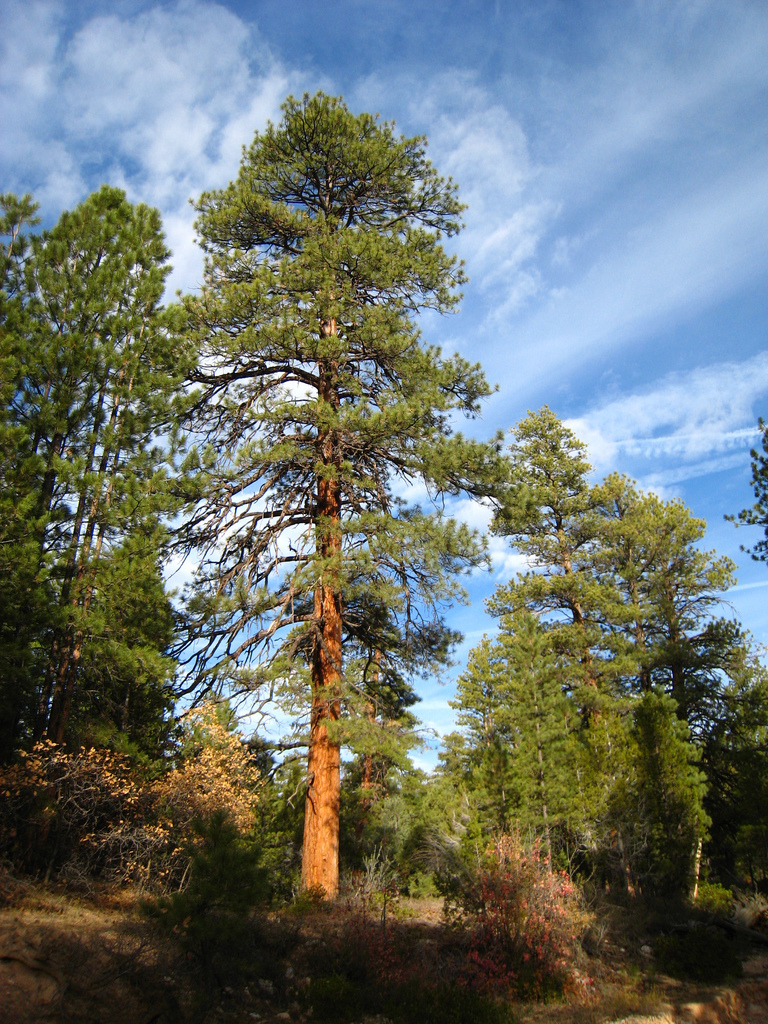
Southwestern Ponderosa Pine
Pinus brachyptera
Pinus ponderosa, commonly known as the ponderosa pine or western yellow pine, is a very large pine tree species of variable habitat native to mountainous regions of western North America. It is the most widely distributed pine species in North America.
Pinus ponderosa grows in various erect forms in 16 western U.S. states as well as British Columbia in Canada and has been introduced in temperate regions of Europe and in New Zealand. It was first documented in modern science in 1826 in eastern Washington near present-day Spokane (of which it is the official city tree). On that occasion, David Douglas misidentified it as Pinus resinosa (red pine). In 1829, Douglas concluded that he had a new pine among his specimens and coined the name Pinus ponderosa for its heavy wood. In 1836, it was formally named and described by Charles Lawson, a Scottish nurseryman. It was adopted as the official state tree of Montana in 1949.
From the article Pinus ponderosa on Wikipedia (CC BY-SA), quoted section by section
Description
Pinus ponderosa is a large coniferous tree. The bark helps distinguish it from other species. Mature to overmature individuals have yellow to orange-red bark in broad to very broad plates with black crevices. Younger trees have blackish-brown bark, referred to as "blackjacks" by early loggers. The five varieties or subspecies, as classified by some botanists, can be identified by their characteristically bright-green needles (contrasting with blue-green needles that distinguish Jeffrey pine). The Pacific subspecies has the longest at 15–24 centimeters (6–9+1⁄2 inches) and most flexible needles in plume-like fascicles of three, and green immature cones. The North Plateau or Columbia ponderosa pine has long 12–20.5 cm (4+3⁄4–8 in) and relatively flexible needles in fascicles of three, and purple immature cones. The Rocky Mountains subspecies has shorter 9.2–14.4 cm (3+1⁄2–5+3⁄4 in) and stouter needles growing in bushy, tuft-like fascicles of two or three, and usually green immature cones (but purple at high altitudes). The southwestern subspecies has stout needles 11.2–19.8 cm (4+1⁄2–7+3⁄4 in) long, in fascicles of three (averaging 68.5–89 mm (2+3⁄4–3+1⁄2 in)). …
Range & habitat
Pinus ponderosa is a dominant tree in the Kuchler plant association, the ponderosa shrub forest. Like most western pines, the ponderosa is generally associated with mountainous topography. However, it is found on banks of the Niobrara River in Nebraska. Scattered stands occur in the Willamette Valley of Oregon and in the Okanagan Valley and Puget Sound areas of Washington. Stands occur throughout low level valleys in British Columbia reaching as far north as the Thompson, Fraser and Columbia watersheds. In its Northern limits, it grows only below 1,300 meters (4,300 ft) elevation, but is most common below 800 meters (2,600 ft). Ponderosa covers 4,000 square kilometers (1×10^6 acres), or 80%, of the Black Hills of South Dakota. It is found on foothills and mid-height peaks of the northern, central, and southern Rocky Mountains, in the Cascade Range, in the Sierra Nevada, and in the maritime-influenced Coast Range. In Arizona, it predominates on the Mogollon Rim and is scattered on the Mogollon Plateau and on mid-height peaks (1,829 to 2,835 meters; 6,000 to 9,300 ft) in Arizona and New Mexico. Arizona pine (P. arizonica), found in the mountains of extreme southwestern New Mexico, southeastern Arizona, and northern Mexico, is sometimes classified as a variety of ponderosa pine, but is presently recognized as a separate species. …
Wikipedia: “Distribution”
What it does
The fire cycle for ponderosa pine is 5 to 10 years, in which a natural ignition sparks a low-intensity fire. Low, once-a-decade fires are known to have helped specimens live for half a millennium or more. The tree has thick bark, and its buds are protected by needles, allowing even some younger individuals to survive weaker fires. In addition to being adapted to dry, fire-affected areas, the species often appears on the edges of deserts as it is comparatively drought resistant, partly due to the ability to close its leaf pores. It can also draw some of its water from sandy soils. Despite being relatively widespread in the American West, it is intolerant of shade. Pinus ponderosa needles are the only known food of the caterpillars of the gelechiid moth Chionodes retiniella. Blue stain fungus, Grosmannia clavigera, is introduced in sapwood of P. ponderosa from the galleries of all species in the genus Dendroctonus (mountain pine beetle), which has caused much damage. Western pine and other beetles can be found consuming the bark. The seeds are eaten by squirrels, chipmunks, quail, grouse, and Clark's nutcracker, while mule deer browse the seedlings. Various animals nest in the ponderosa pines, such as the pileated woodpecker.
Pathology. …
Wikipedia: “Ecology”
At the table
Native Americans consumed the seeds and sweet inner bark. They chewed the dried pitch, which was also used as a salve. They used the limbs and branches as firewood and building material, and the trunks were carved into canoes. The needles and roots were made into baskets. The needles were also boiled into a solution to treat coughs and fevers.
Commercial Uses. Ponderosa pine has long been an important commercial timber species in western North America, valued for its versatile wood. In both the United States and Canada (primarily British Columbia), ponderosa pine forests have been harvested for lumber and other wood products since the 19th century. Old-growth trees were widely used by settlers as lumber, including for railroads. The wood is pale yellow to light brown, straight-grained, and moderately soft, making it suitable for a wide range of applications in construction and manufacturing. Younger trees are of poor quality for lumber due to the tendency to warp.
Structural lumber. Ponderosa pine is extensively used as dimensional lumber in light construction. Its timber is easily milled and was one of the first western woods shipped in quantity to eastern markets in the early 20th century. Common construction uses have included framing (studs and joists), roof decking, and sheathing in houses where only moderate strength is required. …
Wikipedia: “Uses”
In human culture
Pinus ponderosa is the official state tree of Montana. In a 1908 poll to determine the state tree, Montana schoolchildren chose the tree over the Douglas fir, American larch, and cottonwood. However, the tree was not officially named the state tree until 1949. The Ponderosa Ranch in the classic TV series Bonanza was named after the ponderosa pine, commonly found in the Lake Tahoe region where the fictional Cartwright family's ranch was set. Bonanza was one of the first Westerns to be filmed in color and made frequent visual use of scenic pine forests to emphasize the ranch's size and frontier beauty.
Wikipedia: “Culture”
Where it lives
Recorded sightings
—
geo-referenced records in GBIF, from museums, herbaria and field observers.
Drag the globe to turn it. Dots are where records exist, not a range map; darker means more records.
In the stacks
Searching the stacks…
Every page naming Pinus brachyptera in the Biodiversity Heritage Library →
This page is assembled live from iNaturalist, GBIF, Wikipedia, the Source Library and the Internet Archive. It is not yet part of the hand-edited codex. iNaturalist taxon 1592837.