On eBird ↗
Dot-winged Antwren
Live sightings near you, the range map, bar charts of when it is seen, and Macaulay Library photos and recordings.
Dot-winged Antwren
Microrhopias quixensis
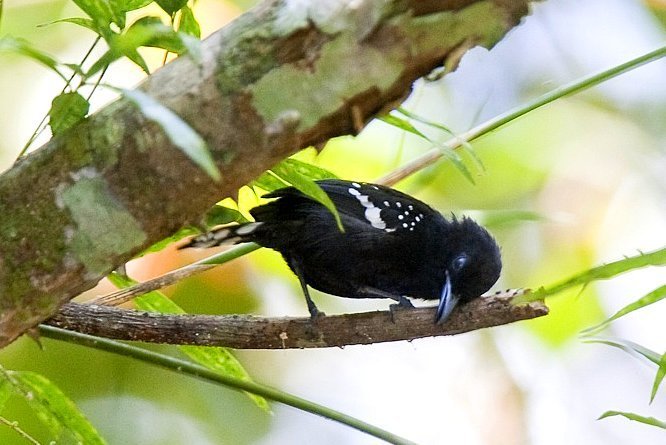
The dot-winged antwren (Microrhopias quixensis) is a passerine bird in the antbird family. In the past it was sometimes known as the velvety antwren, and some of its more distinctive subspecies have their own infrequently used English names. It is a resident in tropical Central and South America from southeastern Mexico south to western Ecuador, northern Bolivia, central Brazil and the Guianas. It is the only member of the genus Microrhopias.
From the article Dot-winged antwren on Wikipedia (CC BY-SA), quoted section by section
Description
The dot-winged antwren is 10 to 12.5 cm (3.9 to 4.9 in) long and weighs 7.5 to 11.5 g (0.26 to 0.41 oz). The species has a long graduated tail. The sexes have different plumage. Adults of the nominate subspecies M. q. quixensis are mostly black. They have a partly concealed white patch between their shoulders. Their greater wing coverts have large white tips and the other coverts smaller ones. Their wing's underside shows additional white areas. Their flight feathers are dark gray with a brown tinge. Their central tail feathers are black and the rest have progressively larger white tips from inner to outer. Adult females have a blackish gray head and upperparts, a black throat, and rufous-chestnut underparts that is darkest on the breast. Their pattern of white on the wings and tail are like the male's. The other subspecies of the dot-winged antwren differ from the nominate and each other thus:
M. q. boucardi: smaller white tips on the tail than nominate; female's underparts are cinnamon with a rufous tinge M. q. virgatus: smaller white tips on the tail than nominate; female's underparts are cinnamon-rufous M. q. consobrina: smaller than nominate with larger white tail tips; female's underparts rufous-chestnut to rufous M. q. intercedens: larger white tips on tail feathers than nominate; female's upperparts blackish gray and throat and underparts rufous M. q. …
Range & habitat
The subspecies of the dot-winged antwren are found thus:
M. q. boucardi: from Veracruz and Oaxaca in Mexico east and south through Belize and eastern Guatemala into northern Honduras M. q. virgatus: from southeastern Honduras south through eastern Nicaragua and eastern Costa Rica into Panama as far as Panamá Province and Guna Yala (former San Blas); also Pacific slope of central and southern Costa Rica and locally on Panama's Pacific slope M. q. consobrina: from Panama's Guna Yala and Darién Province through north-central and western Colombia into Ecuador as far as Guayas Province M. q. quixensis: from southern Colombia's Putumayo and Caquetá departments south through eastern Ecuador into northeastern Peru to the Marañón and Amazon rivers M. q. intercedens: central Peru and southwestern Brazil south of the Amazon as far east as the Madeira River M. q. nigriventris: eastern Andes and foothills in central Peru between San Martín and Cuzco departments M. q. albicauda: from Peru's Ucayali Department southeast into northern Bolivia's Pando Department M. q. microstictus: the Guianas and northeast Amazonian Brazil's Roraima, extreme northern Pará, and Amapá M. q. bicolor: Amazonian Brazil south of the Amazon between the Madeira and Tapajós rivers and south to Rondônia and northwestern Mato Grosso M. q. …
Wikipedia: “Distribution and habitat”
What it does
The dot-winged antwren feeds almost entirely on arthropods. It seldom forages by itself, but usually in pairs or small family groups. It often joins mixed-species feeding flocks that pass through its territory but does not travel with them. It typically forages between about 3 and 10 m (10 and 35 ft) above the ground but will feed higher. It rarely attends army ant swarms but then will take prey from near and on the ground. It forages very actively, flutter-flying, hopping, and hitching up, along, and between trunks and branches. It gleans prey from live vegetation, stems, and vines while reaching, hanging, jumping up, or hovering to capture it.
Wikipedia: “Feeding”
Listen
Looking for field recordings…
Where it lives
Recorded sightings
—
geo-referenced records in GBIF, from museums, herbaria and field observers.
Drag the globe to turn it. Dots are where records exist, not a range map; darker means more records.
In the stacks
Searching the stacks…
Every page naming Microrhopias quixensis in the Biodiversity Heritage Library →
This page is assembled live from iNaturalist, GBIF, Wikipedia, the Source Library and the Internet Archive. It is not yet part of the hand-edited codex. iNaturalist taxon 15922.