On eBird ↗
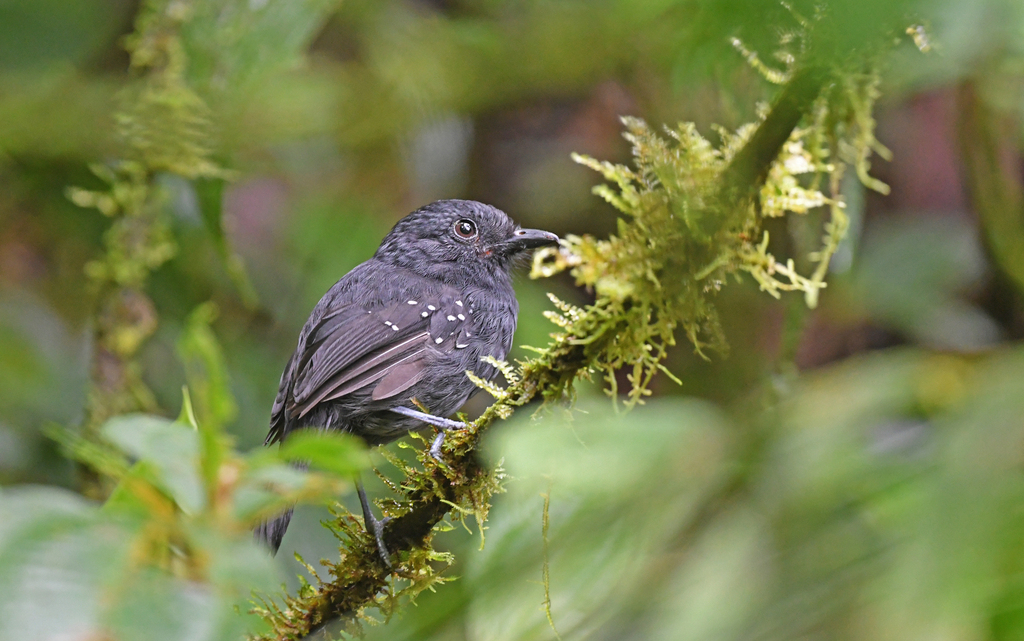
Bicolored Antvireo
Live sightings near you, the range map, bar charts of when it is seen, and Macaulay Library photos and recordings.
Bicolored Antvireo
Dysithamnus occidentalis
The bicolored antvireo (Dysithamnus occidentalis) is a Near Threatened insectivorous bird in subfamily Thamnophilinae of family Thamnophilidae, the "typical antbirds". It is found in Colombia, Ecuador, and Peru.
From the article Bicolored antvireo on Wikipedia (CC BY-SA), quoted section by section
Description
The bicolored antvireo is about 13 to 13.5 cm (5.1 to 5.3 in) long. Adult males of the nominate subspecies D. o. occidentalis have a blackish gray head, upperparts, and tail with a mostly-hidden white patch between the scapulars. Their wings are black with white dots on the greater and median coverts and mostly white lesser coverts which are mostly hidden. Their underparts are a slightly lighter blackish gray than the upperparts. Adult females have a chestnut crown and upperparts with buffy white spots on the wing coverts. Their face, throat, and breast are dark grey with thin white streaks; their belly and crissum are olive-brown. Both sexes of subspecies D. o. punctitectus are paler than the nominate and their lesser wing coverts are completely white.
Range & habitat
The bicolored antvireo has a disjunct distribution. The nominate subspecies is the more northerly of the two. It is found on the Pacific slope of the Andes from southern Antioquia Department in Colombia south into Carchi Province in extreme northern Ecuador. Subspecies D. o. punctitectus is found on the Andes' eastern slope separately in Ecuador's Napo and Morona-Santiago provinces and Peru's Amazonas and San Martín departments. The species inhabits the understorey of humid montane evergreen forest. In most areas it seems to favor natural openings such as those created by treefall and landslide. In elevation it ranges between 1,600 and 2,400 m (5,200 and 7,900 ft) in Colombia and between 2,000 and 2,500 m (6,600 and 8,200 ft) in Peru. In northern Ecuador it occurs at about 2,200 m (7,200 ft) and on the east Andean slope between 1,500 and 2,050 m (4,900 and 6,700 ft).
Wikipedia: “Distribution and habitat”
What it does
The bicolored antvireo's diet is not known in detail but is mostly insects and other arthropods. It usually forages singly or in pairs, and never as part of a mixed-species feeding flock. It typically feeds within 2 m (5 ft) of the ground. It feeds mostly by reaching or lunging from a perch to glean from leaves and twigs and also often sallies from a perch to glean.
Wikipedia: “Feeding”
Listen
Looking for field recordings…
Where it lives
Recorded sightings
—
geo-referenced records in GBIF, from museums, herbaria and field observers.
Drag the globe to turn it. Dots are where records exist, not a range map; darker means more records.
In the stacks
Searching the stacks…
Every page naming Dysithamnus occidentalis in the Biodiversity Heritage Library →
This page is assembled live from iNaturalist, GBIF, Wikipedia, the Source Library and the Internet Archive. It is not yet part of the hand-edited codex. iNaturalist taxon 15915.