On eBird ↗
Southern White-fringed Antwren
Live sightings near you, the range map, bar charts of when it is seen, and Macaulay Library photos and recordings.
Southern White-fringed Antwren
Formicivora grisea
The southern white-fringed antwren (Formicivora grisea) is an insectivorous bird in subfamily Thamnophilinae of family Thamnophilidae, the "typical antbirds". It is found in Brazil, Colombia, French Guiana, Guyana, Suriname, and Venezuela.
From the article Southern white-fringed antwren on Wikipedia (CC BY-SA), quoted section by section
Description
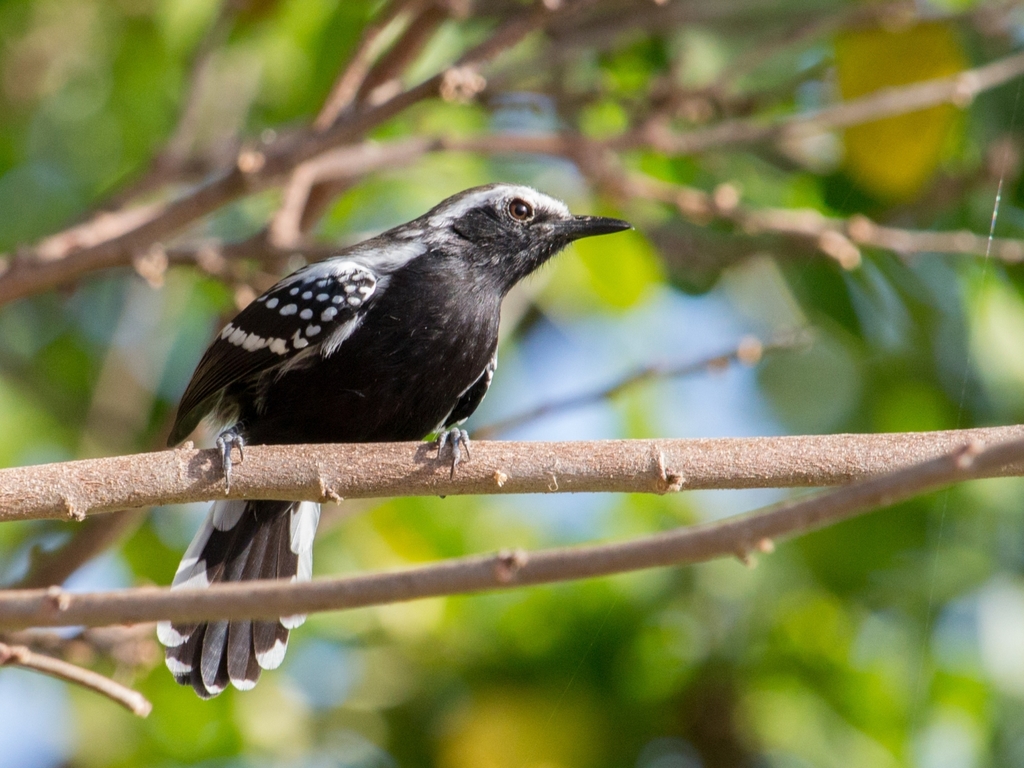
The southern white-fringed antwren is 12 to 13 cm (4.7 to 5.1 in) long and weighs 9 to 12 grams (0.32 to 0.42 oz). Adult males of the nominate subspecies have a white supercilium that extends down the neck, along the side of the breast, and widens on the flanks. Their crown and upperparts are dark grayish brown with white edges on the scapulars and a hidden white patch between them. Their wings are brownish black with white tips on the coverts. Their tail is black with white feather tips that increase in size from the central to the outer feathers. Their face, throat, and underparts are black with white underwing coverts. Adult females have a buff supercilium, browner wings, little or no patch between the scapulars, and a blackish and buff-white mottled face. Their throat and belly are light cinnamon and their breast cinnamon with a tawny tinge. Subadult males early look like adult females and gain a black throat and breast before the rest of the adult plumage. Males of subspecies F. g. rufiventris are like the nominate; females have entirely rufous underparts.
Range & habitat
The southern white-fringed antwren has a disjunct distribution. The nominate subspecies is found in northern Brazil and the Guianas and separately from there in much of Amazonian and eastern Brazil. Subspecies F. g. rufiventris is found from Meta and Caquetá departments in Colombia east into most of Venezuela's Amazonas state. The species inhabits a variety of wooded landscapes, where it favors the understorey to mid-storey at the forest's edges. Subspecies F. g. rufiventris mostly occurs in campina on white-sand soil or young secondary forest. The nominate subspecies occurs in mangroves in the Guianas, in second growth and riparian vegetation in Amazonian Brazil, in tropical deciduous forest in the interior of northeastern Brazil, and in restinga scrublands in coastal eastern Brazil. In elevation it mostly occurs below 1,000 m (3,300 ft) but reaches 1,600 m (5,200 ft) in Venezuela.
Wikipedia: “Distribution and habitat”
What it does
The southern white-fringed antwren feeds on a wide variety of insects and spiders. It typically forages singly, in pairs, or in family groups, and sometimes temporarily as part of a mixed-species feeding flock. It usually forages from the ground to about 5 m (16 ft) above it, but as high as 13 m (43 ft) in gallery and deciduous forest. It forages actively in dense vegetation, taking most prey by gleaning from live leaves, vines, branches, and stems. It sometimes makes short jumps from a perch to reach the underside of leaves and makes short sallies from a perch to capture moths in flight. There are a few records of it following army ant swarms in Amazonian Brazil.
Wikipedia: “Feeding”
Listen
Looking for field recordings…
Where it lives
Recorded sightings
—
geo-referenced records in GBIF, from museums, herbaria and field observers.
Drag the globe to turn it. Dots are where records exist, not a range map; darker means more records.
In the stacks
Searching the stacks…
Every page naming Formicivora grisea in the Biodiversity Heritage Library →
This page is assembled live from iNaturalist, GBIF, Wikipedia, the Source Library and the Internet Archive. It is not yet part of the hand-edited codex. iNaturalist taxon 15909.