On eBird ↗
Black-hooded Antwren
Live sightings near you, the range map, bar charts of when it is seen, and Macaulay Library photos and recordings.
Black-hooded Antwren
Formicivora erythronotos
The black-hooded antwren (Formicivora erythronotos) is a species of bird in the family Thamnophilidae, the antbirds. It is endemic to Brazil, where it is known only from the vicinity of Ilha Grande Bay in the southern part of the state of Rio de Janeiro. It was collected and then not seen for 100 years until it was rediscovered in 1987. It is now known from seven sites. Its range is small and its habitat is fragmented.
From the article Black-hooded antwren on Wikipedia (CC BY-SA), quoted section by section
Description
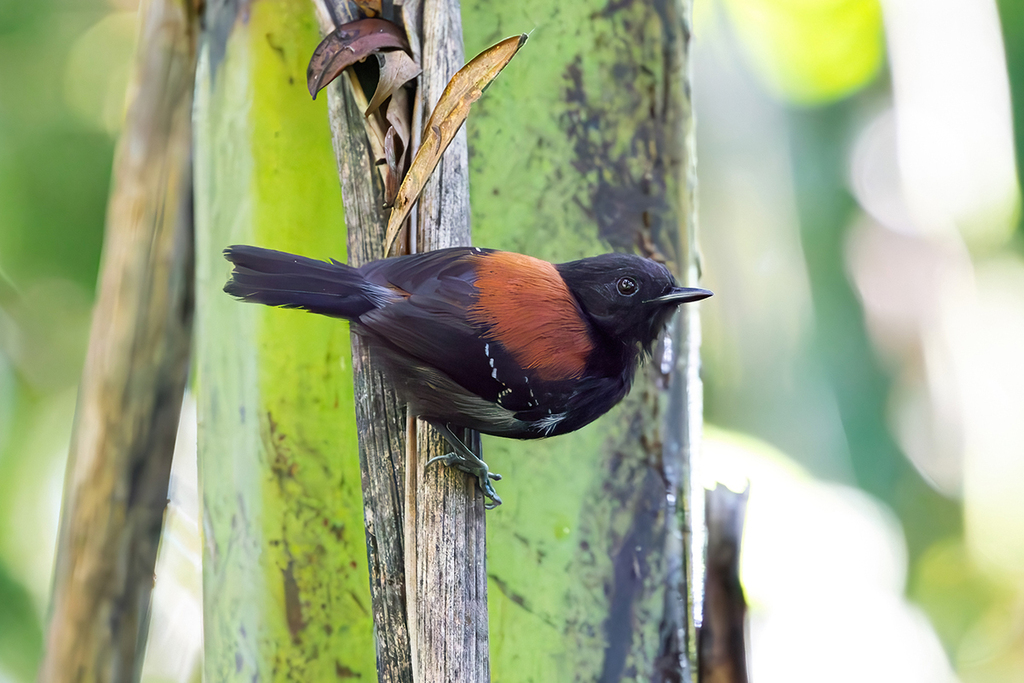
The black-hooded antwren is 11 cm (4.3 in) long. Adult males have a deep rufous back, rump, and uppertail coverts. They are otherwise almost entirely black, with white tips on the wing coverts and white flanks. The center of their throat and breast are black, their flanks white, and their undertail coverts have white bars. Adult females also have deep rufous upperparts. They are mostly olive-brown otherwise, which color is paler and buffier on their underparts. Their wings and tail are blackish with white tips on the coverts. They have variable amounts of thin dark streaks or mottling on their head and throat. Adults have a slim black bill.
Range & habitat
The black-hooded antwren was known from about 20 specimens collected in the 19th century but was not seen for more than 100 years until it was rediscovered in 1987. It was thought to occur somewhat inland near Nova Friburgo but records there are apparently erroneous. It is now found in several subpopulations along the coast of Baía da Ilha Grande in Rio de Janeiro state. There it typically inhabits areas in the early stages of succession such as young second growth and secondary forest. It also occurs in abandoned banana plantations that are reverting to forest.
Wikipedia: “Distribution and habitat”
What it does
The diet of the black-hooded antwren is not known in detail but includes insects, spiders, and small frogs. It typically forages singly, in pairs, or in family groups, and only seldom if ever as part of a mixed-species feeding flock. It usually forages between the ground and about 3 m (10 ft) above it but occasionally feeds as high as 7 m (23 ft). It forages actively, taking most prey by gleaning from live leaves, vines, branches, and stems. It sometimes makes short sallies from a perch to reach the underside of leaves. It is not known to follow army ant swarms.
Wikipedia: “Feeding”
Listen
Looking for field recordings…
Where it lives
Recorded sightings
—
geo-referenced records in GBIF, from museums, herbaria and field observers.
Drag the globe to turn it. Dots are where records exist, not a range map; darker means more records.
In the stacks
Searching the stacks…
Every page naming Formicivora erythronotos in the Biodiversity Heritage Library →
This page is assembled live from iNaturalist, GBIF, Wikipedia, the Source Library and the Internet Archive. It is not yet part of the hand-edited codex. iNaturalist taxon 15907.