On eBird ↗
Serra Antwren
Live sightings near you, the range map, bar charts of when it is seen, and Macaulay Library photos and recordings.
Serra Antwren
Formicivora serrana
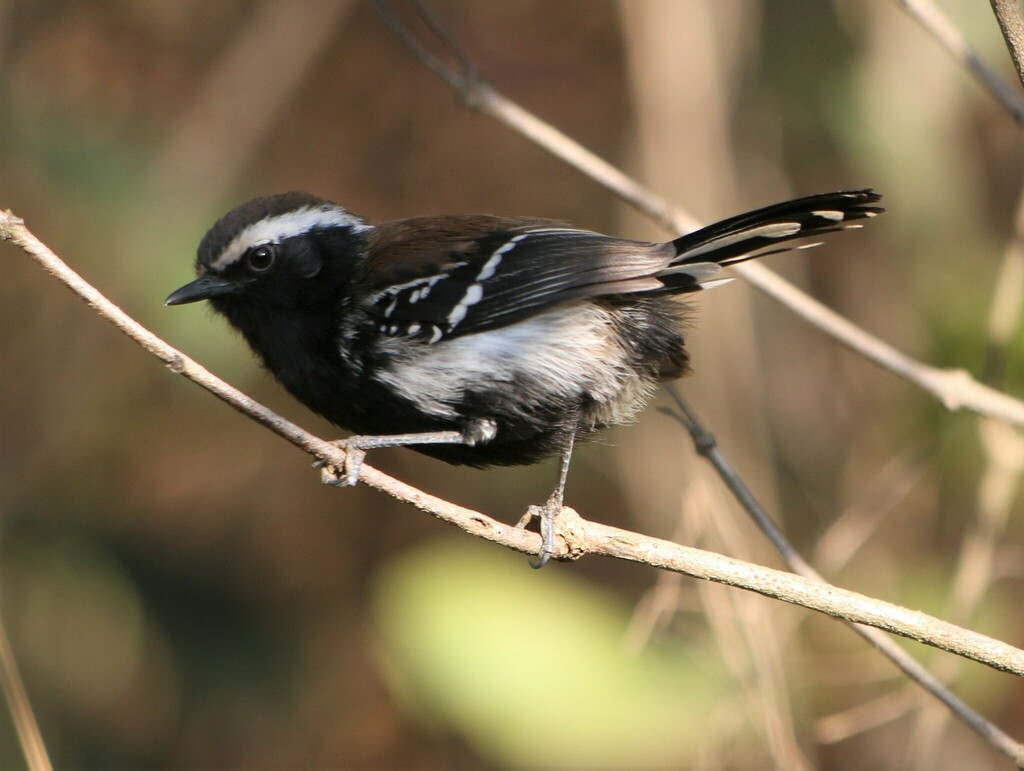
The serra antwren (Formicivora serrana) is a species of bird in the family Thamnophilidae. It is endemic to Rio de Janeiro, Espírito Santo and Minas Gerais in southeastern Brazil. It includes two subspecies: nominate and interposita. The latter closely resembles the restinga antwren, and recent morphological and vocal analysis suggests the restinga antwren should be included in the serra antwren.
From the article Serra antwren on Wikipedia (CC BY-SA), quoted section by section
Description
Antwrens in the genus Formicivora have comparatively long tails, and the males are unusual in having underparts that are darker than the upperparts. The serra antwren is 12 to 14 cm (4.7 to 5.5 in) long and weighs 10 to 13 g (0.35 to 0.46 oz). Adult males of the nominate subspecies F. s. serrana have a white supercilium that extends down the neck, along the side of the breast, and widens and grays on the flanks. Their crown and upperparts are rufous-brown with white edges on the outer scapulars and a hidden white patch between them. Their wings are brownish black with white tips on the coverts, blackish bases on the flight feathers, and cinnamon-brown edges on the tertials. Their tail is black with white feather tips that increase in size from the central to the outer feathers. Their face, throat, and underparts are black with white underwing coverts. Adult females have a wide black band through the eye and their underparts are entirely creamy white. Males of subspecies F. s. interposita and F. s. littoralis differ significantly from nominate males. Males of F. s. interposita have very dark brown to black upperparts, with a narrow and broken white supercilium, very small white tips on the wing coverts, and no white on the underparts. Males of F. s. …
Range & habitat
The subspecies of the serra antwren are found thus:
F. s. serrana: eastern Minas Gerais to central Espírito Santo (but see below) F. s. interposita: Paraíba do Sul valley in far southeastern Minas Gerais and northwestern Rio de Janeiro state F. s. littoralis: separately from the other two subspecies in coastal Rio de Janeiro state including nearshore islands A 2011 survey collected individuals of F. s. serrana in northern Espírito Santo, extending that subspecies' range some 200 km (120 mi) farther north than previously known. Whether these birds represent a separate population or are part of a somewhat continuous distribution wherever suitable habitat exists is unclear. Subspecies F. s. serrana and F. s. interposita inhabit the understorey at the edges of semi-humid evergreen forest, secondary woodland, and drier scrublands. F. s. serrana especially favors stunted forest on poor rocky soils up to 1,550 m (5,100 ft) above sea level. F. s. interposita especially favors secondary woodland near the Paraíba do Sul and in nearby foothills; it reaches only 700 m (2,300 ft) in elevation. Both subspecies have colonized Eucalyptus plantations in Minas Gerais. Subspecies F. s. littoralis occurs only in restinga, a biome on the sandy coastal plain characterized by dense scrub, cacti, and bromeliads.
Wikipedia: “Distribution and habitat”
What it does
The serra antwren's diet has not been detailed but is assumed to include insects, spiders, and other small arthropods. Subspecies F. s. serrana and F. s. interposita typically forage singly, in pairs, or in family groups, and sometimes as part of a mixed-species feeding flock. They usually forage about 1 to 2 m (3 to 7 ft) above the ground, but will feed on the ground and as high as 4 m (13 ft) above it. They forage actively in dense vegetation, taking most prey by gleaning while perched from live leaves, vines, branches, and stems. They sometimes make short jumps from a perch to reach the underside of leaves. The foraging behavior of F. s. littoralis is little known; it does glean prey while perched.
Wikipedia: “Feeding”
Listen
Looking for field recordings…
Where it lives
Recorded sightings
—
geo-referenced records in GBIF, from museums, herbaria and field observers.
Drag the globe to turn it. Dots are where records exist, not a range map; darker means more records.
In the stacks
Searching the stacks…
Every page naming Formicivora serrana in the Biodiversity Heritage Library →
This page is assembled live from iNaturalist, GBIF, Wikipedia, the Source Library and the Internet Archive. It is not yet part of the hand-edited codex. iNaturalist taxon 15905.