On eBird ↗
Narrow-billed Antwren
Live sightings near you, the range map, bar charts of when it is seen, and Macaulay Library photos and recordings.
Narrow-billed Antwren
Formicivora iheringi
The narrow-billed antwren (Formicivora iheringi) is a species of bird in the family Thamnophilidae. It is endemic to eastern Brazil where it occurs in Bahia and Minas Gerais states. Its natural habitat is deciduous and semi-deciduous forest between 250 and 1,050 metres above sea level. It is threatened by habitat loss. The narrow-billed antwren is sometimes put in the monotypic genus Neorhopias.
From the article Narrow-billed antwren on Wikipedia (CC BY-SA), quoted section by section
Description
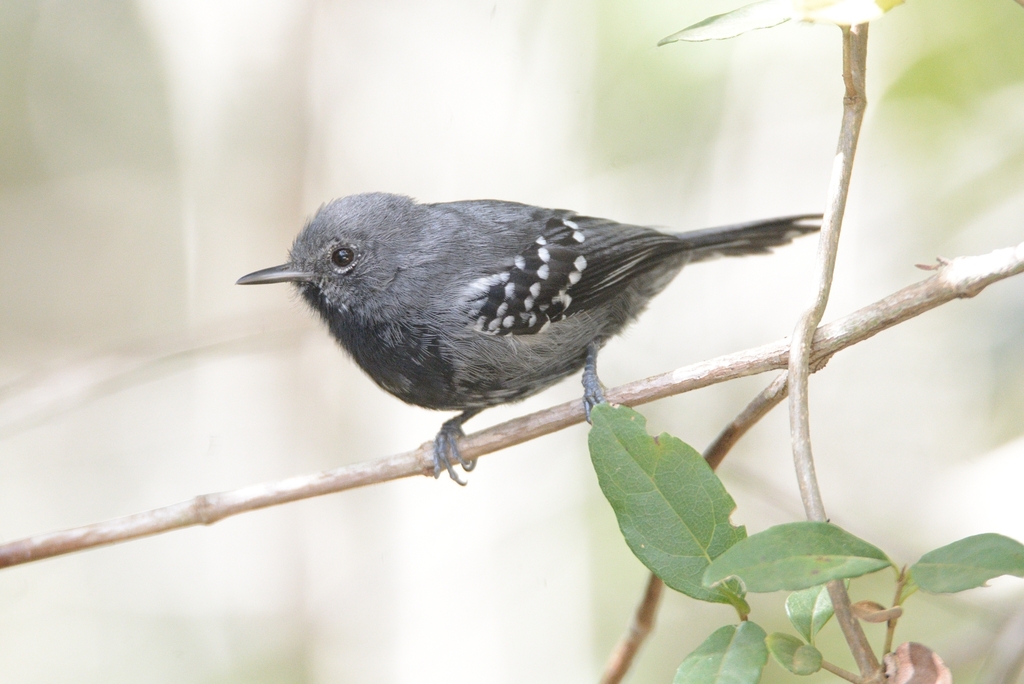
The narrow-billed antwren is 11 to 12 cm (4.3 to 4.7 in) long; one male weighed 8.2 g (0.29 oz). The species is sexually dimorphic and has a longish bill and tail. Adult males are mostly dark gray. Their wings and tail are a darker blackish gray, with white tips on the wing coverts and the outer tail feathers. The center of their throat and breast are black, their flanks white, and their undertail coverts have white bars. Adult females have a pale supercilium and a whitish eye ring. They have olive-brown upperparts with a grayer crown; the olive-brown becomes reddish yellow-brown on the uppertail coverts. Their wings are brown with pale cinnamon edges on the coverts and reddish edges on the flight feathers. Their tail is reddish brown. Their underparts are mostly yellow-ochre that is nearly whitish in the center of the belly; their flanks have some white.
Range & habitat
The narrow-billed antwren has a disjunct distribution inland from the coast in the eastern Brazilian states of Bahia and Minas Gerais. It inhabits the understorey to mid-storey of deciduous forest. In part of Bahia it also occurs in mata-de-cipó, a biome characterized by a relatively open understorey and a few large emergent trees above a dense mid-storey. In elevation it ranges between 250 and 1,100 m (800 and 3,600 ft).
Wikipedia: “Distribution and habitat”
What it does
The diet of the narrow-billed antwren is not known in detail but includes insects and probably spiders. It typically forages singly, in pairs, or in family groups, and sometimes as part of a mixed-species feeding flock. It usually forages between about 1.5 and 8 m (5 and 26 ft) of the ground but occasionally on the ground and as high as 12 m (39 ft). It forages actively but methodically, picking at stems and limbs in woody vine tangles and on somewhat open branches while hitching along them. It also takes prey by gleaning from live leaves, clusters of dead leaves, and clumps of moss while perched, and sometimes makes short sallies from a perch to capture moths in flight.
Wikipedia: “Feeding”
Listen
Looking for field recordings…
Where it lives
Recorded sightings
—
geo-referenced records in GBIF, from museums, herbaria and field observers.
Drag the globe to turn it. Dots are where records exist, not a range map; darker means more records.
In the stacks
Searching the stacks…
Every page naming Formicivora iheringi in the Biodiversity Heritage Library →
This page is assembled live from iNaturalist, GBIF, Wikipedia, the Source Library and the Internet Archive. It is not yet part of the hand-edited codex. iNaturalist taxon 15904.