On eBird ↗
Band-tailed Antbird
Live sightings near you, the range map, bar charts of when it is seen, and Macaulay Library photos and recordings.
Band-tailed Antbird
Hypocnemoides maculicauda
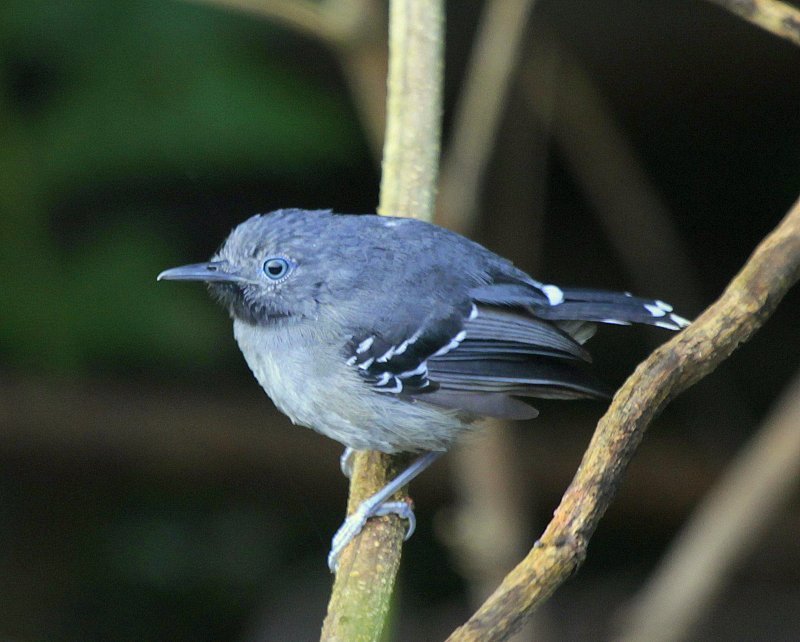
The band-tailed antbird (Hypocnemoides maculicauda) is a species of bird in the family Thamnophilidae. It is found in the Amazon Basin south of the river Amazon (Bolivia, Brazil and Peru). Its natural habitat is subtropical or tropical swamps and flooded forests.
From the article Band-tailed antbird on Wikipedia (CC BY-SA), quoted section by section
Description
The band-tailed antbird is about 12 cm (4.7 in) long and weighs 11.5 to 14.5 g (0.41 to 0.51 oz). Adult males have leaden gray upperparts with a large but usually hidden white patch between their scapulars. Their tail is slate gray with wide white feather tips. Their flight feathers are leaden gray with lighter gray edges and their wing coverts are black with gray and white edges. Their throat is black. Their underparts are mostly a paler gray than their upperparts and with a white belly. Adult females have the same leaden upperparts as males. Their throat and most of their underparts are white. Their breast feathers have gray edges. Their sides are gray and the sides of their breast and belly have a very slight buff tinge. Both sexes have a gray iris and blue-gray legs and feet. Males have a black bill; females have a black maxilla and a gray mandible.
Range & habitat
Most sources place the band-tailed antbird in the Amazon Basin from eastern Peru east through northern Bolivia and central Brazil to the Atlantic, all south of the Amazon River. However, the South American Classification Committee of the American Ornithological Society includes Colombia in the species' range on the basis of a 2020 publication. Xeno-canto has a single song recording from 2022 in extreme southern Colombia. The band-tailed antbird inhabits lowland evergreen forest, almost always in várzea forest along larger rivers, along smaller watercourses, and along the edges of lakes. It favors low vegetation that overhangs water.
Wikipedia: “Distribution and habitat”
What it does
The band-tailed antbird's diet has not been detailed but is known to be mostly insects. Pairs and family groups forage mostly on the ground and up to about 4 m (13 ft) above it, and almost always near or even over water. They actively hop on the ground and through vine tangles and brush. They capture prey by gleaning and reaching and with short sallies from a perch. They occasionally attend army ant swarms.
Wikipedia: “Feeding”
Listen
Looking for field recordings…
Where it lives
Recorded sightings
—
geo-referenced records in GBIF, from museums, herbaria and field observers.
Drag the globe to turn it. Dots are where records exist, not a range map; darker means more records.
In the stacks
Searching the stacks…
Every page naming Hypocnemoides maculicauda in the Biodiversity Heritage Library →
This page is assembled live from iNaturalist, GBIF, Wikipedia, the Source Library and the Internet Archive. It is not yet part of the hand-edited codex. iNaturalist taxon 15899.