On eBird ↗
Orange-bellied Antwren
Live sightings near you, the range map, bar charts of when it is seen, and Macaulay Library photos and recordings.
Orange-bellied Antwren
Terenura sicki
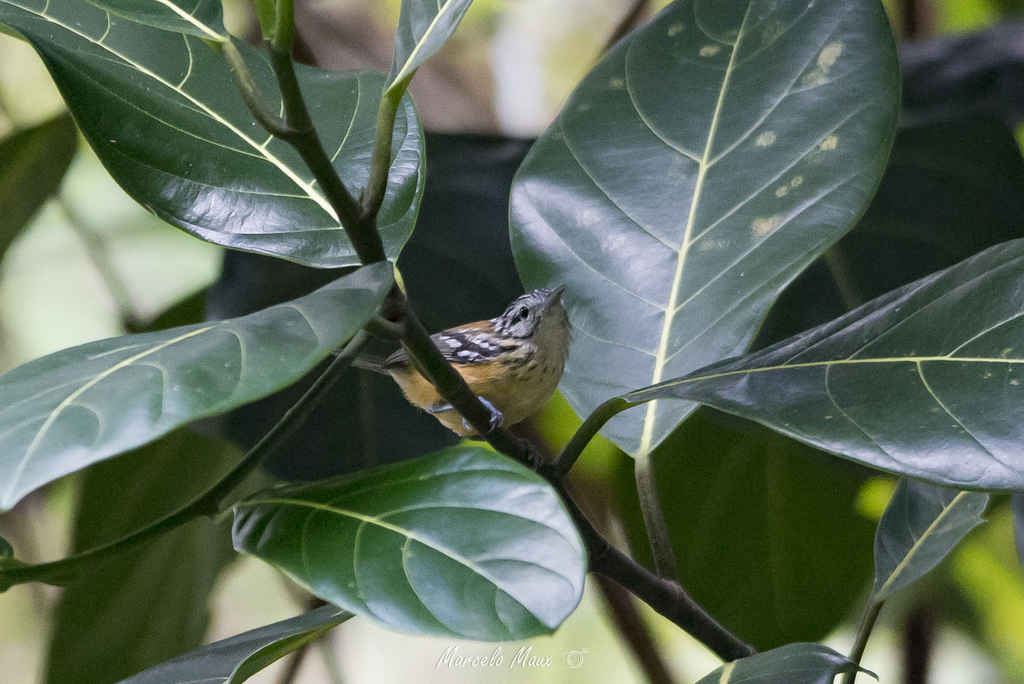
The orange-bellied antwren (Terenura sicki) or Sick's antwren, is a Critically Endangered species of bird in subfamily Thamnophilinae of family Thamnophilidae, the "typical antbirds". It is endemic to Brazil.
From the article Orange-bellied antwren on Wikipedia (CC BY-SA), quoted section by section
Description
The orange-bellied antwren is 9.5 to 10.5 cm (3.74 to 4.13 in) long and weighs 6.5 to 7 g (0.23 to 0.25 oz). Adult males' crown, nape, and upper back are streaked black and white. The rest of their upperparts are black with a few white streaks; they have a hidden white patch between the shoulders. Their wings are black with pale edges on the flight feathers and wide white tips on the coverts. Their tail is blackish. Their throat and underparts are white. Adult females have a rufous back and rump and orange underparts. The white streaks on their head have a pale buff tinge.
Range & habitat
The orange-bellied antwren has a disjunct distribution in the northeastern Brazilian states of Pernambuco and Alagoas. It inhabits the subcanopy and canopy of semi-humid evergreen forest. In elevation it mostly ranges between 200 and 700 m (660 and 2,300 ft) but occurs as low as 100 metres (330 ft).
Wikipedia: “Distribution and habitat”
What it does
The orange-bellied antwren's diet is not known in detail but is mostly insects and probably includes spiders. It forages singly, in pairs, or in family groups, and often though not habitually as part of a mixed-species feeding flock. It feeds mostly between about 7 and 20 m (20 and 70 ft) above the ground though sometimes as low as 5 m (20 ft). It actively and restlessly gleans its prey in dense vegetation, mostly in vine tangles. It typically gleans while perched or with short lunges. It sometimes makes short sallies to hover-glean. It is not known to follow army ant swarms.
Wikipedia: “Feeding”
Listen
Looking for field recordings…
Where it lives
Recorded sightings
—
geo-referenced records in GBIF, from museums, herbaria and field observers.
Drag the globe to turn it. Dots are where records exist, not a range map; darker means more records.
In the stacks
Searching the stacks…
Every page naming Terenura sicki in the Biodiversity Heritage Library →
This page is assembled live from iNaturalist, GBIF, Wikipedia, the Source Library and the Internet Archive. It is not yet part of the hand-edited codex. iNaturalist taxon 15872.