On eBird ↗
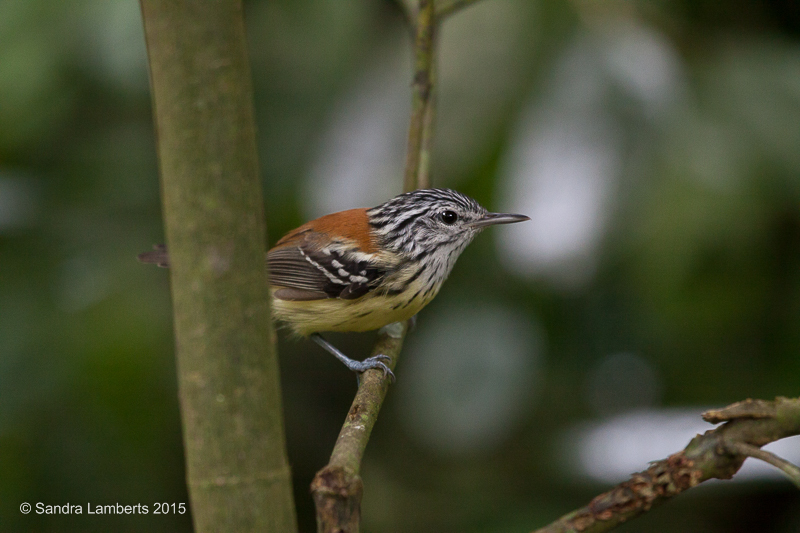
Streak-capped Antwren
Live sightings near you, the range map, bar charts of when it is seen, and Macaulay Library photos and recordings.
Streak-capped Antwren
Terenura maculata
The streak-capped antwren (Terenura maculata) is a species of bird in subfamily Thamnophilinae of family Thamnophilidae, the "typical antbirds". It is found in Argentina, Brazil, and Paraguay.
From the article Streak-capped antwren on Wikipedia (CC BY-SA), quoted section by section
Description
The streak-capped antwren is 9 to 10 cm (3.5 to 3.9 in) long; one individual weighed 6.5 g (0.23 oz). Adult males' crown, nape, and upper back are streaked black and white. The rest of their upperparts are tawny to chestnut with some yellow mixed in on the rump; they have a hidden white patch between the shoulders. Their wings are black with pale yellow edges on the flight feathers (tawny on the tertials) and white tips on the coverts. Their tail is olive-gray. Their throat and upper breast are white with black streaks, their lower breast yellow with black streaks, and their belly and undertail coverts unstreaked yellow. Adult females are much like males, though paler overall. The white streaks on their head and nape have a pale buff tinge and the streaking on their underparts is less distinct than the male's.
Range & habitat
The streak-capped antwren is a bird of the southern Atlantic Forest. It is found coastally in Brazil from Bahia to Santa Catarina and inland in Minas Gerais, São Paulo, and Paraná. Its range continues into eastern Paraguay between Canindeyú and Caazapá departments, and also extreme northeastern Argentina's Misiones Province. It inhabits evergreen forest and secondary woodland; it is found in the forest's mid-storey and canopy. In elevation it ranges from sea level to 1,250 m (4,100 ft).
Wikipedia: “Distribution and habitat”
What it does
The streak-capped antwren's diet is not known in detail but is mostly insects and probably includes spiders. It usually forages in pairs, though also singly or in family groups, and often though not habitually as part of a mixed-species feeding flock. It feeds mostly from about 6 m (20 ft) above the ground to the canopy though sometimes goes all the way to the ground. It actively and restlessly gleans its prey in dense vegetation, from leaves, vine tangles, and mats of vegetation in bamboo stands. It gleans mostly while perched or with short lunges. It sometimes makes short sallies to hover-glean. It is not known to follow army ant swarms.
Wikipedia: “Feeding”
Listen
Looking for field recordings…
Where it lives
Recorded sightings
—
geo-referenced records in GBIF, from museums, herbaria and field observers.
Drag the globe to turn it. Dots are where records exist, not a range map; darker means more records.
In the stacks
Searching the stacks…
Every page naming Terenura maculata in the Biodiversity Heritage Library →
This page is assembled live from iNaturalist, GBIF, Wikipedia, the Source Library and the Internet Archive. It is not yet part of the hand-edited codex. iNaturalist taxon 15870.