On eBird ↗
Rufous-tailed Antbird
Live sightings near you, the range map, bar charts of when it is seen, and Macaulay Library photos and recordings.
Rufous-tailed Antbird
Drymophila genei
The rufous-tailed antbird (Drymophila genei) is a species of bird in subfamily Thamnophilinae of family Thamnophilidae, the "typical antbirds". It is endemic to Brazil.
From the article Rufous-tailed antbird on Wikipedia (CC BY-SA), quoted section by section
Description
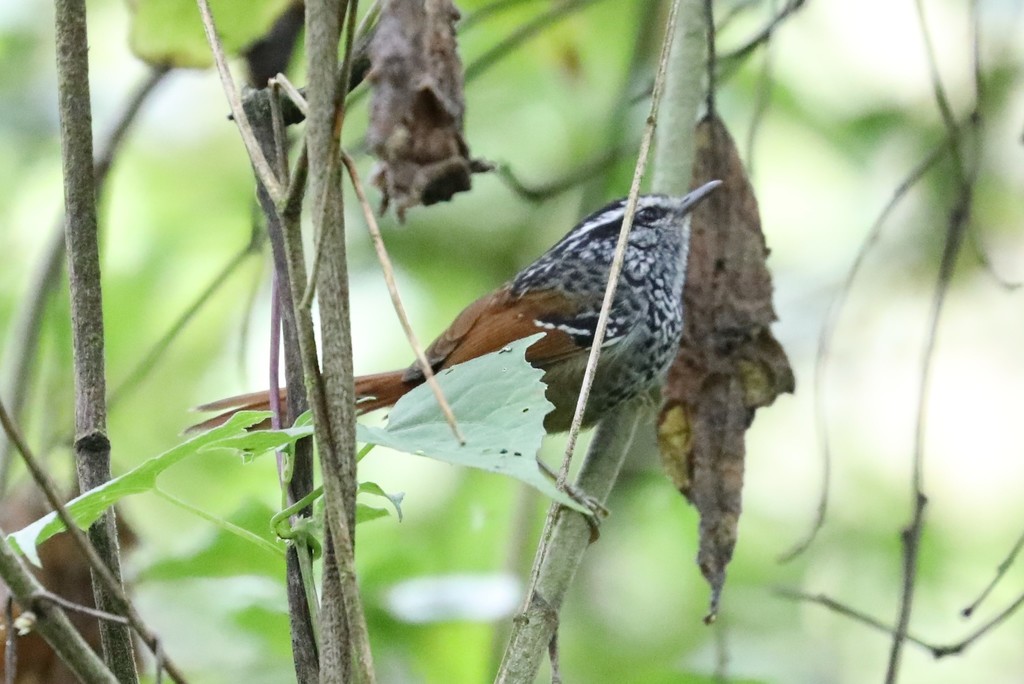
The rufous-tailed antbird is 13 to 14 cm (5.1 to 5.5 in) long. Adult males have a black crown, a white supercilium, a black band through the eye, and white cheeks with black speckles. Their back is olive-brown with black spots and a white patch between the scapulars. Their rump and tail are rufous. Their flight feathers are rufous and wing coverts black with white tips. Their throat and breast are white with black spots that are larger on the latter. Their flanks and crissum are plain rufous-brown. Females have a rufous-brown crown and nape with blackish streaks. They have a whitish supercilium, a dark brown line through the eye, and buff cheeks. Their upperparts, wings, and tail are similar to the male's but without black spots and the interscapular patch. Their throat and underparts are buff with some faint dark marks on the throat and breast.
Range & habitat
The rufous-tailed antbird has a disjunct distribution in southeastern Brazil, in southeastern Minas Gerais, southern Espírito Santo, northeastern São Paulo and Rio de Janeiro. It primarily inhabits bamboo stands in montane evergreen forest though it also occurs in adjoining viny plots and other dense foliage. In elevation it mostly occurs between 1,150 and 2,200 m (3,800 and 7,200 ft) though it is found as low as 800 m (2,600 ft).
Wikipedia: “Distribution and habitat”
What it does
The rufous-tailed antbird feeds mostly on a wide variety of arthropods. It typically forages individually, in pairs, and in family groups, usually within about 3 m (10 ft) of the ground and rarely as high as 7 m (25 ft). It sometimes joins mixed-species feeding flocks that pass through its territory and rarely follows army ant swarms. It gleans prey from leaves both live and dead, vines, and stems by reaching and lunging from a perch.
Wikipedia: “Feeding”
Listen
Looking for field recordings…
Where it lives
Recorded sightings
—
geo-referenced records in GBIF, from museums, herbaria and field observers.
Drag the globe to turn it. Dots are where records exist, not a range map; darker means more records.
In the stacks
Searching the stacks…
Every page naming Drymophila genei in the Biodiversity Heritage Library →
This page is assembled live from iNaturalist, GBIF, Wikipedia, the Source Library and the Internet Archive. It is not yet part of the hand-edited codex. iNaturalist taxon 15860.