On eBird ↗
Salvadori's Antwren
Live sightings near you, the range map, bar charts of when it is seen, and Macaulay Library photos and recordings.
Salvadori's Antwren
Myrmotherula minor
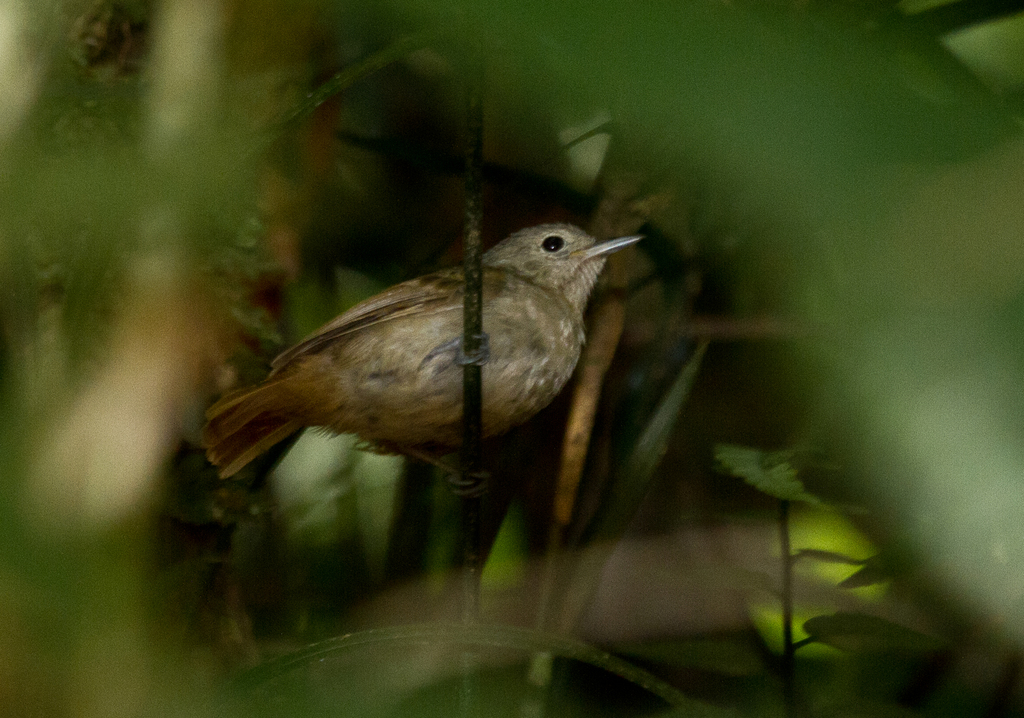
Salvadori's antwren (Myrmotherula minor) is a species of bird in subfamily Thamnophilinae of family Thamnophilidae, the "typical antbirds". It is endemic to Brazil.
From the article Salvadori's antwren on Wikipedia (CC BY-SA), quoted section by section
Description
Salvadori's antwren is about 9 cm (3.5 in) long. It is a smallish bird with a short tail. Adult males are mostly gray that is lighter on the underparts. Their tail is gray with a black band near the end and white tips on the feathers. Their wings are gray with white-tipped blackish coverts. Their throat and the center of the upper breast are black; their crissum has blackish bars. Adult females have a gray head and olive-brown upperparts. Their tail and wings are dull rufous-brown; the tail feathers have russet edges and the wing coverts thin buff edges. Their throat is dingy white and the rest of their underparts deep buff that is deepest on the flanks and crissum. Subadult males lack the adult's black band on the tail.
Range & habitat
Salvadori's antwren is a bird of the Atlantic Forest. It found very spottily and locally in coastal eastern Brazil between Bahia and extreme northeastern Santa Catarina. It inhabits the understorey to mid-storey of evergreen forest and adjacent mature secondary forest in the lowlands and foothills. It favors the forest interior and usually occurs near running water. In elevation it mostly occurs below 500 m (1,600 ft) but is found as high as 900 m (3,000 ft).
Wikipedia: “Distribution and habitat”
What it does
The diet of Salvadori's antwren's diet is not known in detail but is probably mostly insects and spiders. It forages singly, in pairs, or in family groups, and usually as part of a mixed-species feeding flock. It typically forages around the crown and perimeter of trees with medium-size to large leaves. It feeds mostly between about 4 and 8 m (10 and 30 ft) above the ground but will go as low as 1 m (3 ft) and as high as 12 m (40 ft). It seeks prey mostly by gleaning live leaves, and also takes prey from clusters of dead leaves, moss, and hanging Usnea lichen.
Wikipedia: “Feeding”
Listen
Looking for field recordings…
Where it lives
Recorded sightings
—
geo-referenced records in GBIF, from museums, herbaria and field observers.
Drag the globe to turn it. Dots are where records exist, not a range map; darker means more records.
In the stacks
Searching the stacks…
Every page naming Myrmotherula minor in the Biodiversity Heritage Library →
This page is assembled live from iNaturalist, GBIF, Wikipedia, the Source Library and the Internet Archive. It is not yet part of the hand-edited codex. iNaturalist taxon 15840.