- Plants
- ›Vascular Plants
- ›flowering plants
- ›monocots
- ›Agaves, Orchids, Irises, and Allies
- ›agave and allies
- ›Century plant subfamily
- ›Agave
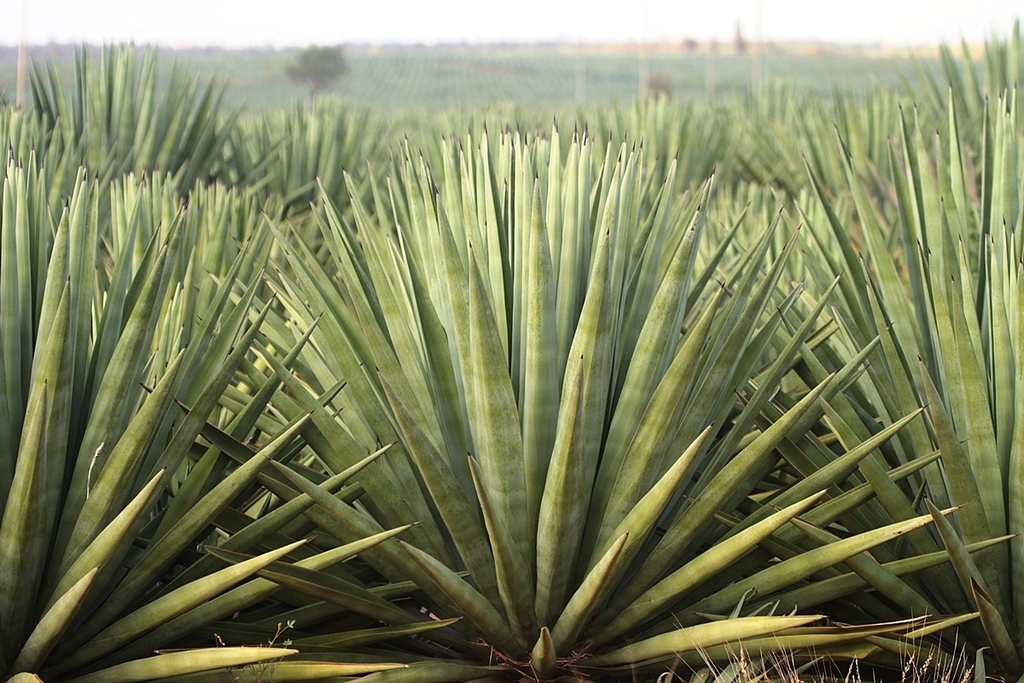
sisal
Agave sisalana
Sisal (, Spanish: [siˈsal]; Agave sisalana) is a species of flowering plant native to southern Mexico, but widely cultivated and naturalized in many other countries. It yields a stiff leaf fiber used in making rope and various other products. The sisal fiber is traditionally used for rope and twine, and has many other uses, including cloth, footwear, hats, bags, carpets, geotextiles, and dartboards. It is also used as fiber reinforcements for composite fiberglass, rubber, and concrete products. Like other agaves, the pith of the leaves can be fermented and distilled to make mezcal.
Sisal has an uncertain native origin, but is thought to have originated in the Mexican state of Chiapas. Historically, sisal was used by the Aztecs and Maya for a crude fabric. It spread to other parts of the world in the 19th century, with Brazil becoming the major producer. Global sisal production in 2020 was 210,000 tons, with Brazil being the largest producer, followed by Tanzania, Kenya, Madagascar, China, and Mexico.
From the article Sisal on Wikipedia (CC BY-SA), quoted section by section
At the table
Traditionally, sisal has been the leading material for agricultural twine (binder twine and baler twine) because of its strength, durability, ability to stretch, affinity for certain dyestuffs, and resistance to deterioration in saltwater. The importance of this traditional use is diminishing with competition from polypropylene and the development of other haymaking techniques, while new higher-valued sisal products have been developed. Apart from ropes, twines, and general cordage, sisal is used in low-cost and specialty paper, dartboards, buffing cloth, filters, geotextiles, mattresses, carpets, handicrafts, wire rope cores, and macramé. Sisal has been used as an environmentally friendly strengthening agent to replace asbestos and fiberglass in composite materials in various uses, including the automobile industry. The lower-grade fiber is processed by the paper industry because of its high content of cellulose and hemicelluloses. The medium-grade fiber is used in the cordage industry for making ropes and baler and binder twine. Ropes and twines are widely employed for marine, agricultural, and general industrial use. The higher-grade fiber after treatment is converted into yarns and used by the carpet industry. Other products developed from sisal fiber include spa products, cat-scratching posts, lumbar support belts, rugs, slippers, cloths, and disc buffers. …
Wikipedia: “Uses”
How it is grown
Sisal was used by the Aztecs and the Maya to make a fabric. In the 19th century, sisal cultivation spread to Florida, the Caribbean islands, and Brazil (Paraiba and Bahia), as well as to countries in Africa, notably Tanzania and Kenya, and Asia. Sisal reportedly "came to Africa from Florida, through the mechanism of a remarkable German botanist, by the name of Hindorf." In Cuba its cultivation was introduced in 1880 by Fernando Heydrich in Matanzas. The first commercial plantings in Brazil were made in the late 1930s, and the first sisal fiber exports from there were made in 1948. Brazilian production did not accelerate until the 1960s, and the first of many spinning mills was established. Today, Brazil is the major world producer of sisal.
Propagation. Propagation of sisal is generally by using bulbils produced from buds in the flower stalk or by suckers growing around the base of the plant, which are grown in nursery fields until large enough to be transplanted to their final positions. These methods offer no potential for genetic improvement. In vitro multiplication of selected genetic material using meristematic tissue culture offers considerable potential for the development of improved genetic material.
Fiber extraction. …
Wikipedia: “Cultivation”
Where it lives
Recorded sightings
—
geo-referenced records in GBIF, from museums, herbaria and field observers.
Drag the globe to turn it. Dots are where records exist, not a range map; darker means more records.
In the stacks
Searching the stacks…
Every page naming Agave sisalana in the Biodiversity Heritage Library →
This page is assembled live from iNaturalist, GBIF, Wikipedia, the Source Library and the Internet Archive. It is not yet part of the hand-edited codex. iNaturalist taxon 158103.