On eBird ↗
Northern Slaty-Antshrike
Live sightings near you, the range map, bar charts of when it is seen, and Macaulay Library photos and recordings.
Northern Slaty-Antshrike
Thamnophilus punctatus
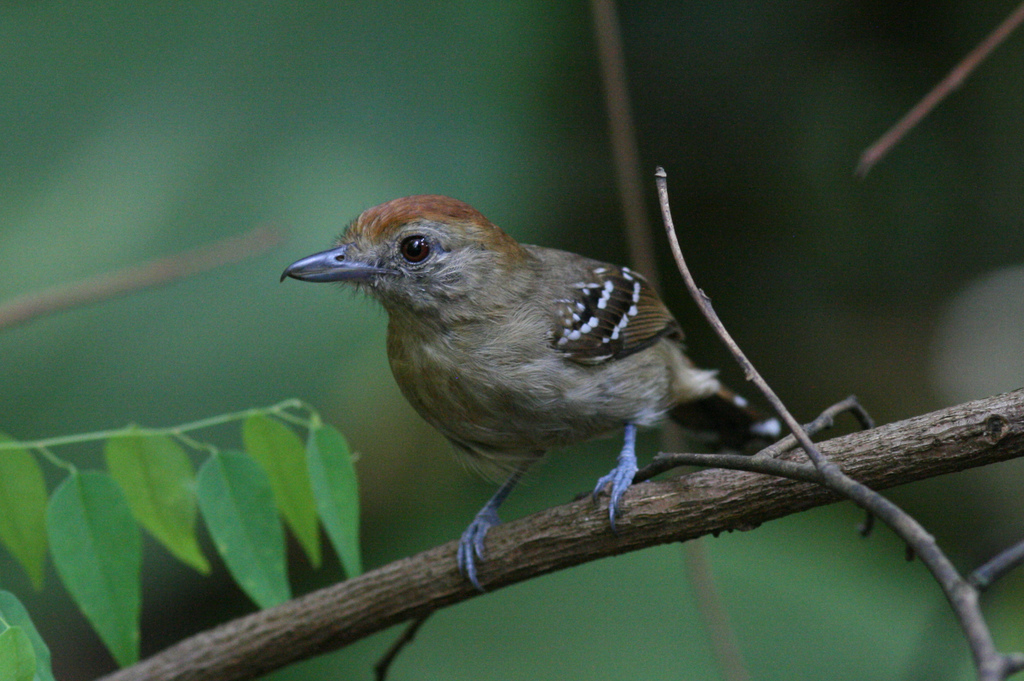
The northern slaty antshrike (Thamnophilus punctatus) is a species of bird in the family Thamnophilidae. It previously included the Natterer's slaty antshrike, Bolivian slaty antshrike, Planalto slaty antshrike and Sooretama slaty antshrike as subspecies, in which case the combined species simply was referred to as the slaty antshrike.
From the article Northern slaty antshrike on Wikipedia (CC BY-SA), quoted section by section
Description
The northern slaty antshrike is 13 to 15 cm (5.1 to 5.9 in) long and weighs 16 to 18 g (0.56 to 0.63 oz). Members of genus Thamnophilus are largish members of the antbird family; all have stout bills with a hook like those of true shrikes. This species exhibits significant sexual dimorphism. Adult males of the nominate subspecies T. p. punctatus have a gray forehead and a black crown. Their back is gray with a few black feather tips and a hidden white patch between their scapulars. Their face is gray. Their wings and wing coverts are black with white spots and edges. Their tail is black with white spots and tips on the outer feathers. Their underparts are slaty gray with sometimes a whitish belly. Adult females have a tawny crown and yellowish olive-brown upperparts. Their wings are dark brown with white spots on the coverts and pale buff edges on the flight feathers. Their tail is reddish yellow-brown with white spots and tips on the outer feathers. Their underparts are light buffy olive that is whiter on the throat and belly. Males of subspecies T. p. interpositus have a black forehead, crown, and upperparts and dark gray underparts. Females are a darker clay color than the nominate. Males of subspecies T. p. …
Range & habitat
The northern slaty antshrike has a disjunct distribution: Each subspecies has a separate range. The nominate subspecies T. p. punctatus has by far the largest range. It is found from eastern and southern Venezuela east across the Guianas and Brazil east of the Negro River and north of the Amazon to the Atlantic in Pará and Amapá states. There are also sight records from extreme eastern Colombia that are attributed to punctatus. Subspecies T. p. interpositus is found on the east side of the Andes from western Venezuela south into Colombia as far as Caquetá Department. T. p. leucogaster is found in the watersheds of the Marañón River and its tributary Chinchipe River in far southern Ecuador's Zamora-Chinchipe Province and northern Peru's departments of Cajamarca and Amazonas. T. p. huallagae is found only in the Huallaga River watershed in northern Peru's Department of San Martín. The northern slaty antshrike inhabits a variety of forested and wooded landscapes, where it favors the understorey to mid-storey. In Brazil and the Guianas it occurs in forest on white-sand soil, semi-open woodlands, and older secondary forest from sea level to 1,000 m (3,300 ft). In Colombia it favors the edges of several forest and woodland types below 600 m (2,000 ft). In Ecuador and Peru it occurs in dryish deciduous woodland, in Ecuador at about 650 m (2,100 ft) and Peru up to 1,200 m (3,900 ft). …
Wikipedia: “Distribution and habitat”
What it does
The northern slaty antshrike's diet has not been detailed but includes insects and other arthropods. It usually forages singly or in pairs and sometimes joins mixed-species feeding flocks that pass through its territory. It usually forages in the understorey and mid-storey, mostly between 1 and 6 m (3 and 20 ft) of the ground but as high as 12 m (39 ft). It usually forages by gleaning prey while perched or with short upward sallies. It has been observed flipping over leaves on the ground. It takes prey from leaves, branches, and vines. It sometimes follows army ant swarms in its territory.
Wikipedia: “Feeding”
Listen
Looking for field recordings…
Where it lives
Recorded sightings
—
geo-referenced records in GBIF, from museums, herbaria and field observers.
Drag the globe to turn it. Dots are where records exist, not a range map; darker means more records.
In the stacks
Searching the stacks…
Every page naming Thamnophilus punctatus in the Biodiversity Heritage Library →
This page is assembled live from iNaturalist, GBIF, Wikipedia, the Source Library and the Internet Archive. It is not yet part of the hand-edited codex. iNaturalist taxon 15767.