On eBird ↗
Bamboo Antshrike
Live sightings near you, the range map, bar charts of when it is seen, and Macaulay Library photos and recordings.
Bamboo Antshrike
Cymbilaimus sanctaemariae
The bamboo antshrike (Cymbilaimus sanctaemariae) is a species of bird in the family Thamnophilidae. It is found in Bolivia, Brazil, and Peru. Its natural habitat is subtropical or tropical moist lowland forests.
From the article Bamboo antshrike on Wikipedia (CC BY-SA), quoted section by section
Description
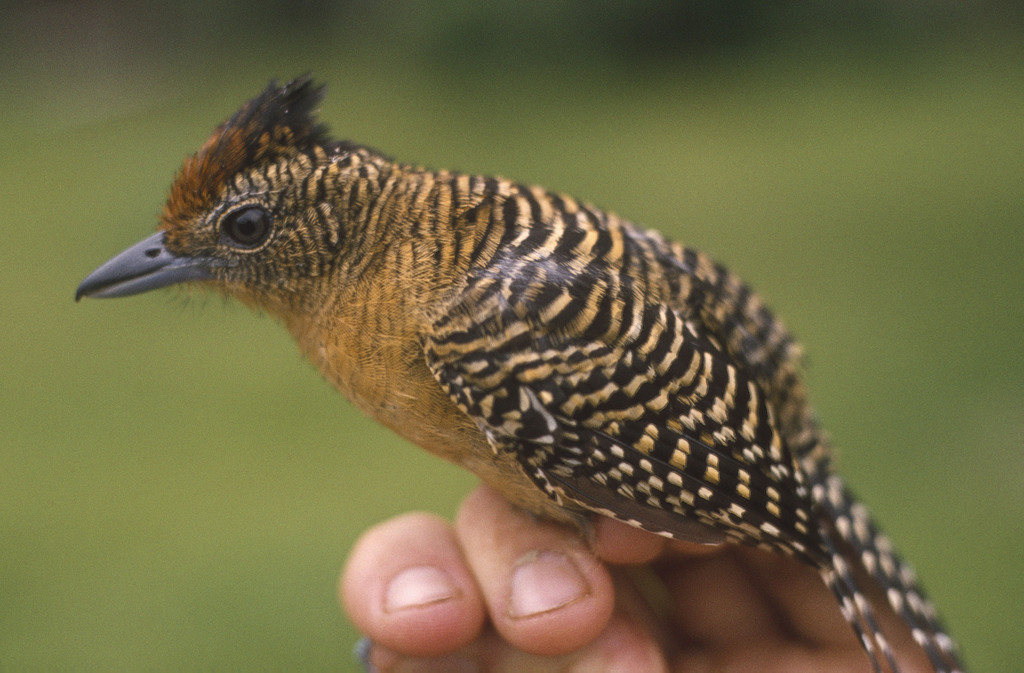
The bamboo antshrike is 16 to 17 cm (6.3 to 6.7 in) long and weighs 28 to 33 g (0.99 to 1.2 oz). This species exhibits significant sexual dimorphism. Both sexes have a small crest, a dark brown iris, and a somewhat heavy bill with a hook at the end like true shrikes. Adult males have a black forehead and crown; the rest of their plumage is thin black and white bars. Females have a rufous crown with black tips on the crest feathers. Their upperparts and tail have thin dark brown and pale yellowish brown bars, their throat is plain buffy white, and the rest of their underparts are mostly plain cinnamon-buff with darker barring on the sides and flanks.
Range & habitat
The bamboo antshrike is found in the western Amazon Basin of southeastern Peru, western Brazil, and northwestern Bolivia. In Peru it occurs in the departments of Ucayali, Cuzco, Madre de Dios, and Puno. In Brazil it occurs in Acre and Rondônia states, and in Bolivia the departments of Pando, La Paz, and Beni. The bamboo antshrike almost exclusively inhabits stands of bamboo, typically of genus Guadua, in humid lowland and foothill forest. There it favors the upper levels of the bamboo. It sometimes is found in dense tangles of vines in floodplain forest (even with no bamboo), where it is more broadly seen from the mid-storey to the canopy. In elevation it ranges up to about 1,450 m (4,800 ft).
Wikipedia: “Distribution and habitat”
What it does
The bamboo antshrike's diet has not been detailed but is known to include insects. It forages singly or in pairs and occasionally joins mixed-species feeding flocks as they pass through its territory. It forages mostly in the crown of bamboo stands but also in vine tangles; it may go as high as 20 m (65 ft) above the ground in trees above bamboo stands. It feeds mostly by gleaning or making short sallies from a perch during pauses while hopping along branches and bamboo stems. It occasionally investigates clusters of dead leaves.
Wikipedia: “Feeding”
Listen
Looking for field recordings…
Where it lives
Recorded sightings
—
geo-referenced records in GBIF, from museums, herbaria and field observers.
Drag the globe to turn it. Dots are where records exist, not a range map; darker means more records.
In the stacks
Searching the stacks…
Every page naming Cymbilaimus sanctaemariae in the Biodiversity Heritage Library →
This page is assembled live from iNaturalist, GBIF, Wikipedia, the Source Library and the Internet Archive. It is not yet part of the hand-edited codex. iNaturalist taxon 15751.