On eBird ↗
Bananal Antbird
Live sightings near you, the range map, bar charts of when it is seen, and Macaulay Library photos and recordings.
Bananal Antbird
Cercomacra ferdinandi
The Bananal antbird (Cercomacra ferdinandi) is a Near Threatened species of bird in subfamily Thamnophilinae of family Thamnophilidae, the "typical antbirds". It is endemic to central Brazil.
From the article Bananal antbird on Wikipedia (CC BY-SA), quoted section by section
Description
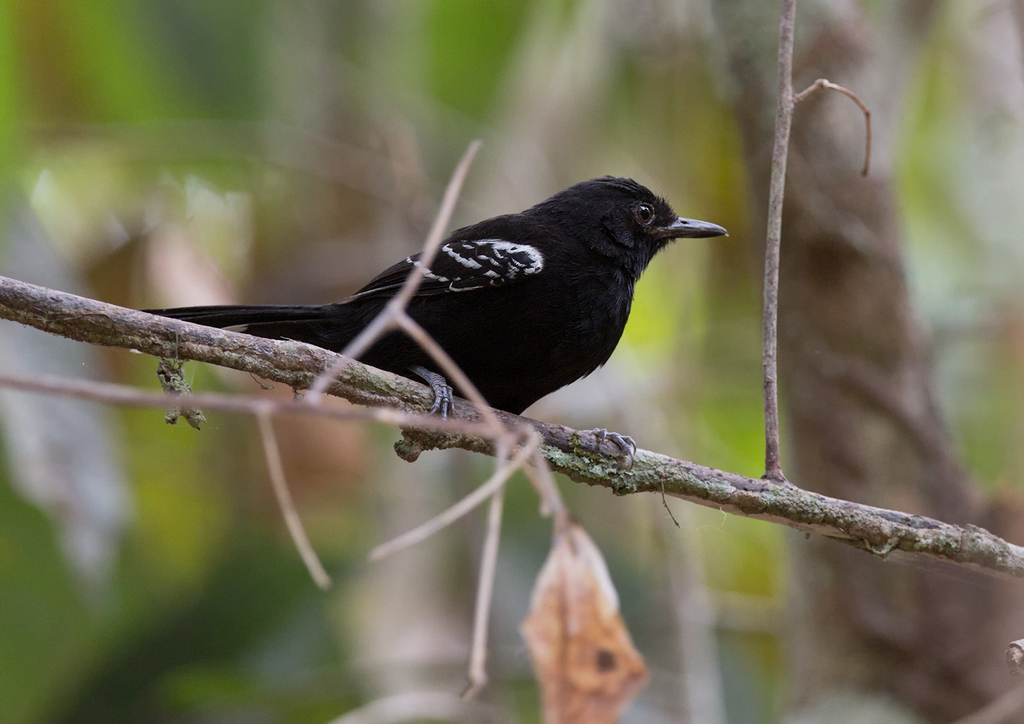
The Bananal antbird is 16 cm (6.3 in) long; one individual weighed 15 g (0.53 oz). Adult males are almost entirely black, with white edges on their outer scapulars, a white patch between them, and a hidden white patch under them. Their wing coverts and tail feathers have white tips and their flight feathers have white inner edges. Females are mostly gray, with white in the same places as the male and thin white streaks on their throat and breast.
Range & habitat
The Bananal antbird is found along the Araguaia and Tocantins rivers and some of their tributaries in central Amazonian Brazil. Its range is centered on the large Ilha do Bananal in the Araguaia. Its range extends from northwestern Goiás and eastern Mato Grosso north through western Tocantins into southeastern Pará and western Maranhão. The species inhabits gallery forest and nearby mature secondary forest that is also near water such as oxbow lakes. It occurs almost entirely in vine tangles and other dense vegetation from the understorey to the mid-storey.
Wikipedia: “Distribution and habitat”
What it does
The Bananal antbird's diet has not been detailed but is known to be insects and probably includes spiders. Individuals, pairs, and family groups usually forage between about 3 and 15 m (10 and 50 ft) above the ground, but also regularly pursue prey to the ground. They seldom join mixed-species feeding flocks.
Wikipedia: “Feeding”
Listen
Looking for field recordings…
Where it lives
Recorded sightings
—
geo-referenced records in GBIF, from museums, herbaria and field observers.
Drag the globe to turn it. Dots are where records exist, not a range map; darker means more records.
In the stacks
Searching the stacks…
Every page naming Cercomacra ferdinandi in the Biodiversity Heritage Library →
This page is assembled live from iNaturalist, GBIF, Wikipedia, the Source Library and the Internet Archive. It is not yet part of the hand-edited codex. iNaturalist taxon 15742.