On eBird ↗
Mato Grosso Antbird
Live sightings near you, the range map, bar charts of when it is seen, and Macaulay Library photos and recordings.
Mato Grosso Antbird
Cercomacra melanaria
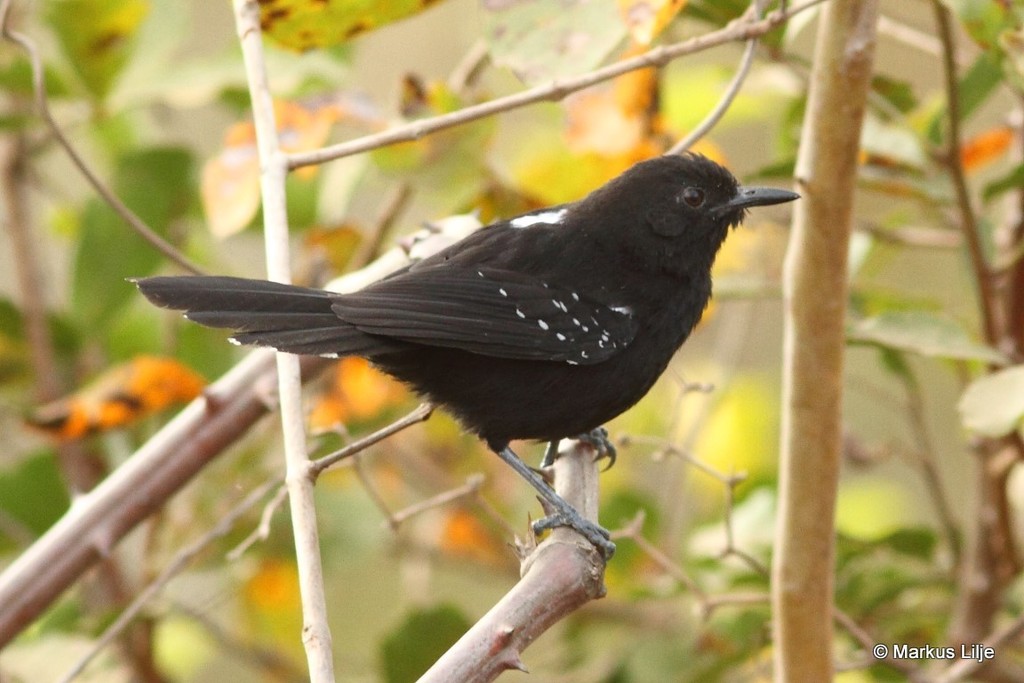
The Mato Grosso antbird (Cercomacra melanaria) is a species of bird in the family Thamnophilidae. It is found in Bolivia, Brazil, and Paraguay. Its natural habitats are subtropical or tropical dry forests and subtropical or tropical moist lowland forests.
From the article Mato Grosso antbird on Wikipedia (CC BY-SA), quoted section by section
Description
The Mato Grosso antbird is 16 to 16.5 cm (6.3 to 6.5 in) long and weighs 18.5 to 19.5 g (0.65 to 0.69 oz). Adult males are almost entirely black, with white edges on their outer scapulars, a white patch between them, and a hidden white patch under them. Their wing coverts and tail feathers have white tips and their flight feathers have white inner edges. Females have an olive-grey head and upperparts with a white interscapular patch. Their wings and tail are dark gray; their wing coverts and tail feathers have white tips. Their underparts are pale olive-gray that is whiter on their throat and the center of their breast.
Range & habitat
The Mato Grosso antbird has a disjunct distribution. One population is found in the central Bolivian departments of Beni and Cochabamba. Another is found from far eastern Santa Cruz Department in Bolivia south into extreme northern Paraguay and east into south-central Brazil's Mato Grosso and Mato Grosso do Sul states. It primarily inhabits gallery forest, tropical deciduous forest, and seasonally flooded savanna woodlands, in most cases near water. Within them it heavily favors areas whose understorey is dense with tangles of vines. In addition, part of the central Bolivian population occurs in dry Chaco forest. In elevation it is found up to 800 m (2,600 ft).
Wikipedia: “Distribution and habitat”
What it does
The Mato Grosso antbird's diet has not been detailed but is known to be insects and spiders. Individuals, pairs, and family groups usually forage from the ground up to about 3 m (10 ft) above it, though occasionally as high as 8 m (25 ft). They hop and flutter-fly among vine tangles and other dense vegetation and usually take prey by gleaning and lunging from a perch. They sometimes briefly join mixed-species feeding flocks that pass through their territory. They are not known to follow army ants.
Wikipedia: “Feeding”
Listen
Looking for field recordings…
Where it lives
Recorded sightings
—
geo-referenced records in GBIF, from museums, herbaria and field observers.
Drag the globe to turn it. Dots are where records exist, not a range map; darker means more records.
In the stacks
Searching the stacks…
Every page naming Cercomacra melanaria in the Biodiversity Heritage Library →
This page is assembled live from iNaturalist, GBIF, Wikipedia, the Source Library and the Internet Archive. It is not yet part of the hand-edited codex. iNaturalist taxon 15737.