On eBird ↗
Rio Branco Antbird
Live sightings near you, the range map, bar charts of when it is seen, and Macaulay Library photos and recordings.
Rio Branco Antbird
Cercomacra carbonaria
The Rio Branco antbird (Cercomacra carbonaria) is a Vulnerable bird species in subfamily Thamnophilinae of family Thamnophilidae, the "typical antbirds". It is found in Brazil and Guyana.
From the article Rio Branco antbird on Wikipedia (CC BY-SA), quoted section by section
Description
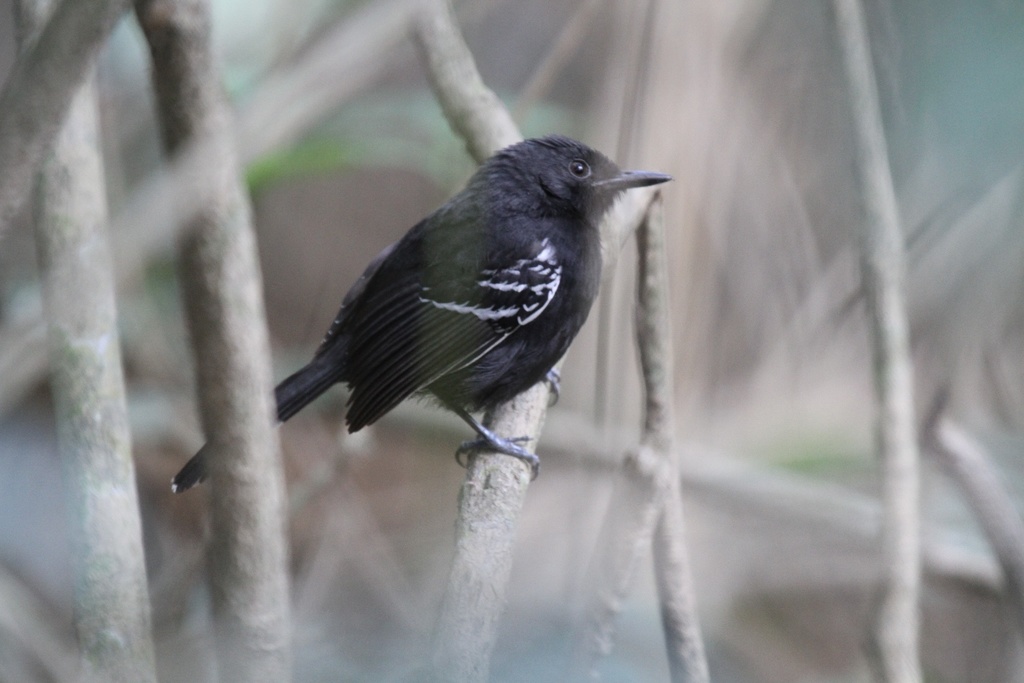
The Rio Branco antbird is 14 to 15.5 cm (5.5 to 6.1 in) long; one individual weighed 14.5 g (0.51 oz). Adult males are almost entirely black, with white edges on their outer scapulars, a white patch between them, and a hidden white patch under them. Their wing coverts and tail feathers have white tips and their flight feathers have white inner edges. Females have a brownish gray head and upperparts with a white interscapular patch. Their wings and tail are dark gray with greenish gray edges on the flight feathers. Their wing coverts are blackish gray with white tips and their tail feathers have white tips. Their throat and upper breast are white with dark gray spots, their lower breast and belly are streaked with gray and buff-white, and their sides, flanks, and crissum are buff-gray.
Range & habitat
The Rio Branco antbird is found along the Rio Branco from the Ireng River on the Guyana-Brazil border south downstream to the middle Rio Branco in Roraima and also on some of its tributaries. It inhabits the understorey to mid-storey of gallery forest and forested river islands. It almost always occurs in dense, vine-laden thickets. In elevation its range appears to be restricted to between 800 and 900 m (2,600 and 3,000 ft).
Wikipedia: “Distribution and habitat”
What it does
The Rio Branco antbird's diet has not been detailed but is known to be insects and probably also includes spiders. Individuals, pairs, and family groups usually forage between about 1 and 7 m (3 and 23 ft) above the ground, though occasionally as high as 10 m (33 ft). They hop among vine tangles and other dense vegetation and usually take prey by gleaning and lunging from a perch and also sometimes with short fluttering flights. They are not known to join mixed-species feeding flocks nor to follow army ants.
Wikipedia: “Feeding”
Listen
Looking for field recordings…
Where it lives
Recorded sightings
—
geo-referenced records in GBIF, from museums, herbaria and field observers.
Drag the globe to turn it. Dots are where records exist, not a range map; darker means more records.
In the stacks
Searching the stacks…
Every page naming Cercomacra carbonaria in the Biodiversity Heritage Library →
This page is assembled live from iNaturalist, GBIF, Wikipedia, the Source Library and the Internet Archive. It is not yet part of the hand-edited codex. iNaturalist taxon 15734.