On eBird ↗
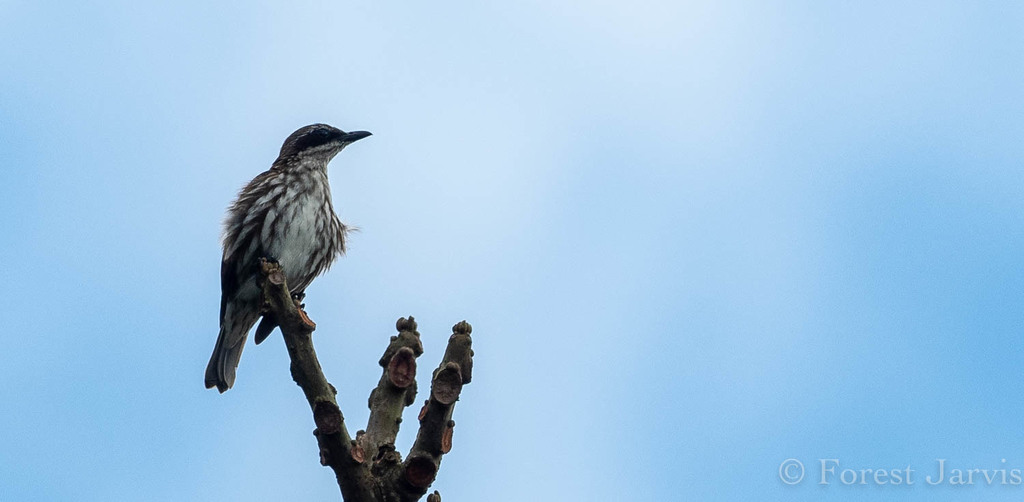
Stripe-breasted Rhabdornis
Live sightings near you, the range map, bar charts of when it is seen, and Macaulay Library photos and recordings.
Stripe-breasted Rhabdornis
Rhabdornis inornatus
The stripe-breasted rhabdornis (Rhabdornis inornatus), also known as the stripe-breasted creeper or plain-headed creeper, is a species of bird currently placed in the starling family, Sturnidae. It is endemic to the Philippines on the islands of Mindanao, Leyte, Samar and Biliran. It is typically found in tropical montane and submontane forest but has been found as low as 230 masl in Leyte. It is part of a species complex that includes the Visayan rhabdornis and the Grand rhabdornis which were formerly subspecies of this bird.
From the article Stripe-breasted rhabdornis on Wikipedia (CC BY-SA), quoted section by section
Range & habitat
It is found in tropical montane and submontane forest typically 800 to 1,750 meters above sea level but has been found as low as 230 masl in Leyte. The IUCN has classified the species as being of Least Concern but is declining in population. It is said to be uncommon throughout its range. It is affected by habitat loss through deforestation, mining, land conversion and slash-and-burn - just not to the same extent as lowland forest. It is found in multiple protected areas such as Mount Apo and Kitanglad Mountain Range but like all areas in the Philippines protection is lax.
== References ==
Wikipedia: “Habitat and conservation status”
What it does
It is a generalist with its diet as it feeds on various food sources such as insects, berries, nectar and even small amphibians. It typically forages in the canopy and perches on dead trees. Typically forages in groups of up to 10 individuals but a large flock of 100 birds has been spotted during an termite larvae emergence. Not much is known about its breeding habits but juveniles have been reported from Feb to June. Nests in tree cavities.
Wikipedia: “Ecology and behavior”
Listen
Looking for field recordings…
Where it lives
Recorded sightings
—
geo-referenced records in GBIF, from museums, herbaria and field observers.
Drag the globe to turn it. Dots are where records exist, not a range map; darker means more records.
In the stacks
Searching the stacks…
Every page naming Rhabdornis inornatus in the Biodiversity Heritage Library →
This page is assembled live from iNaturalist, GBIF, Wikipedia, the Source Library and the Internet Archive. It is not yet part of the hand-edited codex. iNaturalist taxon 15709.