On eBird ↗
Fire-tailed Myzornis
Live sightings near you, the range map, bar charts of when it is seen, and Macaulay Library photos and recordings.
Fire-tailed Myzornis
Myzornis pyrrhoura
The fire-tailed myzornis (Myzornis pyrrhoura) is a bird species formerly placed in the Old World babbler family (Timaliidae). Its genus Myzornis is monotypic, and has recently been placed in the (much reduced) Old World warbler family Sylviidae.
From the article Fire-tailed myzornis on Wikipedia (CC BY-SA), quoted section by section
Description
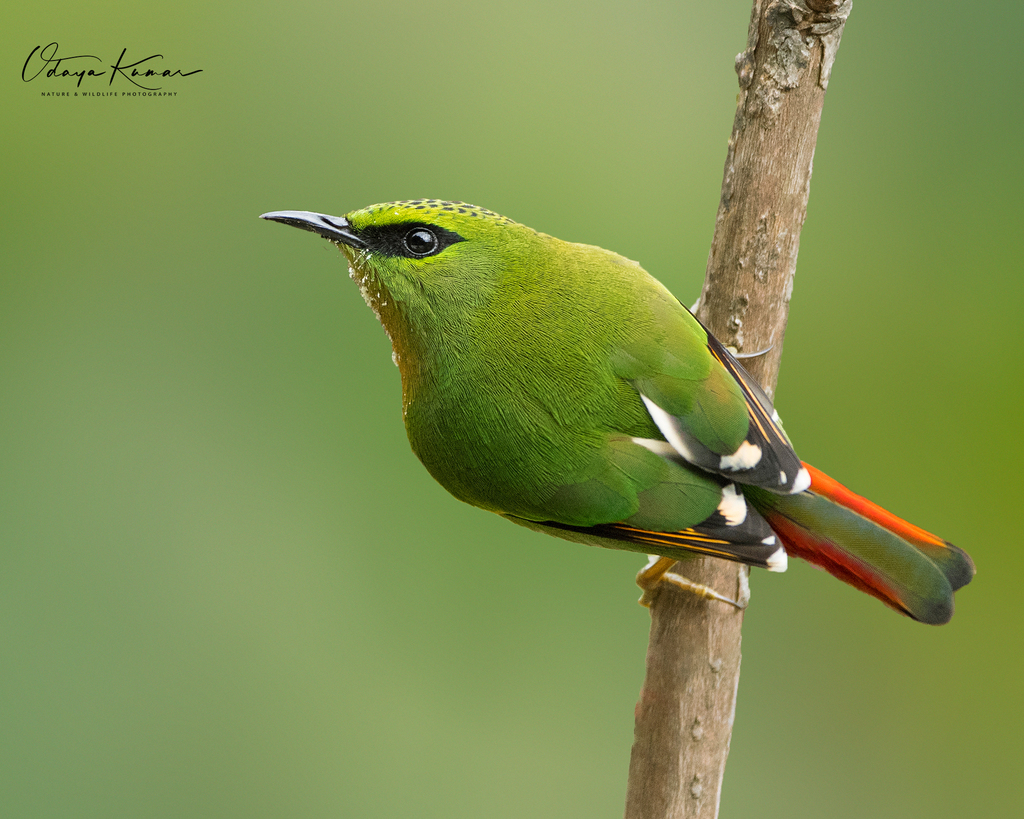
The fire-tailed myzornis is a small species of warbler-like bird, 11–13 cm (4.3–5.1 in) long and weighing 10–13 g (0.35–0.46 oz). It has bright green plumage with a black mask around the eyes and black scalloping on the crown. The wing is black and white with a streak of bright red and the sides of the tail are bright red. The bill is long, slightly curved, and black. It is usually silent, but has a high-pitched tsi-tsit call.
Range & habitat
The species is found in the Himalaya in Bhutan, southwestern China (southeast Xizang, western Yunnan), northeastern India (Arunachal Pradesh, Sikkim, northernmost West Bengal), northern Myanmar, and Nepal. Its natural habitat is temperate to alpine moist montane forests. It is a common species in the upper ridges of the Sikkim and Arunachal Himalayas, between 1,600–4,300 metres according to climatic conditions and seasonal variation. It prefers bamboo thickets, rhododendrons, birches, and junipers. There is some seasonal movement, occurring at (2,000–) 2,700–3,950 m or higher in summer, and descending to lower altitudes of 1,600–2,750 m in autumn and winter.
Wikipedia: “Distribution and habitat”
What it does
The fire-tailed myzornis feeds on insects, spiders and small arthropods, as well as consuming fruit, nectar (particularly from rhododendron flowers) and sap from trees. The breeding season is mainly in April to June, but may be longer, as juveniles have been observed in mid-September in Bhutan.
Wikipedia: “Ecology”
Listen
Looking for field recordings…
Where it lives
Recorded sightings
—
geo-referenced records in GBIF, from museums, herbaria and field observers.
Drag the globe to turn it. Dots are where records exist, not a range map; darker means more records.
In the stacks
Searching the stacks…
Every page naming Myzornis pyrrhoura in the Biodiversity Heritage Library →
This page is assembled live from iNaturalist, GBIF, Wikipedia, the Source Library and the Internet Archive. It is not yet part of the hand-edited codex. iNaturalist taxon 15562.