- Animals
- ›Arthropods
- ›Hexapods
- ›Insects
- ›Winged and Once-winged Insects
- ›Ants, Bees, Wasps, and Sawflies
- ›Narrow-waisted Wasps, Ants, and Bees
- ›Ichneumonid and Braconid Wasps
- ›Ichneumonid Wasps
- ›Rhyssinae
- ›Megarhyssa
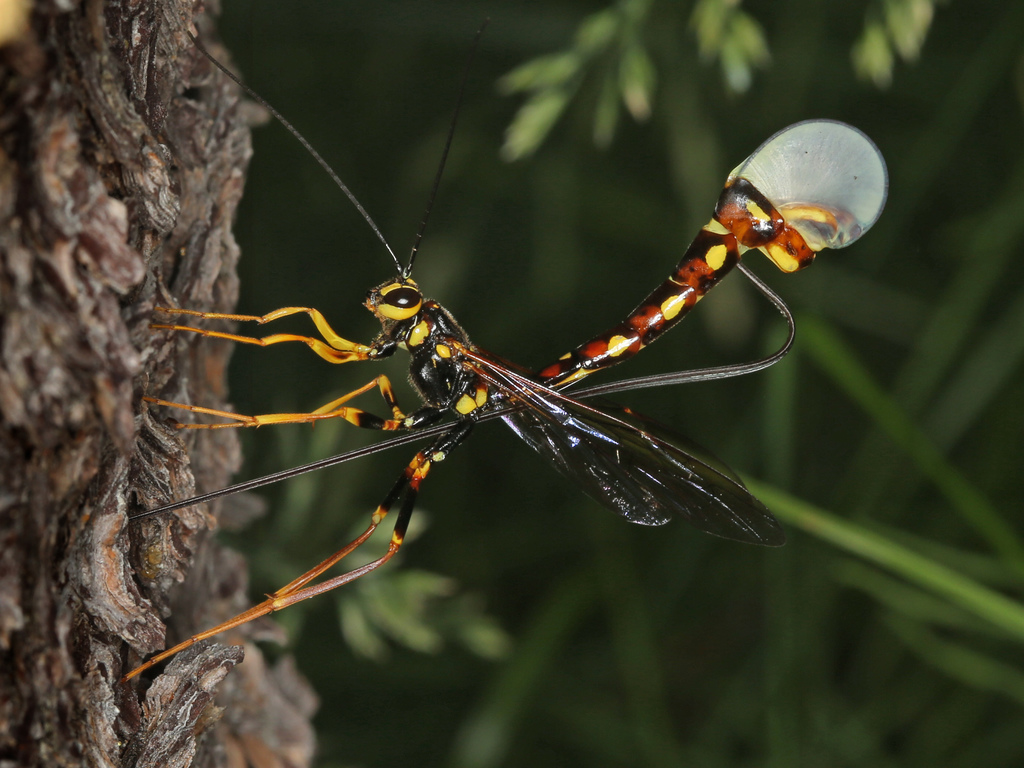
Norton's Giant Ichneumonid Wasp
Megarhyssa nortoni
Megarhyssa nortoni, also known as Norton's giant ichneumonid wasp or the western giant ichneumonid wasp, is a species of large ichneumon wasp.
From the article Megarhyssa nortoni on Wikipedia (CC BY-SA), quoted section by section
Description
Megarhyssa nortoni is black, reddish brown, and yellow and has distinguishing round yellow spots down the side of the abdomen. Its legs are mostly yellow. Its wings are transparent, and the body is elongated with a length of 1.4 inches (36 mm). The female is notable for an ovipositor of 2 inches (51 mm) to 3 inches (76 mm) in length. The male is less colorful with no ovipositor.
Wikipedia: “Description and identification”
Range & habitat
This species is native to North America including parts of the United States and Canada. The subspecies M. nortoni nortoni has a western distribution from the Pacific Coast to Colorado while the subspecies M. nortoni quebecensis has an eastern distribution from the northeastern US and southeastern Canada. It is found in coniferous forests where horntail larvae are present. It has also been introduced to Australia, New Zealand, Tasmania, Brazil, and South Africa to help control horntail forest pests.
Wikipedia: “Distribution and habitat”
What it does
Megarhyssa nortoni is a predatory insect. Its larvae are parasitoids of horntail wasp larvae in coniferous trees. The adult female hunts horntail larvae for egg placement. It smells wood-eating fungus, utilized by the horntail larvae to predigest wood pulp, and uses its antennae to detect vibrations made by the horntail larvae. The female M. nortoni curls its ovipositor over its abdomen to insert the tip of the ovipositor at a right angle into the bark and cuts into the tree until it reaches the horntail larval tunnel. The female then deposits a very slender egg through its ovipositor into the tunnel on or near the horntail larva. The M. nortoni larva then hatches to eat the live horntail larval host from the inside causing the horntail larva's eventual death. The M. nortoni larva pupates inside its host and emerges the following summer as an adult. Although imposing, the female M. nortoni does not sting and is harmless to humans. Adult M. nortoni feed on nectar and water.
== References ==
Wikipedia: “Behavior”
Listen
Looking for field recordings…
Where it lives
Recorded sightings
—
geo-referenced records in GBIF, from museums, herbaria and field observers.
Drag the globe to turn it. Dots are where records exist, not a range map; darker means more records.
In the stacks
Searching the stacks…
Every page naming Megarhyssa nortoni in the Biodiversity Heritage Library →
This page is assembled live from iNaturalist, GBIF, Wikipedia, the Source Library and the Internet Archive. It is not yet part of the hand-edited codex. iNaturalist taxon 154343.