On eBird ↗
Gray-winged Trumpeter
Live sightings near you, the range map, bar charts of when it is seen, and Macaulay Library photos and recordings.
Gray-winged Trumpeter
Psophia crepitans
The grey-winged trumpeter (Psophia crepitans) is a member of a small family of birds, the Psophiidae. It is found in the northern Amazon rainforest and Guiana Shield in tropical South America. Unlike all other trumpeters, the rump and back are grey in the grey-winged trumpeter.
From the article Grey-winged trumpeter on Wikipedia (CC BY-SA), quoted section by section
Description
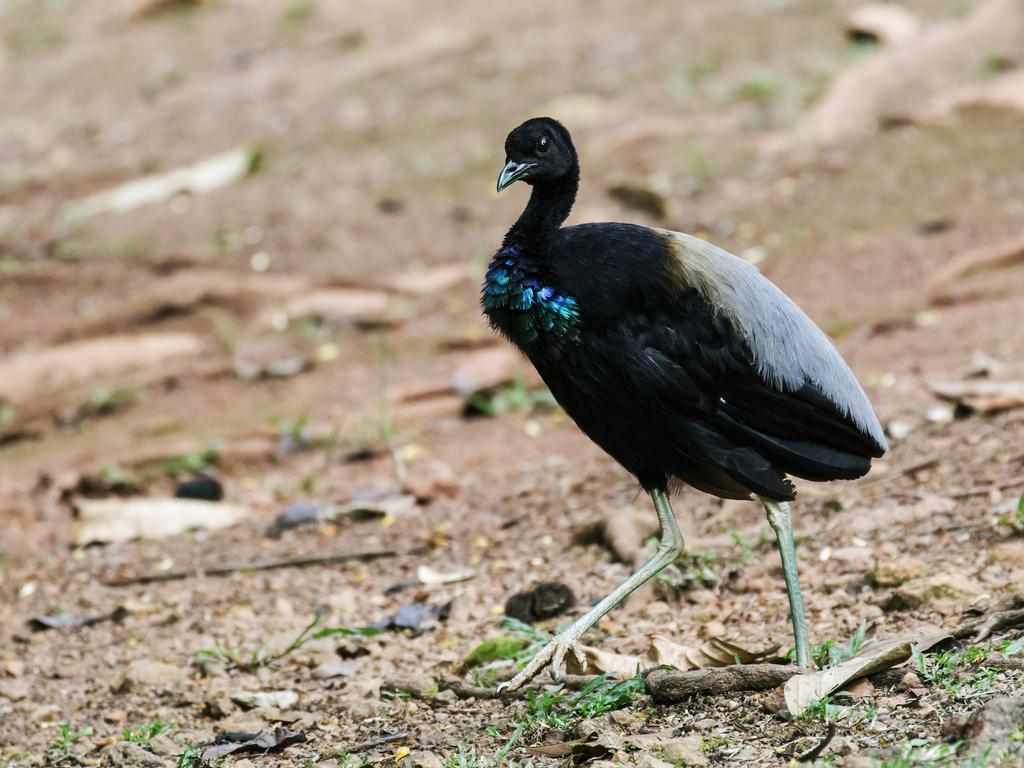
The grey-winged trumpeter is a chicken-like bird with a long neck and legs and a hump-backed profile. It is 45 to 52 centimetres (18 to 20 in) long. Two males weighed 0.82 and 1.02 kg (1.8 and 2.2 lb) and six females weighed between 0.79 and 1.06 kg (1.7 and 2.3 lb). The sexes are similar in appearance. Their stout, slightly decurved, bill is yellowish-green and their legs and feet greenish-olive. Their plumage is mostly black. The nominate subspecies has green or violet iridescence on the lower neck. Its inner wings and rump are ashy grey and the middle of the back is ochre to chestnut. Subspecies P. c. napensis has bronzy or purple iridescence, lighter grey wings and rump, and a more ferruginous back, and P. c. ochroptera has entirely ochraceous wings, rump, and middle back. The newly hatched chicks have russet-brown down with pale lines along the back giving good camouflage.
Range & habitat
The grey-winged trumpeter is a bird of the northern Amazon Basin. The nominate subspecies is found from southeastern Colombia east through eastern and southern Venezuela and the Guianas and south into Brazil to the Amazon River east of the Rio Negro. P. c. ochroptera is found in northwestern Brazil north of the Amazon and west of the Rio Negro. P. c. napensis is found from southeastern Colombia south through eastern Ecuador into northeastern Peru and east into extreme northwestern Brazil north of the Amazon. The grey-winged trumpeter inhabits dense lowland tropical rainforest. Within that broad category it favours landscapes away from human habitations and with an open understory and many fruiting trees. Despite being mostly a bird of the lowlands it sometimes can be found in higher elevation cloudforest.
Wikipedia: “Distribution and habitat”
What it does
The grey-winged trumpeter is a gregarious species that lives in flocks of up to about 15 birds of all ages. Each flock maintains a territory that varies between 58–88 ha (140–220 acres). Being weak flyers, they spend most of their time on the ground foraging for food. At night, they roost low in the canopy in trees.
Movement. The grey-winged trumpeter is entirely non-migratory and tends to move only within its flock territories. It does not cross major rivers.
Feeding. Adult grey-winged trumpeters feed mostly on soft fruit that has fallen to the forest floor. Though much of it has been knocked loose or picked and dropped by squirrel monkeys or arboreal birds, it tends to persist so the trumpeters do not need follow monkey troops. Fruits eaten are usually those of large trees but trumpeters will pick fruit from shrubs as well. About 10% of their diet is small arthropods, some of which they capture when following army ant swarms. Chicks are fed a greater percentage of arthropods when young. Adults also eat small vertebrates but only rarely.
Breeding. Grey-winged trumpeters are polyandrous and cooperative breeders. Up to three males mate with the dominant female of the flock, and all members contribute to raising the young. …
Wikipedia: “Behaviour”
Listen
Looking for field recordings…
Where it lives
Recorded sightings
—
geo-referenced records in GBIF, from museums, herbaria and field observers.
Drag the globe to turn it. Dots are where records exist, not a range map; darker means more records.
In the stacks
Searching the stacks…
Every page naming Psophia crepitans in the Biodiversity Heritage Library →
This page is assembled live from iNaturalist, GBIF, Wikipedia, the Source Library and the Internet Archive. It is not yet part of the hand-edited codex. iNaturalist taxon 151.