On eBird ↗
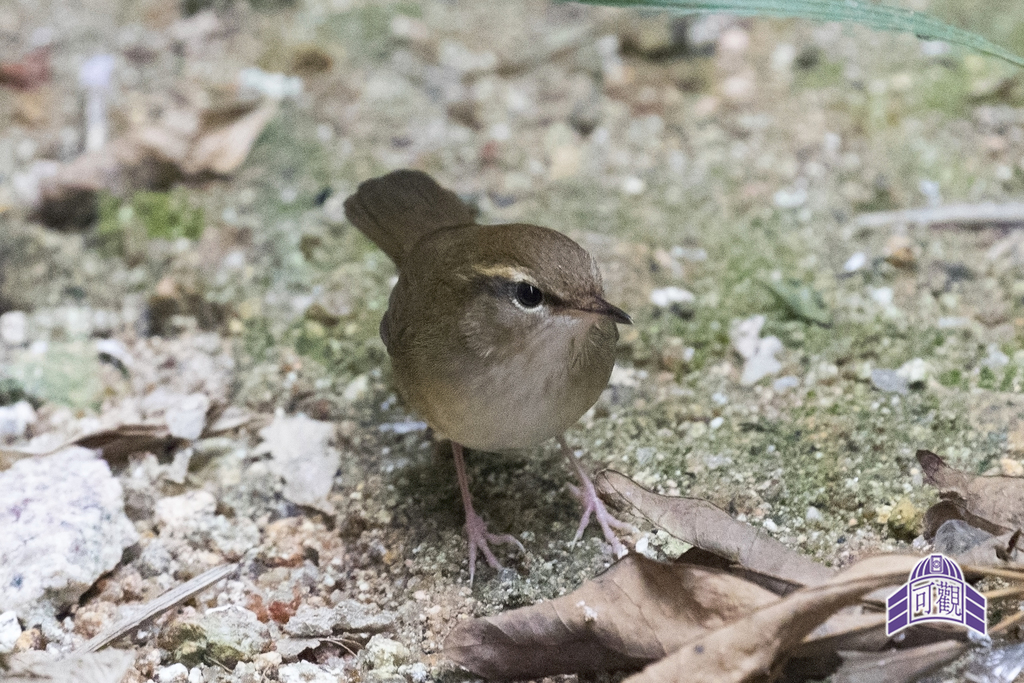
Pale-footed Bush Warbler
Live sightings near you, the range map, bar charts of when it is seen, and Macaulay Library photos and recordings.
Pale-footed Bush-Warbler
Hemitesia pallidipes
The pale-footed bush warbler (Hemitesia pallidipes) is a species of oriental warbler in the family Cettiidae that is found in southern Asia. It occurs in the Himalayan region west from Dehradun through the foothills of Nepal to northeastern India. It also occurs in Myanmar, Laos, northern Vietnam and southern China. A single sighting was recorded from Kandy, Sri Lanka in March 1993.
From the article Pale-footed bush warbler on Wikipedia (CC BY-SA), quoted section by section
Range & habitat
The pale-footed bush warbler usually associates with Themeda grasslands. The habitat and altitudinal limit for pale-footed bush warbler vary slightly from place to place. For example, in Thailand, its habitat is grassland and scrub from foothills up to 1,800 m (5,900 ft). In China, it is found in woodland up to 1,525 m (5,003 ft).
Nepal. The pale-footed bush warbler is a resident bird for Nepal. It is mostly found in Chitwan. This species is threatened by habitat loss and population decline in Nepal.
India. In peninsular India the pale-footed bush warbler U. p. pallidipes has been reported as breeding in the Eastern Ghats by Salim Ali and Sidney Dillon Ripley. They collected a specimen from Sunkarametta, Araku Valley, Vishakapatnam district [altitude of 1,000 m (3,300 ft)] in the month of April. A male adult of the subspecies U. p. osmastoni was first described from Andaman Islands [altitude 730 m (2,400 ft)] by Ernst Hartert. Nest-building in U. p. osmastoni was described by Bertram Beresford Osmaston in the year 1907. Subspecies U. p. pallidipes has also been reported from Simlipal Tiger Reserve, Simlipal National Park Odisha [altitude 600–1,500 m (2,000–4,900 ft)] in December 2012 from a grassland near a Sal forest
Wikipedia: “Distribution and habitat”
What it does
The pale-footed bush warbler is extremely shy and is a great skulker, meaning it is very difficult to see even during the breeding season. This species breeds from May to July. The bird is usually found either by itself or in pairs in low bushes and grass clumps. It is also known as a ground-dwelling species; thus, it flies less than a meter above ground. It moves through grass reeds keeping low, staying mostly out of sight and it feeds on the lower half of grass reeds.
Vocalization. The pale-footed bush warbler has a loud song. Because it remains near the ground, it is more easily heard than seen. This species remains mostly silent during winter but its call and song can be easily heard during spring. Its explosive song is the best way to signal the presence of its species.
== References ==
Wikipedia: “Behaviour”
Listen
Looking for field recordings…
Where it lives
Recorded sightings
—
geo-referenced records in GBIF, from museums, herbaria and field observers.
Drag the globe to turn it. Dots are where records exist, not a range map; darker means more records.
In the stacks
Searching the stacks…
Every page naming Hemitesia pallidipes in the Biodiversity Heritage Library →
This page is assembled live from iNaturalist, GBIF, Wikipedia, the Source Library and the Internet Archive. It is not yet part of the hand-edited codex. iNaturalist taxon 1506571.