- Animals
- ›Chordates
- ›Vertebrates
- ›Birds
- ›Cranes, Rails, and Allies
- ›Rails, Gallinules, and Coots
- ›Mustelirallus
On eBird ↗
Zapata Rail
Live sightings near you, the range map, bar charts of when it is seen, and Macaulay Library photos and recordings.
Zapata Rail
Mustelirallus cerverai
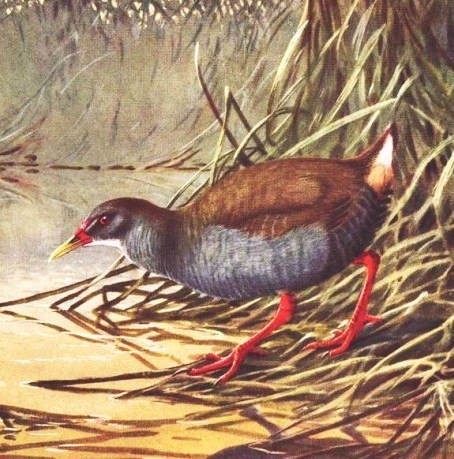
The Zapata rail (Mustelirallus cerverai) is a medium-sized, dark-coloured rail. It has brown upperparts, greyish-blue underparts, a red-based yellow bill, white undertail coverts, and red eyes and legs. Its short wings render it almost flightless. It is endemic to the wetlands of the Zapata Peninsula in southern Cuba, where its only known nest was found in sawgrass tussocks. Little is known of its diet or reproductive behaviour, and its described calls may belong to a different species.
The species was discovered by Spanish zoologist Fermín Zanón Cervera in March 1927 in the Zapata Swamp near Santo Tomás, in the southern Matanzas Province of Cuba. The swamp holds one other bird found nowhere else, the Zapata wren, and also gives its name to the Zapata sparrow. Due to ongoing habitat loss in its limited range, its small population size, and predation by introduced mammals and catfish, the Zapata rail is evaluated as critically endangered on the IUCN Red List of Threatened Species. Tourism and climate change may pose threats in the future.
From the article Zapata rail on Wikipedia (CC BY-SA), quoted section by section
Description
This is a medium-sized, dark rail, approximately 29 cm (11.4 in) long. The upperparts are olive-brown and the forehead, head sides, and underparts are slate-grey, with some white barring on the lower belly. The flanks are grey-brown and the undertail is white. The iris, legs, and feet are red, and the bill is yellow with a red base. The tail feathers are only sparsely barbed, and the wings are very short and rounded. The sexes are similar in appearance, but immature birds are duller and have olive feet and bill; the chicks, as with all rails, are covered with blackish down. The Zapata rail's call is described as a bouncing cutucutu-cutucutu-cutucutu similar to that of the bare-legged owl, and a loud limpkin-like kuvk kuck. However, these calls may actually be those of the spotted rail. There are no similar species in Cuba; the sympatric spotted rail is much the same size, but is heavily spotted and barred with white. The Zapata rail's plumage is intermediate between those of the Colombian crake and the plumbeous rail, but these are mainland birds of Central and South America.
Range & habitat
This rail is a Cuban endemic restricted to the northern part of the 4500 km2 (1740 mi2) Zapata Swamp, which is also the only location for the Zapata wren and the nominate subspecies of the Zapata sparrow. The favoured habitat of the Zapata rail is flooded vegetation, 1.5–2.0 m (60–80 in) tall, consisting of tangled, bush-covered swamp and low trees, and preferably near higher ground. Typical plants of the swamp are wax myrtle, the willow Salix longipes, the sawgrass Cladium jamaicensis, and the narrow leaf cattail. The species was once more widespread, with fossil bones found at Havana, Pinar del Río, and the Isla de la Juventud. Barbour did not believe that the rail, Zapata sparrow, and Zapata wren were relics in the sense that they once ranged widely over Cuba (as did, for example, the dwarf hutia and the Cuban crocodile), since the birds are so highly modified for swamp conditions. He considered that conditions similar to those found today may once have extended over the large submerged area now represented by the shallow banks, with scattered mangrove keys, which stretch towards the Isla de la Juventud and perhaps eastward along the southern Cuban coast. The birds fossilized at Isla de la Juventud are smaller than the single extant specimen, but the paucity of available material makes it impossible to establish whether the populations were genuinely different.
Wikipedia: “Distribution and habitat”
What it does
The Zapata rail usually breeds in Cladium jamaicensis sawgrass, building the nest above water-level on a raised tussock. Breeding occurs around September, and possibly also in December and January. American ornithologist James Bond found a nest containing three white eggs 60 cm (2 ft) above water level in sawgrass, but little else is known of the breeding biology. Rails are usually monogamous, and all have precocial chicks which are fed and guarded by the adults. The bird prefers to feed in sawgrass. The diet is not recorded, but most marsh rails are omnivorous, feeding on invertebrates and plant material. The rails may disperse in the rainy season, returning to permanently flooded areas in the dry months. Like other rails, this species is difficult to observe as it moves through the sawgrass, and may crouch to avoid detection, but is not usually particularly wary. When disturbed, it may run a short distance and then stop with its tail raised and the conspicuous white undertail showing. Despite its short wings, the Zapata rail may not be completely flightless. On morphological grounds it would be classed as a flightless species, since the pectoral girdle and wing are as reduced as in other species of rails that are considered to be flightless, but Bond reported that he saw one flutter about ten feet across a canal.
Wikipedia: “Behaviour”
Listen
Looking for field recordings…
Where it lives
Recorded sightings
—
geo-referenced records in GBIF, from museums, herbaria and field observers.
Drag the globe to turn it. Dots are where records exist, not a range map; darker means more records.
In the stacks
Searching the stacks…
Every page naming Mustelirallus cerverai in the Biodiversity Heritage Library →
This page is assembled live from iNaturalist, GBIF, Wikipedia, the Source Library and the Internet Archive. It is not yet part of the hand-edited codex. iNaturalist taxon 1506285.