On eBird ↗
Rüppell's Bustard
Live sightings near you, the range map, bar charts of when it is seen, and Macaulay Library photos and recordings.
Rüppell's Bustard
Heterotetrax rueppelii
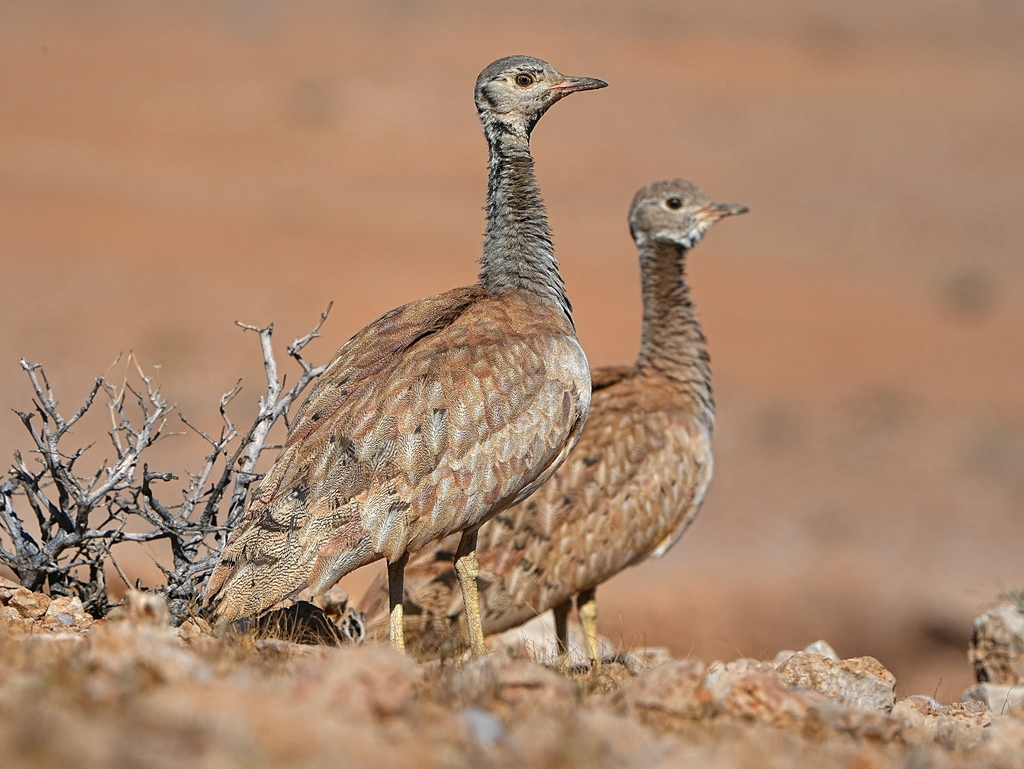
Rüppell's korhaan (Heterotetrax rueppelii), also known as Rüppell's bustard, is a species of bird in the family Otididae. The species is represented by a small bustard, only 60 cm long. The head and neck are grey, with black stripes down the throat (less marked in females), through the eye, and on the sides of the neck, and white cheeks. The body is sandy brown above, and white below. The legs are sandy yellow-brown. Rüppell's korhaan received its...
From the article Rüppell's korhaan on Wikipedia (CC BY-SA), quoted section by section
Description
Rüppell's korhaan is a small bustard, only 60 cm (24 in) long. The head and neck are grey, with black stripes down the throat (less marked in females), through the eye, and on the sides of the neck, and with white cheeks. The body is sandy brown above, and white below. The legs are sandy yellow-brown.
Range & habitat
Rüppell's korhaan is native to southwestern Africa in Angola and Namibia. It is one of thirteen native bird species found in the western part of Namibia. The bird's habitat is areas with low rainfall such as deserts, plains, and savannahs, where its exceptionally well developed senses play a major role in its survival and safety. It is commonly found in the Namibrand Nature Reserve, at Mirabib and Ganab in the Namib-Naukluft Park, at Bloedkoppie, and in the Spitzkoppe surroundings.
Wikipedia: “Habitat”
What it does
Rüppell's korhaan is usually monogamous but sometimes breeds in large family groups. It lays eggs all year round with a peak season from February to May. Nests are made among rocks and stone with some occasional plant coverage. It can lay 1–3 eggs in one breeding cycle and these are incubated solely by the female. Rüppell's korhaan is omnivorous, having a diet of mostly invertebrates such as small reptiles and termites, though it also eats leaves and seeds. Eating is usually done while pecking at the ground as it walks.
Wikipedia: “Behaviour”
Listen
Looking for field recordings…
Where it lives
Recorded sightings
—
geo-referenced records in GBIF, from museums, herbaria and field observers.
Drag the globe to turn it. Dots are where records exist, not a range map; darker means more records.
In the stacks
Searching the stacks…
Every page naming Heterotetrax rueppelii in the Biodiversity Heritage Library →
This page is assembled live from iNaturalist, GBIF, Wikipedia, the Source Library and the Internet Archive. It is not yet part of the hand-edited codex. iNaturalist taxon 1505960.